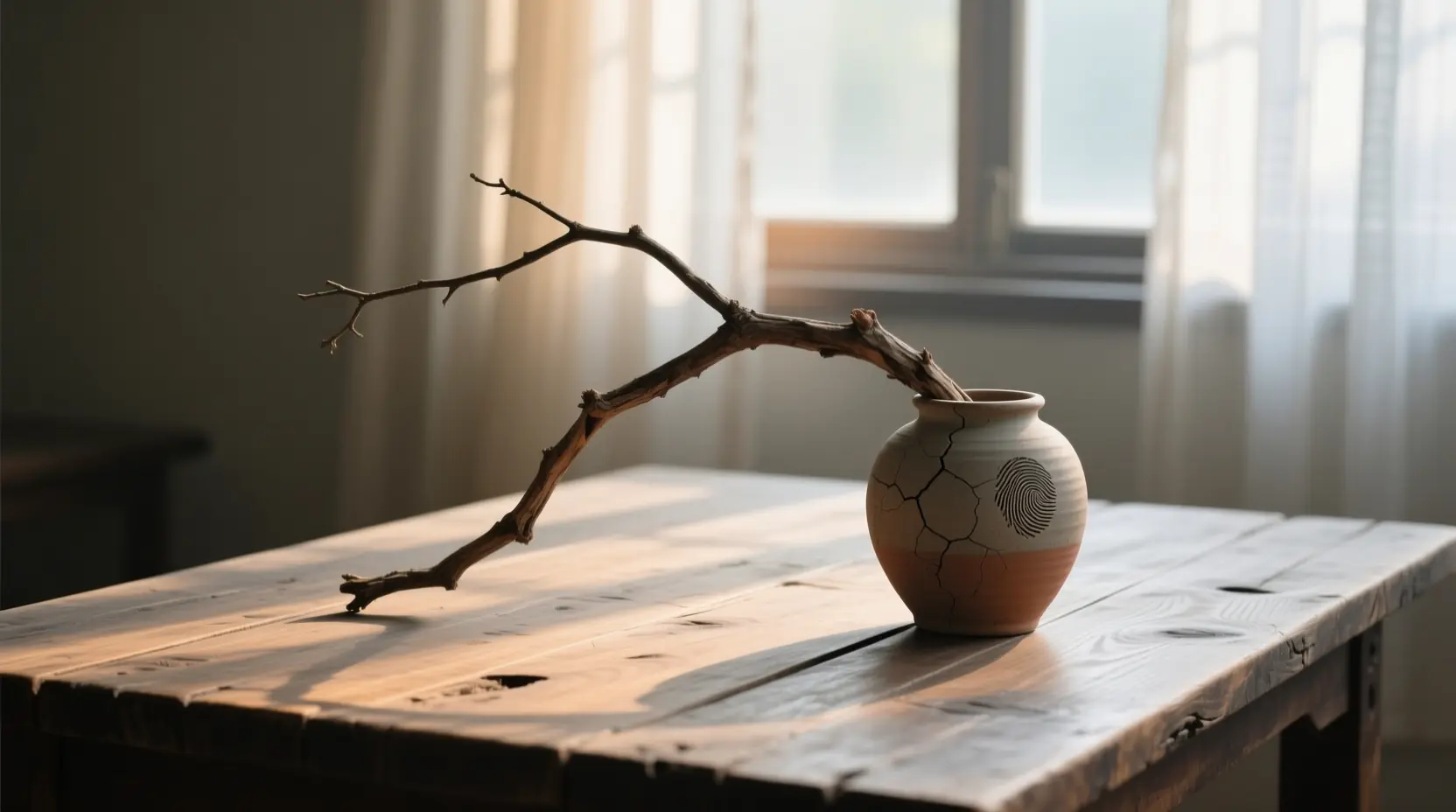
A Whisper of Damp Earth
The air has a weight to it. Cool. Carrying the scent of soil after a quiet rain—not a storm, but a night’s gentle weeping. You stand within it. And in your hands, you hold a single branch.
It is not a perfect specimen. Its line is not straight. It curves, a subtle defiance against the idea of the plumb. One side wears a shawl of leaves; the other is bare, skeletal. There is a knuckle, an old scar, where a limb was lost to wind or time. A story written in wood.
This. This is where we begin. Not with the hothouse bloom, flawless and forced. But with this offering from the world as it is. Crooked. Scarred. Alive. This is the first, hushed breath of wabi-sabi. Not an arrival, but a noticing. Beauty is not a condition of flawlessness, but a quality of presence. It is here, now, in your hands.
The Space Between Arranging and Listening
Ikebana as a Dialogue with the Already-Formed
There is a path known as Ikebana. A word often translated, often diminished. It is not flower arranging. It is a conversation. A meditation conducted with the fingertips.
You are not a creator here, imposing a vision. You are a listener. Your role is to lean in, to discern the story that already sleeps within the stems. Within the tensile curve of a twig. Within the silent yearning of a leaf toward the light. You are drawing out a narrative that the wind began, that the seasons shaped.
Its soul is wabi-sabi. The profound, quiet beauty of the imperfect, the impermanent, the incomplete. It finds a stark poetry in the crack. A deep reverence in the slow fade from green to gold to brittle brown. An elegance in the solitary, unaccompanied bloom.
The Vessel Holds a Silence
Choosing the Container That Speaks of Time
First, you must choose a vessel. Do not rush to the smooth and the glossy. Let your hands wander. Find the unglazed clay pot, its surface rough as tree bark. Feel where the fire licked it unevenly—a shadow here, a blush there. A crackle in the glaze is not a fault line. It is a map. A memory of the kiln’s fierce breath, a record of its transformation from soft earth to enduring form.
A wooden container, worn satin-smooth by generations of palms and the lap of water, holds a different kind of silence. It hums. It is not empty. It is full of history.
Let the vessel speak first. Its shape, its heft, its very texture will suggest the kind of conversation it wishes to host. A wide, open bowl asks for low, sprawling thoughts—a meadow in miniature. A tall, slender cylinder invites a reaching, an ascent, a line stretching for heaven. The vessel is the first, and perhaps the wisest, teacher. It murmurs: *This is the space we have. This is the ground from which life will rise.*
To See the Line the Wind Drew
Shin, Soe, Hikae: A Triad Whispered by Nature
Return now to your branch. Sit with it. Turn it in the cool morning light. Do not see it as ornament. See it as a line. A line drawn not by a human hand, but by the persistent push of prevailing winds. By years of sun arching across the sky. By the quiet struggle for a place in the canopy.
Ikebana is, at its bony core, the art of line.
The primary line is *Shin*. The heaven line. It is the tallest, the most assertive spirit. It does not demand straightness. It demands truth. It is the aspiration, the initial, upward breath of the arrangement.
Next, you find *Soe*. The supporting line. The earth. It offers a counterpoint, a different angle. A whisper set against the declaration of *Shin*. It provides foundation, a gentle gravity.
Then, *Hikae*. The moderating line. It balances. It mediates. Often the shortest, the most humble. Yet, without its quiet presence, the structure feels unresolved, a sentence without a full stop.
These are not rigid rules to be measured. They are whispers you have heard your whole life without knowing. Look at a pine clinging to a cliffside. Its trunk, leaning into the gale—that is *Shin*. The strong, lower arm bracing against the stone—*Soe*. The small, upward-turning tuft of needles catching the last light—*Hikae*. The triad exists everywhere, in every tangle of wild growth. You are not inventing it. You are recognizing it. You are simply giving it a frame, a moment of focused attention.
The Honourable and Necessary Empty
Ma: The Space Where the Mind Can Rest
Here is a lesson the cluttered modern eye forgets. We rush to fill. We fear the blank canvas, the silent pause. In Ikebana, the space—*Ma*—is as vital as the material itself. It is the silence between the piano notes that makes the melody. It is the held breath.
When you place your *Shin* branch, resist the urge to plant it in the dead center. Let it rise from the edge. Allow a vast expanse of emptiness to open beside it, below it. This emptiness is not a lack. It is a sanctuary. It is where the observer’s mind can wander, can rest, can enter and complete the thought with their own contemplation.
The branches do not occupy the vessel. They *inhabit* it. They coexist with the air. With the long, shifting shadows they cast upon the wall as the sun journeys. Crowding is a form of anxiety. Sparse simplicity is a form of profound trust. Trust in the power of one single, flawed bloom. Trust in the sheer eloquence of a bare, crooked line against the void.
The Soul of the Season, Unadorned
Becoming a Student of the Calendar’s Truth
A wabi-sabi florist does not fight the calendar. They become a humble student of its turning pages. What does this late autumn morning truly offer? It may not offer the proud, symmetrical rose. It offers instead the last few rosehips, their skins splitting like old parchment to reveal the bright orange seeds within. A dried milkweed pod, rattling its silent song. A maple branch where leaves, half-eaten by insects, have become lace—a intricate tapestry of decay and breathtaking beauty.
In winter, it is the stark, dramatic silhouette of the leafless branch. The solemn, enduring green of a single pine needle. A camellia bloom, its outer petals already tinged with a brown edge—a tender reminder that its glory is fleeting, that its very perfection lies in its acceptance of decline.
This is *mono no aware*. The poignant, gentle awareness of the transience of all things. It is not sadness. It is a deep, aching appreciation. You are not capturing a trophy. You are capturing a moment *on its way to passing*. You are holding a whisper of the inevitable, and finding it beautiful.
Bring the outside in, as it truly is. A lichen-crusted stone can anchor your arrangement. A piece of driftwood, weathered smooth by sea and time. A stem that still clings to last year’s brittle leaf. These are the truthful textures of the world. Rough stone. Weathered wood. The raw, unbleached linen of a dried grass. This is the honest fabric of reality.
A Practice for the Hands, a Balm for the Heart
Beginning with One, and Listening
Begin simply. With your one branch. With one shepherd’s purse plucked from the roadside gravel. Place it in your chosen, quiet vessel.
Then, spend time. Just look. Move it a finger’s width to the left. See how the light now catches the dew on a particular leaf. Turn the vase a quarter turn. Observe how the relationship with the window, with the wall, shifts into a new and unexpected harmony. This is not decorating. This is composing. You are working with the fundamental elements: line, space, form, and the immutable truth of the season.
Your hands will learn a language deeper than vocabulary. They will learn the subtle angling of a stem in the *kenzan*, the spiked metal frog that holds the creation firm. There is technique, yes. A strategic placement. But the technique is not the goal. It is the servant. The servant of the feeling, of the discovered harmony. A harmony that must, by its very nature, include asymmetry. Include emptiness. Include the graceful mark of time’s passage.
Do not seek perfection. Seek expression. Seek a feeling that settles in your bones. If a leaf tears as you work, leave it be. It is now part of the story. If a blossom drops a single petal, let it come to rest at the arrangement’s base. It is a tender memento mori. Your arrangement is not a frozen statue. It is a living, changing entity. It will open further tonight. It will bend toward the light tomorrow. It will fade, slowly, gracefully, next week. Watch this process with the same reverence you gave its birth. The fading is its final, most poignant, and most beautiful poem.
The Quiet That Comes After the Making
Living with the Arrangement
There comes a moment when you know. The last tiny adjustment of a leaf tip brings everything into a silent, humming alignment. You feel it not in your mind, but in your chest. A settling. A deep, quiet peace.
Stop.
Place the arrangement in a quiet corner. On a bare wooden table, perhaps. Where the morning light will find it like a benediction. Where its shadow will stretch and morph across the floor as the afternoon wanes. Live with it. Do not merely walk past it. Sit with it. As you would sit with an old friend, no words necessary. Let it speak to you over the coming days as it changes, as it ages. This is the true practice. The making is the meditation. The living with it, day by subtle day, is the understanding.
You are not just learning an art. You are cultivating an eye. A *wabi-sabi* eye. Soon, you will begin to see latent beauty where others see only the spent, the crooked, the incomplete. A broken terracotta pot becomes the perfect vessel for a cluster of hen-and-chicks. A water-worn sea glass holds a single, majestic peony. A gnarled, ancient root is recognized as a sculpture, waiting only for the companionship of a spray of nandina berries.
This is the quiet gift. You begin to see the world not as a catalogue of resources, but as a continuous, graceful, and endless cycle of growth, decay, and return. You see the soul in objects. You feel the weight of time, not as a destroyer, but as the gentlest and most profound of artists, adding patina, adding character, adding depth that no pristine newness can possess.
The path of wabi-sabi floristry is endless, because it is not a path to a destination. It is the walk itself. Each season, each fallen branch, each empty, echoing vessel is a new beginning. A new and quiet conversation. It asks only for your attention. Your humility. And your willingness to see the profound, aching beauty in a single, imperfect, transient thing. To hold it gently, with reverence. And then, when the time comes, to let it go.
So start. Start with that one branch you are holding. Listen to what it has to say. It may not shout. It whispers.
The rest is just a matter of leaning in. And beginning.