The Forest Silence of a Room
First, forget the lamp. Remember the sun. The moon. The slow, patient fire in the hearth. To speak of a home shaped by Wabi-Sabi, one must first unlearn noise. Seek not an empty silence, but a full one. The silence found between the calls of birds. Beneath the soil where roots drink, slow and deep. A house that has learned this silence does not shout. It listens. And its gentlest teacher, its most profound sculptor, is the light that has traveled from the sky.
When a Dusty Sunbeam Finds the Grain
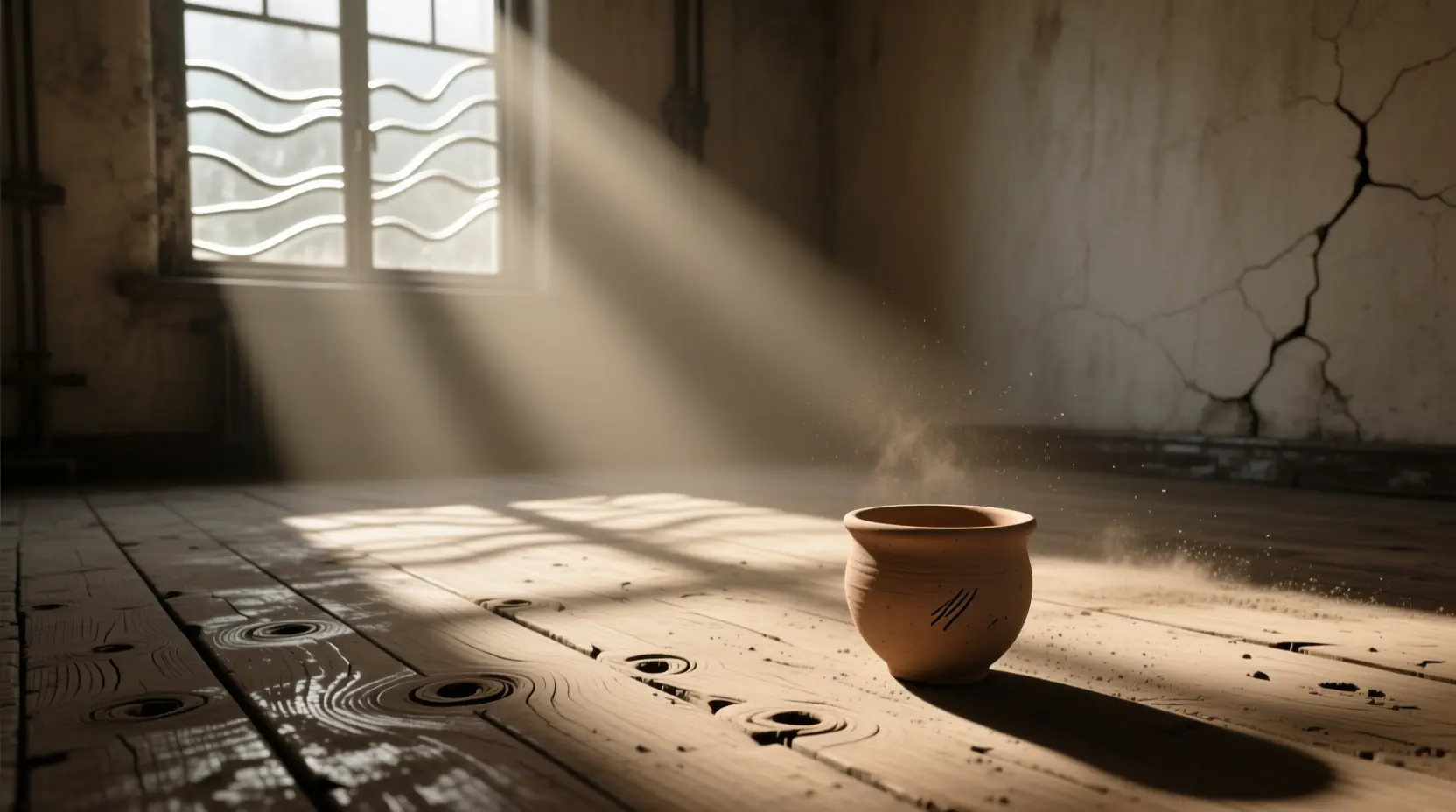
Imagine a single beam. Morning light. It enters through imperfect glass. A wave. A bubble, a faint ripple from a breath blown a century ago. It does not land with the harshness of a grid. It spills. It pools. It finds the floorboards not as a surface, but as a story.
The light touches the raised grain. Each ridge casts a long, tiny shadow. It finds the knots—the dark eyes of the tree that once grew toward this very sun. It reveals hollows worn by generations of quiet footsteps. Here, the floor is no longer a floor. It is a record. Of growth. Of use. Of patient aging. Electric light flattens this story. It declares, “Here is a floor.” Sunlight whispers, “Here is a life.”
This is the first lesson. Natural light does not illuminate objects. It reveals their essence. It finds the *shibui*—the astringent, subtle beauty—in the roughness of a clay cup. In the uneven weave of linen. It honors the crack in the plaster, not as a flaw, but as a valley where shadows may dwell.
The Day’s Breath Upon the Wall
A Wabi-Sabi home breathes with the day. It does not fight the cycle. It joins it.
In the first hours, light is cool. Pale. The light of possibility, of dew on grass. It creeps across a hand-troweled wall, turning ochre to a fleeting, soft gold. You see the craftsman’s thumbprints. The humble truth of the material. This light asks for nothing. It simply is.
The sun climbs. Light gains strength. It becomes direct. Honest. It finds the weave of a *tatami* mat, each strand of rush grass distinct. It warms the smooth curve of a river stone. Shadows are sharp. Clean. They define space. They carve a room not with walls, but with contrast. A leaf from the maple outside traces a trembling silhouette on the *shoji*. The screen itself, paper and wood, glows from within. Not a barrier, but a filter. Turning fierce light into a soft, diffuse hum.
Then, afternoon. The light grows weary. It slants. Long and languid, rich with the amber of impending evening. This is the light of deep looking. It catches dust motes swirling—not as dirt, but as a galaxy of tiny stars. It sets aflame the copper patina of a kettle, the deep lacquer of a worn bowl. This light has memory. It is the light of stories told by the hearth.
Shadows Are the Ink of Emptiness
We often fear shadows. We call them dark corners. We flood them with light. But in the way of Wabi-Sabi, shadow is not absence. It is partner. The necessary silence.
*Ma*—the sacred pause, the emptiness—is given form by shadow. A deep alcove, a *tokonoma*, is not for flooding. It is a vessel for ambiguity. The scroll, the single flower, half-emerges from the gloom. You must lean in. Contemplate. The shadow respects the object, refuses full assault. It allows mystery. The play of light and dark across a mossy stone is what gives it soul. Without shadow, a rock. With shadow, a mountain.
The slide of a *fusuma* door changes everything. As it moves, it redefines light and shadow. A bright room becomes a cave of shade. A dim corridor is pierced by a sunbeam. The architecture is not static. It is a performance with the sun. A day-long dance of brightness and retreat.
The Patina of Years, Lit From Within
Everything here is on a journey. The wood darkens. Copper turns to verdigris. Linen softens, fades. Natural light is the gentle hand that guides this returning.
A beam on a weathered bench shows not grey wood, but a spectrum. Silver where rain caressed. Darker grey in sheltered grain. Flecks of honey-brown where an arm rested. A map of human presence. Of weather. Of time. Artificial light shows a grey bench. Sunlight shows a biography.
This acceptance is the heart. We watch the *shoji* paper yellow, become brittle. We do not see deterioration. We see the paper drinking the light of ten thousand days. When it tears, we repair with care. The patch ages differently. Catches light in its own way. The home is never finished. It is always becoming.
How to Invite the Sun In
You do not design a home for light. You design a home that *welcomes* it. You become a collaborator.
It begins with surrender. Observe the sun’s path on your land. Note where morning light first touches. Where evening lingers last. Place windows not for a view alone, but to capture these moments. A small, high window might allow a single beam to strike a particular stone at the solstice. A ritual of light.
Choose materials that converse with light. Hand-made paper that glows. Unsealed plaster that drinks light in a soft, matte embrace. Unvarnished wood that welcomes the sun’s patina. Avoid the glossy, the perfect, the reflective. These fight with light, throw it back. Seek materials that accept light. Hold it for a moment. Then let it go.
Keep the path clear. Light is a shy guest. It will not force through clutter. The principle of *kanso*, simplicity, is functional. It clears the stage. A clean, bare surface of wood or stone is a canvas for the sun’s passage.
And finally, learn to sit. To watch. Take tea not in a room blasted bright, but in the particular pool of light that exists at 3 o’clock on an autumn afternoon. Feel its warmth. Watch its slow crawl. Become aware of the day turning. Become, yourself, part of the cycle.
Lit From Within by Ancient Sun
In the end, a home lit by nature is a lesson in impermanence. The light that highlights the crackle in the glaze of your cup at noon will be gone by dusk. Tomorrow’s light is different. The beam that falls on the pine today will, in a month, find the camellia.
This is not sadness. It is a call to profound attention. It teaches you to see the now. To cherish the temporary masterpiece the sun paints on your wall each day, knowing it will never be painted the same again.
In this quiet collaboration with the oldest light, your home ceases to be a shelter from the world. It becomes a bridge. A place where boundaries grow thin. Inside and outside. You and the turning earth. And in that luminous, fading space, you find peace. Not the peace of stillness, but the peace of flowing with the river of time, lit from within by the ancient, forgiving sun.