When Stillness is Only Waiting
The room sits as you left it. The objects are placed, their geometry serene. The palette is hushed, a symphony of stone and sand. Yet, the air is still. It does not breathe with you. It holds the quiet of expectation, not the deep silence of arrival. You have built a stage of perfect calm, but the spirit has not yet begun to dance.
Come. Sit with me by this old wall. Feel its coolness, worn smooth not by design, but by decades of rain and sun. We will not speak of solutions. We will listen. For the space between your intention and the feeling in the air… that is where the true work lies. In the gap between the ideal and the real. In the acceptance of the grain that runs counter to your plan.
The Patina That Cannot Be Bought
You have chosen pieces that speak of peace. Their lines are clean. Their surfaces unblemished. But they sit like strangers in a silent hall, polite and distant.
A room must earn its soul. Like a river stone, it is shaped only by the flow of life. That vase, too perfect, refuses the memory of water. That table, its lacquer unbroken, has not yet welcomed the ghost of a coffee cup, the faint, spectral ring of shared conversation. You seek stillness, but you have built a museum of it. Life is a gentle abrasion. Allow it. A scratch on the floorboard is not a flaw; it is the first sentence of a story written in passing. Let the sun fade the fabric in one uneven patch. Let the wood dry and crack ever so slightly along its own secret grain. In these small surrenders, the room begins to sigh. It settles into itself. It becomes a companion, not a display.
The False God of Emptiness
You have learned that clutter is the enemy of the mind. And so you have created a void. A vast, polished plain. But emptiness is not peace. Peace is a profound fullness, perfectly balanced. It is density and weight, held in tender arrangement.
Consider the forest floor. Is it barren? No. It is a living tapestry of fallen leaves, moss-kissed stones, a single blue jay feather. Each element rests where it has fallen, yet together they compose a deep, resonant order. Your room may be afraid of its own echo. A single, weathered bowl on a wide sill. A solitary painting on a vast wall. They can feel like apologies for taking up space. Do not fear to gather. A trio of stones, different in heft and hue, pocketed from a morning walk. A stack of linen-bound books, their spines softened into velvet by time. Group them not with a ruler, but with a feeling. Let your hand place them as it would arrange kindling for a fire—each piece supporting, leaning, conversing in a silent tongue. The space between them is not empty; it is charged. It is the breath between words. The pause that gives meaning to the sound.
Light That Cuts, Light That Cradles
You have invited the light. But has it come as a guest, or as an invader?
Modern light is a blade. It cuts. It defines. It accuses. The light of a soulful space is a cloth. It drapes. It softens. It conceals only to reveal more deeply. The unforgiving overhead sun—even from a bulb—flattens the soul from objects. It banishes the gentle shadows where mystery dwells, where corners hold their quiet thoughts. See how the late afternoon sun slants through this dusty windowpane? It does not illuminate the floorboards; it anoints them. It pools like liquid amber in the imperfections.
Seek layers. A pool of lamplight, low and contained, for the close work of mending or the tracing of words on a page. The diffuse wash from a paper lantern, turning walls into a soft, glowing skin. Candles, whose light is alive, flickering with the room’s own breath. In the evening, have the courage to let darkness gather in the corners. Allow the room to retreat into itself, to know rest. A room perpetually lit has no depth. A room that knows shadow knows contemplation. And in that contemplative gloom, you may finally find rest for your own eyes.
The Anchor of the Slight Warp
Everything matches. The harmony is precise, mathematical. And therein lies the stillness of a stopped pendulum. A perfection that has nowhere to go, no reason to be.
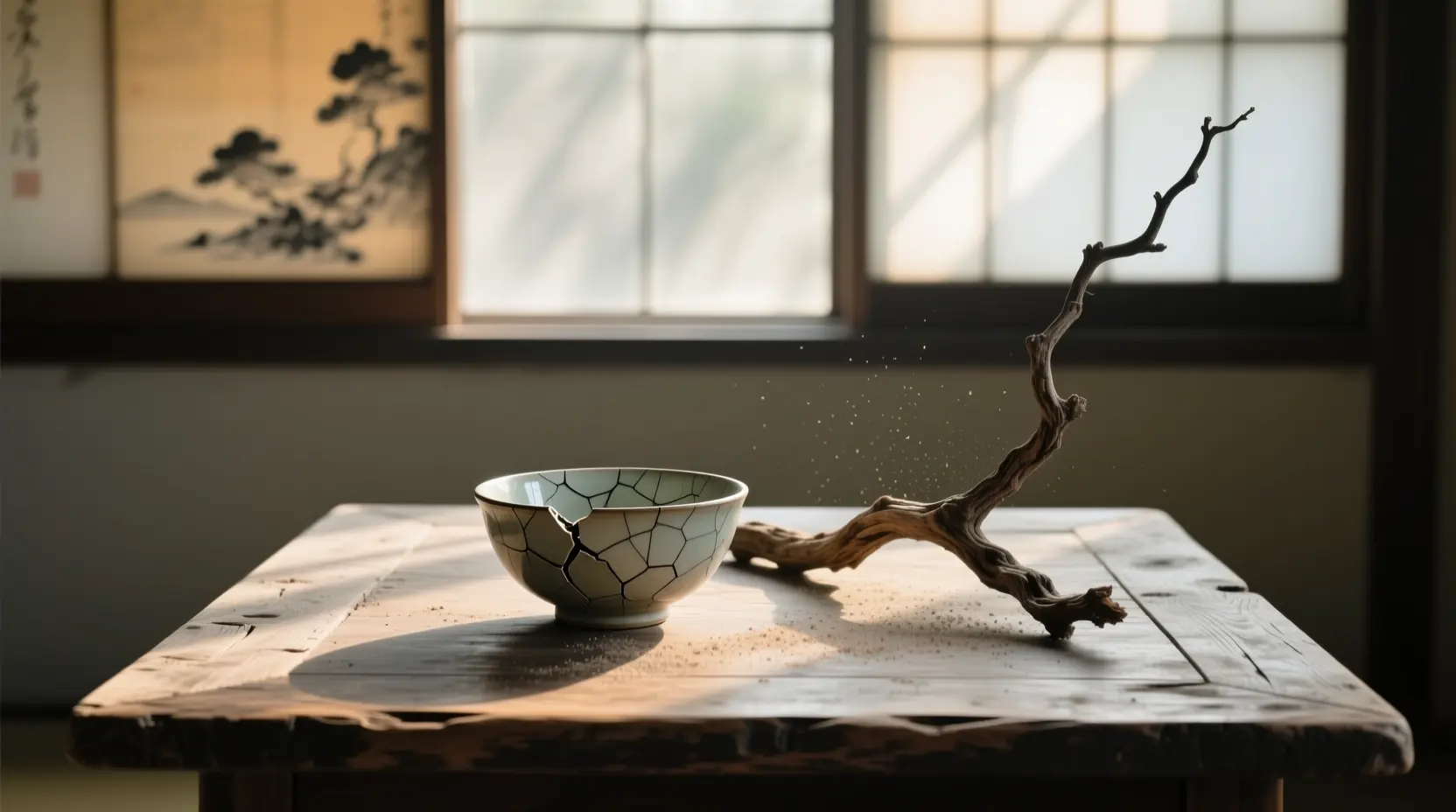
The hand that seeks only flawlessness is a nervous hand. It betrays a fear of the unexpected, the unplanned. The human spirit finds repose not in flawless order, but in the one thing that confesses, quietly, “I am here, as I am.” A swatch of burlap rug, its rough weave a protest against the smooth floor. A ceramic cup, glorious in its slight warp, born from the fire’s own, unpredictable breath. A branch, gnarled and twisted by wind, placed beside the perfect curve of a porcelain vase. These are the room’s anchors. They ground the space in the undeniable reality of the natural world—a world of asymmetry, of accident, of resilient, rugged beauty. They whisper, “You too may be imperfect, and you too may belong here.” This is the quiet heart of wabi-sabi: the austere beauty of the incomplete, the impermanent. It is the crack in the teacup that we run our fingers over, again and again, remembering the warmth it once held.
The Silence Between the Sounds
You have hushed the machines. The air is still. But the silence is thin, brittle. It is the silence of waiting for a sound that never comes.
True silence is not the absence of sound, but a vessel for the right sounds. It is a canvas for the small, inevitable symphonies of existence. The room lacks a pulse. Listen. Here, by this wall, we have the distant, resonant plink of water from a bamboo shishi-odoshi, marking time not in seconds, but in contemplative drips. The faint, papery rustle of a reed blind stirred by a breeze you cannot feel on your skin. The deep, almost inaudible tick of an old wooden clock—the heartbeat of the house itself.
Introduce one element, just one, that speaks this ancient language. A small stone fountain where water learns gravity anew. A wind chime of hollow bamboo, speaking only when the world exhales. Even the simple, ritualistic scratch and hiss of a match, lighting a single stick of incense. These sounds do not break the silence; they define its edges. They give it texture and dimension. They make the silence something you can lean into, a presence rather than an absence.
The Fingerprint You Try to Wipe Away
I see the care in the arrangement. The studied placement. But I do not see you. I see the idea of Zen, polished and presented, but not the fingerprint of the seeker. Not the smudge of the journey.
A room becomes a sanctuary when it bears witness to the path, not just the destination. It is a map of your attention. Where has your hand lingered? A smooth worry-stone, dark from the oil of your thumb. A book left open, spine cracked, at a passage you are still digesting with your soul. A feather placed on the sill after a morning walk, simply because it was beautiful. These are not decorations. They are offerings. They are the humble, daily altars of a life being lived. Do not curate your soul. Let it leave its traces. The room should not look like a temple you visit. It should become the temple you are building, patiently, within yourself, one imperfect, heartfelt object at a time. The dust that gathers in a sunbeam is not neglect; it is the room’s own memory of the air you moved through, a testament to your presence.
The Life Not Yet Lived Upon Its Surfaces
You walk softly here. You speak in hushed tones. This is a good beginning. But reverence, when it becomes a rule, can become a beautiful prison.
A soulful room is not a place for life to be paused. It is a place for life to be felt more deeply. It is a bowl that must be used to know its balance in the hand. A floor that must be sat upon, cross-legged and weary, to know its support. Have you laughed in this room? Have you wept? Has sunlight been allowed to fall, unabashed, across the fur of a sleeping cat? The room absorbs these moments. It soaks them into its grains and plasters, its very patina. Do not make it a shrine to an ideal. Let it host the mundane miracle of your existence. Drink tea here, and let a single drop stain the wood, a dark moon of memory. Read here, and let the book fall to your chest as you doze, its pages open to a mystery. The room becomes sacred not when all activity ceases, but when all activity—even the boiling of water, even the slow mending of cloth—is performed with a thread of presence. It is not about the absence of life. It is about the absolute, radiant presence of it, in all its flawed and fleeting beauty.
A Final, Grounding Whisper
So you see, the feeling you seek is not a thing to be built, but a relationship to be tended. Like a garden, it requires not force, but patient attendance. It asks you to see with the soft gaze, to touch with the receptive hand, to listen for the spaces between.
Begin not with adding, but with subtracting the heavy idea of how it should be. Sit in the room at different hours. Watch where the light longs to pool. Notice the corner that feels lonely, not empty. Listen for what the space itself is whispering for. Perhaps it is not another object, but the removal of one. Perhaps it is not more silence, but the right, single, natural sound.
Bring in one thing that has known wind, or water, or the warmth of a kiln, or the grip of another hand. One thing that is unabashedly, quietly itself. Place it not with design, but with care. Then tend to it. Dust it not as a chore, but as a ritual of re-acquaintance. Water the plant slowly, mindfully, feeling the weight of the pot change in your hand.
The room will not become “Zen.” It will, day by slow day, become a home for your own quiet mind. And one evening, you will enter, and you will not think of the word at all. You will simply breathe, and the room will breathe with you. The stone will feel solid beneath you. The wood will tell its slow story. The light will fall as a blessing. And you will be, at last, not in a place you have made, but in a place where you have finally, quietly, arrived.