The Wind Does Not Rush Here
It lingers.
It traces the contours of a single stone. A sigh through the needles of a potted pine. It carries the scent of last night’s rain from a mossy tile, a memory of a distant mountain. This is not a shout. It is a whisper. A remembered echo. It lives on a balcony, in the space between the railing and the sky. You have asked about stone, and moss, and quiet. You have asked how to bring the mountain’s patience to a place of concrete and glass. Come. Sit on this worn bench. Let us talk not of making a garden, but of listening for one. It is already there, sleeping in the grain of a pebble, in the curve of an old, cracked bowl. We are merely awakening it.
The First Stone: Not Choosing, But Being Chosen
Do not go to a shop with a list.
Go for a walk. A slow walk. By a riverbank, a vacant lot, the forgotten edge of a construction site where the earth has been turned. Let your eyes grow soft. Unfocus. Do not look for a perfect sphere, a sparkling crystal. Perfection is a loud, exhausting demand. It speaks only of itself.
Look instead for the stone that seems weary. The one with a quiet face. The one rolled by patient water, scoured by centuries of sand. Its edges are gone. Worn away. It is smooth, not with polish, but with surrender. Pick it up. Feel its cool weight in your palm. It is not heavy with burden, but with presence. This stone has finished its long journey. It is ready to rest. In your hand, it is no longer debris. It is an island. A miniature mountain. The first, silent anchor of your world.
Bring it home. Place it on the balcony floor. Do not center it. Let it drift to a corner, as if it had settled there of its own accord, tired from its travels. This is the beginning. All true things grow from a center that is slightly off.
A Vessel for Rain, a Bowl for Sky
Next, find a container.
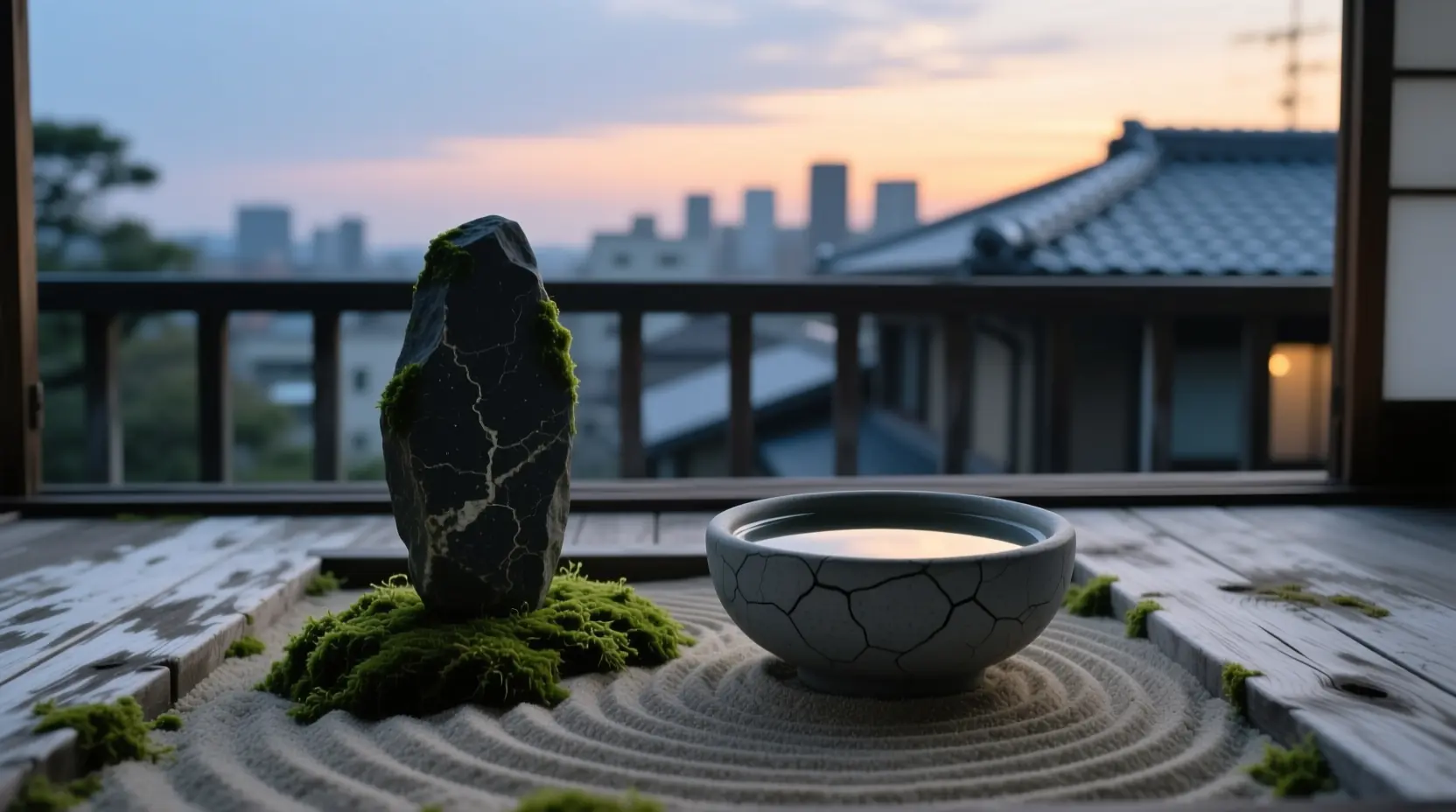
Not a shiny pot. Look for clay that remembers the potter’s thumbprints. For wood greyed by decades of sun and frost, its grain raised like the topography of an old, forgotten land. A bowl with a crack, its fissures a delicate, silver tracing. These are not flaws. They are diaries. They hold more weather, more stories, than a flawless vessel ever could.
Fill it not with rich, black soil, but with poor earth. A mix of sand, a handful of clay, some crushed gravel. We are not building a feast for roots, but a monastery floor for stillness. In this spare ground, we nestle our first stone. Perhaps a second, smaller one, leaning against it like a child asleep against a parent’s shoulder. This is *koke-shibumi*—the austere elegance of moss and stone. But the moss may not come for a long time. For months, it may just be stone and bare earth. Waiting. This is good. We are learning to see the beauty in the absence, in the promise. We are learning patience.
The Conversation of Stones
People speak of design. Of rules and principles.
I speak of friendship. Of quiet introductions.
Place your stones as you would introduce old, silent companions. Let them converse. One stands upright, resolute—a *Reisho* stone, a steadfast monk. Another lies prone, horizontal—a sleeping beast, a fallen log. A third is small, a distant peak on the horizon of a slate slab.
Do not force a triangle. Do not seek balanced weight. Seek *asymmetric harmony*. Like a line of wild geese crossing an autumn sky, it feels complete precisely because it is not symmetrical. Leave empty space—*ma*. This emptiness is not a lack. It is the breath between words. The silence that holds the sound. It is where the morning light will pool, later, a liquid gold on the grey floor. It is where the shadow will deepen at dusk, a well of coolness.
Walk away. Look from the kitchen doorway. Come back tomorrow with the dawn. The stones may have shifted in the night light. They will tell you, in their quiet way, if they are content.
The Green Patina of Time
Now we invite life.
Not the boastful, shouting life of blooms, but the humble, green life that thrives on neglect. Moss. It does not come from a packet. It is a guest, not a product. Find a patch in a shady park, on the damp, north side of an old tree. Take a small piece, no larger than your palm, with a silent prayer of thanks. Crumble it over your stone, over the poor earth. Mist it daily with rainwater, if you can catch it. Water from the sky holds a different softness. A kindness.
Then, you wait.
You are not growing moss. You are creating a home where moss might *choose* to grow. This is the heart of it all. We do not command. We do not force. We curate conditions for grace. The first green fuzz, appearing like the shadow of a cloud on the stone’s shoulder, is a greater victory than any riotous rose. It is a pact. A quiet yes.
Let the weather work. Do not shield your garden from the rain. Let the stones darken with moisture, becoming profound and deep. Let the sun bleach the wood to the bone. Let the winter frost etch its delicate, crystalline patterns on the clay. This weathering—*yūgen*—is the garden’s deepest meditation. It is a collaboration with the cosmos. A slick of damp on stone at dusk holds more depth than any mirror. It holds the memory of the cloud that passed.
Stages for the Fleeting
A stone garden is not a still life.
It is a stage for the ephemeral. This is *mono no aware*—the gentle sorrow, the aching beauty, of impermanence. We must provide the quiet props for this daily drama.
A shallow dish of water becomes a sky-catch. It holds the passing clouds. The daytime moon. The sudden, sharp flash of a sparrow drinking, its tiny twin shimmering in the depths. A single, slender branch of a maple, pruned to its essential lines, will tell the whole, silent story of the year. In spring, a haze of red buds, a promise. In summer, a canopy of green whispers. In autumn, a slow-burning flame of orange and gold. In winter, the stark, beautiful bones of its structure, etched against the wool-grey sky.
Perhaps a simple lantern of blackened iron. Not to light, but to hold shadows in its alcoves. At dawn, it is a stark silhouette. At noon, a deep, cool well of shade. At twilight, it seems to absorb the last light. This changing face is its truth. Its only constant is change.
The Broom, The Can, The Hand
The care of this place is its purpose.
It is not maintenance. It is ceremony. A moving meditation.
Each morning, take a bamboo broom. Its sound is a whisper on the tiles. Sweep the fine sand or gravel around your stones. Not to tidy, but to trace. To converse. Your sweeping lines are the ripples on a pond, the marks of wind on a desert dune. They are a record of your presence, gentle and non-possessive. They will be erased by the afternoon breeze, by a stray leaf, and you will sweep again tomorrow. This is the lesson, written daily in sand: our efforts are beautiful, necessary, and temporary.
Pluck a single fallen leaf from the moss. Not all the leaves. Just one or two. Leave some to curl and melt into the earth, feeding the green from which they came. Use an old copper watering can, dented and silent. Pour the water in a slow, high arc, like rain falling from a branch, not a torrent from a tap. This is listening. You are learning the thirst of stone. The patient drink of moss. The way the earth accepts a gift.
Sitting in the Kingdom of One Tatami
In the evening, take your seat. On a cushion of raw, unbleached linen.
The day’s heat is leaving the tiles, a slow exhalation. The city’s noise is a distant river, a rumble you feel more than hear. You are not looking *at* the garden. You are allowing it to enter you. To settle in your bones.
See how the last sun gilds only the topmost curve of the upright stone, a final blessing. Watch the blue dusk fill the empty spaces first, the *ma*, welling up like cool water. A moth, grey as ash, lands on the still water of the dish, and its perfect twin appears in the depth below. You did not make this. You arranged a few humble, weathered things, and then you stepped back. You held the space. The world filled in the rest—the angle of the light, the length of the shadow, the insect’s brief pilgrimage, the weather’s hand, the slow, inevitable patina of days.
This balcony is no longer a ledge on a building. It is *sanrin-tōzai*—the mountains and forests, right here. The stone is a peak. The moss is an ancient, sleeping valley. The water dish is a vast, calm lake. You have compressed the cosmos into a single, glancing view. This is the magic of limitation. By accepting a small space, by honoring its edges, you have touched the infinite.
The stone does not speak. The moss does not bloom with fanfare. Yet, in their silent, aging, imperfect presence, everything is said. They whisper the oldest truth: that there is profound beauty in the unfinished, the worn, the quietly returning to earth. That growth and decay are the same, slow dance. That peace is not the absence of change, but a deep, abiding companionship with it.
Your stone garden is complete not when the last element is placed, but when you finally sit down, your breath slowing, and feel no need to add anything more. The wind has a different voice here now. It is your own breath, slowed to the rhythm of stone. Listen. It is enough. It is more than enough.