Before Renovating, Listen
First, to the sound of your space. Not the noise of living, but the hum beneath it. The sigh of tired floorboards. The hollow echo from a barren wall. The quiet longing of a kitchen that has forgotten its purpose. It wants to speak a different story. Not of replacement, but of renewal. It seeks a skin, not a mask.
In this listening, a name might surface. A murmur, not a shout. A suggestion, like water finding a fissure in old stone. Microcement.
Sit. Let us speak of this substance. Not with the clamor of commerce, but with the quiet reverence of one studying a leaf’s veins. We will speak of origin, of grain, of the patina that only truth and time can bestow. For before you invite any material into your home, you must know its soul. You must feel its weight in your spirit.
The Clay of a New Continuity
Think of the oldest things you know by touch. The inside of a clay jug, cool and slightly rough. A sun-baked riverbed, cracked and mapped by thirst. A pebble worn smooth in a stream’s endless palm. This is its lineage. Microcement is earth, remembered. Cement, polymers, minerals—ground to a dust fine as pollen. Mixed with water. Made pliant.
It is not a slab to be imposed. It is a membrane to be grown.
It flows. Over floors. Up walls. Across the curve of a counter, the hollow of a basin. It does not recognize the corner. It denies the seam. It weaves a room into a single, silent sentence. Your space becomes a grotto. A cell. A shore at low tide. There is a profound quiet in this seamlessness. The eye, so accustomed to edges and borders, finds rest. The mind unclenches. No grout lines to trace like prison bars. No abrupt transitions to jar the soul.
A singular, flowing plane. Like a held breath.
The Philosophy of the Faint Flaw
We venerate the silvered cedar shingle. The worn step, hollowed by generations. The linen napkin, softened to a cloud by countless washings. We call this wisdom. Microcement is born of this understanding. It does not resist time; it invites its collaboration.
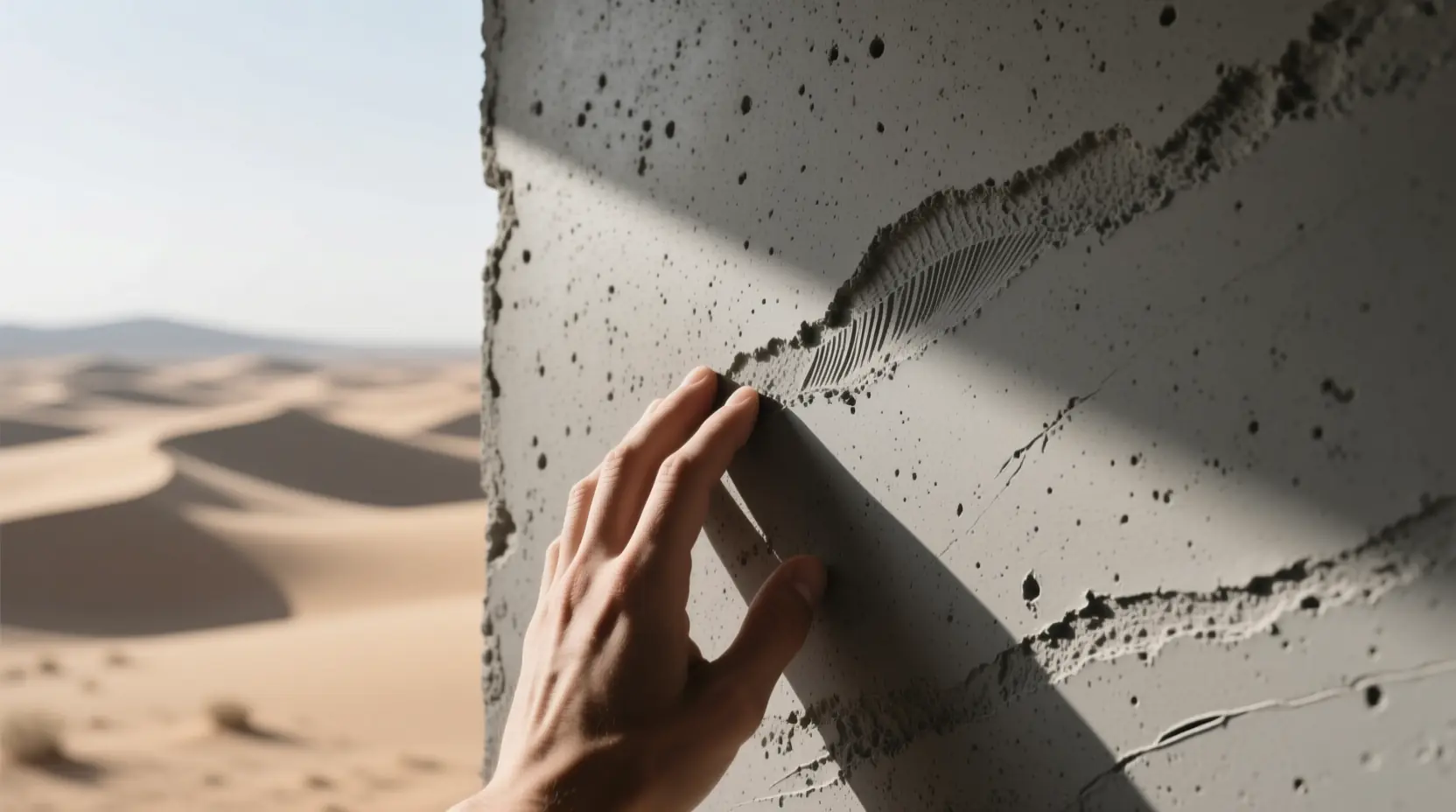
Its surface is a parchment of its own making. Here, a slight ridge where the trowel paused to breathe. There, a whisper of tonal shift, like dusk gathering in a valley. This is not error. This is authenticity. A perfect, plastic laminate shouts its newness, then fades into brittle obsolescence. Microcement whispers of its birth, and ripens.
It accepts the gentle scar of a dragged chair. The soft sheen of a daily path from door to hearth. It does not pretend to be eternal granite. It is a humble, living hide. It ages beside you. It inscribes the soft story of your life upon its skin, absorbing the quiet light of passing days.
Perfection is a rigid, lonely state. Character is a conversation.
The Unseen Foundation
A soul cannot settle on restless ground. The foundation is everything. The true artisan knows this. His primary labor is not in the final, visible coat. It is in the patient, hidden preparation. The sacrament of the substrate.
Your old tiles. Your fractured concrete. Your weary wood. They are the past, the bones. They must be cleansed. Stabilized. Made peaceful. The microcement will be laid directly upon them—a grafting, not a burial. This demands integrity. The surface must be made receptive, often with a primer, a keying coat. A vow of stability before the marriage.
If there is a crack in the spirit beneath, a tremble of movement, it will reveal itself. Like doubt through faith. Preparation, then, is an act of deep honesty. You cannot conceal a restless heart.
The Ritual of Layers
And then, the application. It is a meditation in layers. Thin. Deliberate. Like laying down washes of ink.
The first coat is the bond. A quiet adhesion. It says, I am here, and I listen.
The second, often with a mesh of fiberglass, embedded. A latent strength. A promise of unity.
Then, the body coats. Two, perhaps three. Each spread with a steel trowel held not as a tool, but as an extension of the wrist, of the breath. Pressure is poetry. Angle is inflection. Here, the craftsman’s spirit bleeds into the work. His rhythm becomes the hills and valleys of the texture. His patience dictates the flow.
No roaring machines. Only hand, material, and intention in a silent pact.
Finally, the seal. The guardian. It can be matte—a finish that drinks light like thirsty earth. Or satin—a soft glow, like stone at the water’s edge at dawn. This seal is its breath. It allows the surface to feel cool, alive, while protecting it from the gentle abrasions of living: water, oil, the small, sacred spills of existence.
The Covenant of Care
Once settled, it asks for little, but understands much. Sweep it. Damp-mop it. Use cleaners without harsh spirits, without violent chemistry. It is not delicate. But it is aware.
To drag the sharp tooth of metal across its skin is a discordant note. Felt pads under chair legs are a courtesy, like removing shoes upon entry. It is a quiet companion. It demands no wax, no high-gloss ritual, only mindful coexistence.
In time, the seal may wear thin where life is most lived—the threshold, the kitchen’s heart. This is natural. This is the path wearing smooth through a field. The craftsman can return, touch that single area with renewal, and the story continues. The life of this skin is measured in decades, in the long arc of a shared life. It is a lifetime companion.
A Question of Light and Shadow
Is it for every room? For every spirit?
Consider the light. In a north-facing chamber, humble and dim, a pale, matte microcement will gather the faint light, hold it, diffuse it softly. It becomes a vessel for luminescence. In a sun-drenched atrium, a tone of grey or earthen terracotta will drink in the warmth, holding the sun’s memory into the evening.
It finds a sublime home in the bath. A seamless wet room, floor flowing into wall into basin, is a return to the spring, the grotto. No corners for shadow or dampness to conspire. It offers a monastic simplicity in the kitchen—a continuous counter, a silent backsplash, where the food becomes the ceremony. It grounds living spaces, connecting them in an unbroken, silent river.
Yet, it is cool underfoot. Like slate, like river stone. In a place of deep winters, this is a sensation to be met, not feared. The radiant heart of underfloor heating is its perfect companion. A marriage of ancient material and gentle, modern warmth.
The Craftsman’s Hand, The Material’s Truth
This is not a product to purchase. It is a process to welcome. The craftsman is not a installer, but a translator. His skill lives in his eye, in the quiet certainty of his hands. Seek his previous work. Lay your own palms upon it. Feel for the soul within the surface.
It may ask more of you at the outset than a crate of mass-produced tiles. But tiles are a chorus of fragments, a hundred small beginnings and ends. Microcement is a single, sustained note. You are not covering your home. You are bestowing upon it a new, continuous hide. A second nature.
Before any decision, hold a sample. Feel its paradox—the silk and the stone in one. Observe it at first light, and again in the trembling light of a single candle. Listen. See if its quiet, grounding song finds an echo in the quiet of your own bones.
The Wisdom Worn Smooth
In the end, microcement offers a lesson far older than interior design.
It teaches that true strength is fluid, born of seamless connection. It teaches that beauty is not a frozen image, but a living process—accepting light, bearing witness, earning character. It whispers that the most profound spaces are often the most silent, the most simple. A bowl of broth on a seamless, earthy countertop nourishes differently. A bath in a continuous, curving basin feels like immersion in an origin.
Your home is not a showroom. It is your nest, your cave, your sanctuary. The materials within it should speak of the ground from which we came, of the human hand that shaped them, of time’s respectful, polishing passage.
Microcement is not a trend. It is a remembering. A way to bring the quiet, unbroken soul of a river stone, the seamless contour of a windswept dune, into the daily liturgy of your life.
Listen again to your space.
What is it whispering for?
Perhaps it does not cry out for something new.
But for something utterly, deeply true.