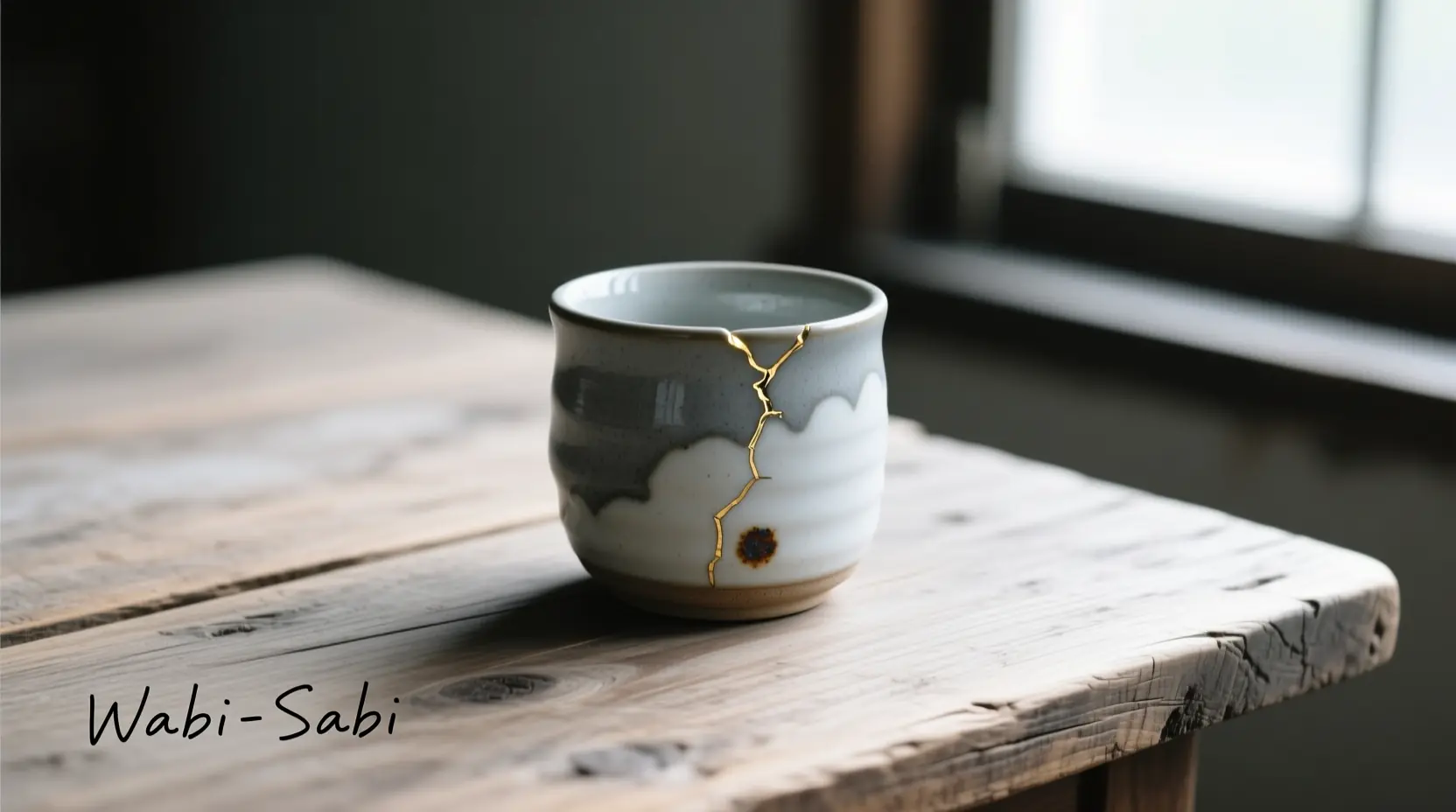
A Void, or a Vessel for the World
Consider the cup in your hand.
Not with your eyes. With your palms. With the quiet skin of your fingertips. Feel its curve. Is it a closed thing, a perfect and sterile conclusion? Or is it an opening?
Does it carry the chill of the factory shelf? Or the memory of earth?
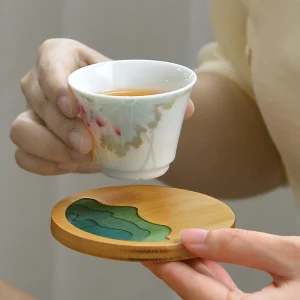
A slight undulation, there—where a thumb pressed into yielding clay, a century ago, or yesterday. A whisper of a whorl, fossilised in the glaze. A colour that does not sit, but moves. A deep, pooling blue in the belly, thinning to the grey of a morning haze on the rim. It is not a container. It is a conversation. A long, slow dialogue between earth, fire, water, and a pair of listening hands.
The Memory in the Mud
All true things begin humbly. In dirt. In water. In the common mud.
Here, the paths fork.
One road leads to the machine. The mud is silenced. Pressed into a forgetting so complete it becomes a ghost. A thousand ghosts, all identical. Soulless and efficient. They speak the language of nowhere.
The other path is older. It is walked by hands. The artisan’s hands do not force. They greet. They knead the cold clay, feeling for its breath, its reluctance, its willingness. On the wheel, it is a coaxing. A partnership. The clay rises. It wobbles, finding its centre not from a command, but from a collaboration.
No two pulls are alike. Ever. The clay remembers this. It holds the rhythm of the maker’s pulse on a damp Tuesday. The faint tremor of a passing truck. The focused silence of a mind emptied of all but this one, rising form. This memory is not a flaw. It is the vessel’s soul. Its first, quiet story.
The Kiln is a Primal Sky
Then, the glaze. To the machine, glaze is a uniform skin. A flat colour. A closed door.
To the artisan, glaze is a universe. Ground stone. Whispers of iron and copper. Ash from an old fire. It is brushed on—a prayer in liquid mineral. Then, the surrender.
The kiln is not an oven. It is a primal womb. A miniature, roaring earth. Here, control is an illusion. Chaos is the only law. The glaze melts. It flows like lava. It breathes. It crystallises. The iron bleeds a rusty tear. The copper flares into a verdant green, then softens to a mossy whisper.
What emerges is a captured sky. A unique, unrepeatable weather system frozen in stone. Where it pooled, a deep forest pool. Where it thinned, the first light of dawn. Your cup holds a world within its curve. A record of a transformative journey through elemental flame.
The Heft of Presence
Lift the machine-made thing. It is often light. Anxious. A shell. Its handle is a cold afterthought, fitting no hand in particular. It fears the tap of a spoon.
Now, lift the one born of hand and earth. Feel its weight. This is not burden. This is substance. A promise of stability. It sits in the palm with a quiet confidence. An anchor.
The handle is not attached. It is grown. Pulled gently from the body itself. It knows the curl of fingers, the pause between thoughts. It has a heft. This heft asks something of you. To be present. To cradle, not clutch. To sip, not gulp. It grounds the simple act of morning tea into a small, steady ceremony.
Kintsugi: The Gold in the Break
All things age. All things falter.
The machine-made piece fears this. A chip, a crack, a stain is a death sentence. It is discarded without a thought. For it had no life to mourn.
The handmade piece carries a different wisdom. Wabi-sabi. The beauty of the imperfect, the worn, the transient. It already bears the honourable marks of its making—the pock from the kiln shelf, the gentle ripple of the wheel.
And as you use it, you inscribe your own chapter. The fine crackle in the glaze darkens, a map of a thousand warm washes. The unglazed foot wears smooth, a polished record of its countless returns to the wooden table.
And if it breaks? In the old way, they mend it with gold. Kintsugi. The breakage is not hidden. It is illuminated. The delicate veins of gold lacquer do not say ‘fixed’. They say, ‘This, too, is part of my story. This hurt is now my most precious place.’ The piece becomes more valuable for having been broken. It is a quiet, profound lesson in your own resilience. A whisper against the cult of perfection.
A Ritual, Not a Function
To drink from the void is to perform a function. Hydration.
To drink from the vessel is to enact a ritual. Your eye reads the cloudscape in its glaze. Your palm feels the anchor of its weight. Your thumb finds the indentation made by another thumb, in another time. You are connected. A thread runs from the earth of its origin, through the fire, through the maker’s hands, through all its quiet mornings, to you, in this moment. Your coffee tastes of more than bean. It tastes of attention. Of continuity. Of care.
Curating a Quiet Ecology
This is what a home cries out for. Not more sterile objects. But soulful companions.
A bowl that makes a simple heap of rice feel like an offering. A plate that turns a weekday supper into a still life. A vase that cradles a single, foraged branch as if it were the only flower that ever mattered.
Your home is not a warehouse. It is an ecology. The objects within it should have life. They should have come from somewhere. They should bear the gentle marks of the world and of time. They should calm the eye. Steady the breath. They speak in texture: the roughness of raw clay meeting the silk of glaze, the gritty honesty of a sand-pitted surface.
They ask you to touch. To feel. To be tactile in a world of glass.
An Invitation, in a Single Curve
To choose this way is a quiet rebellion. A vote for slowness. For the particular over the mass. It is to support not an industry, but a person. A gaze. A pair of hands that see a world in a lump of earth.
Begin with one piece. Just one. Let it be your teacher.
Hold it in the half-light. Feel its balance. Trace its silhouette against the window. Watch how it holds the dawn. Let it slow your racing pulse.
Notice how it changes the space it occupies. How it gathers silence around it. How it asks for nothing, but gives a sense of quiet order. A grounded beauty.
In time, you may find another. A bowl. A small dish for an olive stone. Let your collection grow as a garden grows. Slowly. Organically. Each piece a discovery. A fellow traveller. Each with its own spirit, its own weathered story.
Your rooms will grow quieter. More grounded. More true. For they will be inhabited not by products, but by presences. Testaments to the human hand, the wisdom of material, and the profound, enduring beauty of a thing made with care, to be used with care, until it returns, peacefully, to the silent earth from which it first awoke.
This is the way of the clay. The way of the hand. The way of a life, and a home, that is truly alive.