The Hearth’s Hum, the Letting-Go Leaf
A kettle. On iron. Water approaching a change of state. Not a shriek. A hum. A low, gathering vibration.
Outside the pane: a single leaf. Copper-bronze. Brittle-veined. It holds to the branch. A tenuous grip. The wood knows. The leaf knows. A quiet pact with gravity. There is a profound peace in this knowing. A peace that does not announce itself. It settles. Like silt in still water. Like dust in a slanted, late-day sunbeam.
This acceptance. This is the first breath. The root-scent of an understanding. To name it is to scatter it. Wabi-sabi. It is a feeling in the throat before it is a thought in the mind.
Wabi: The Richness of Enough
The word carries old, lonely echoes. Wabi. Once, the ache of lack. Of remote living. Wind through bare branches. An empty bowl. Then, a turning. Under the quiet gaze of Zen, the loneliness softened. Transmuted. It became the serenity of voluntary solitude. Not poverty of spirit, but abundance of space. The clarity found when the non-essential falls away.
A bare room. The scrape of tatami underfoot. The hollow ring of a bamboo vase holding one, wild-stemmed flower. It is the beauty of the essential. The warmth found not in more, but in enough. The space between notes where the music breathes.
Sabi: The Patina of Conversation
Sabi. This is time’s gentle handwriting. Not decay as destruction, but as a record. A story. The moss that velvets the north face of a stone. The way cedar greys under sun and rain, its grain rising like a hidden topography. The softened edge of a wooden step, worn by generations of passing feet.
It is the silver that tarnishes. The book spine that cracks with love. The iron gate that rusts into hues of umber and flame. These are not flaws. They are a conversation. The object has spoken with rain, with sunlight, with the oil of human hands. It has a history written on its skin. Sabi is the dignity of that history. The beauty of having lived.
The Crack That Makes the Vase Whole
Consider the tearoom. A deliberate sanctuary of imperfection. The door is low. You must bend to enter. All hierarchies are shed at the threshold like a heavy coat.
Inside: earth walls, absorbing sound. Paper-filtered light. A humility of materials. Here, the utensils are not chosen for their pomp. A water jar, perhaps slumped a little in the kiln’s fierce heart. A tea bowl, its glaze crawling into unpredictable rivers. The prized piece may be one that broke. And was mended.
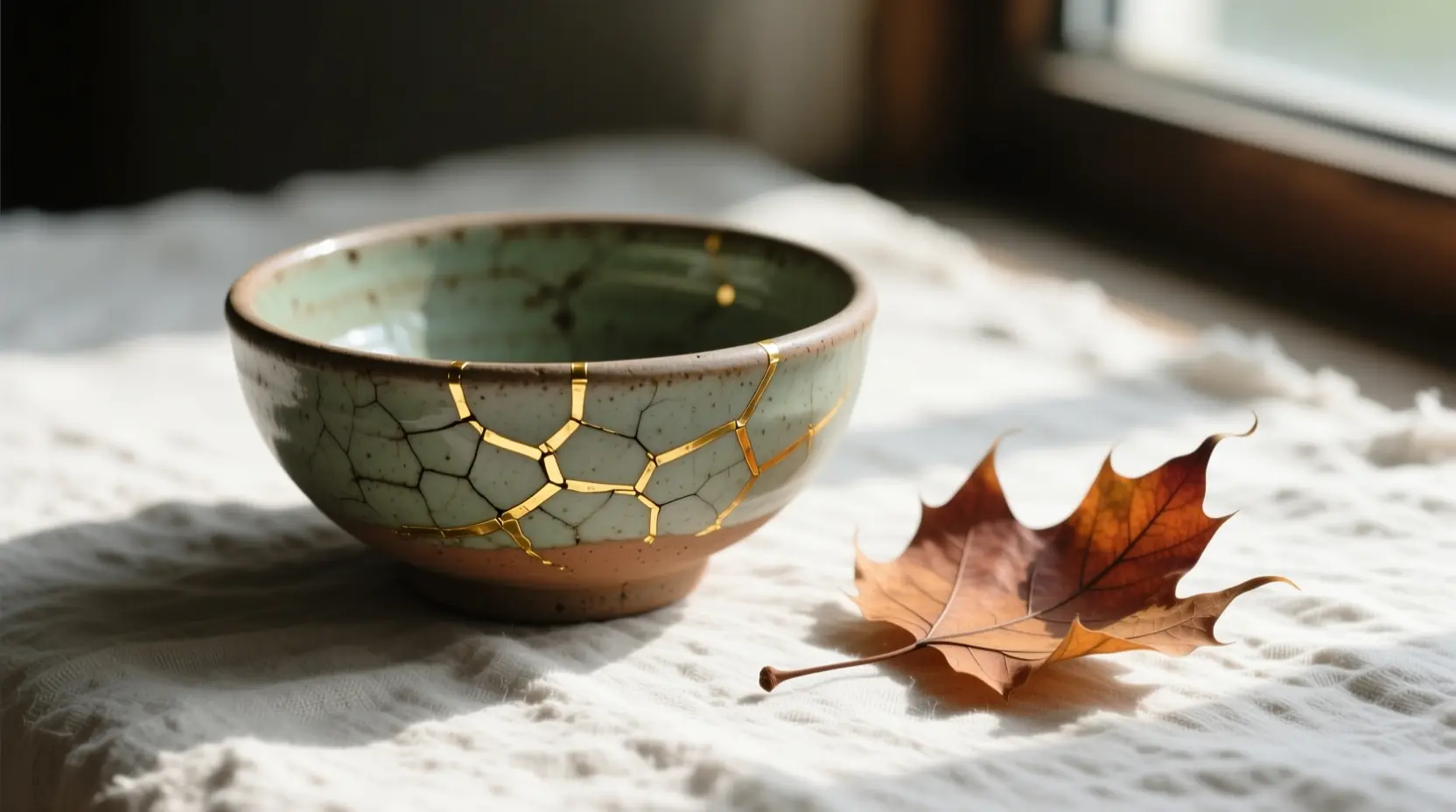
Seams of gold lacquer trace the fracture lines. Kintsugi. The break is not hidden. It is illuminated. Gilded. The philosophy is plain: the break is now part of the object’s truth. It did not end with the crack. It transformed. It became more itself. More valuable for having been broken, and for acknowledging the break. The gold says: Here, I was vulnerable. Here, I endured.
To See With a Different Light
This seeing is a practice. A way of orienting the soul.
Embrace the Off-Center. Nature abhors the static line, the perfect mirror. A tree reaches, twists, contorts toward light. Wabi-sabi finds life in asymmetry. In the odd-numbered arrangement. One dominant stone, two in quiet attendance. The tension is dynamic. Unresolved. It breathes.
Listen to the Texture. Seek the quiet narrative of use and age. The water-stain on oak, a memory of spill. The way linen crumples into soft hills and valleys. The rust on a hinge, singing a slow, oxidising song. These are not blemishes. They are a language. A surface without this text is silent. It has nothing to say.
Honor the Unadorned. Let the material be itself. Do not force wood to be stone. Let the rough, torn edge of handmade paper remain. Let the concrete wall be bare to hold the play of shadow. This honesty is a form of integrity. The object makes no false promise. It is simply, wholly, what it is.
Bow to the Fleeting. The most piercing beauty is often the most transient. The hoarfrost etching a ghost forest on the pane at dawn, gone by mid-morning. The cherry blossom, celebrated precisely for the heartbreaking brevity of its display. This awareness—mujo, impermanence—does not invite despair. It sharpens appreciation to a fine point. It teaches you to taste the tea while it is warm. To feel the sun’s patch on the floor while it lasts.
A Gentle Rebellion
In a world shouting of the new, the perfect, the seamless, this is a quiet resistance. A slow rebellion.
It is the mend in the knee of worn trousers. The choice of the hand-thrown cup, weighty and uneven on the lip. It is allowing the moss to grow between the paving stones. It is repairing, not replacing. It is sitting, hands empty, to watch the evening light climb a wall and fade.
To live this is not an aesthetic to purchase. It is a gaze to cultivate. A slowing of the pulse. A noticing. To feel the cool underside of a stone. To trace the hairline crack in old plaster. To accept the patina, the tarnish, the gentle fray, not as failure, but as natural punctuation in a long, whispered sentence.
It speaks, finally, of us. We are asymmetrical. We bear the textures of our years—lines etched by smiles, scars that map old battles. We are, all of us, transient. In learning to honour the crack in the vase, the grey in the wood, we learn a gentler grammar for ourselves. Our own repairs—the resilience learned, the wounds integrated—become our kintsugi. Seams of gold in the soul.
The Spiral Descent
Darkness gathers now. The leaf has released its hold. It spirals down. A slow, silent pirouette onto the waiting moss. It is not a tragedy. It is a returning.
This is the heart of it.
In the great turn—growth, decay, return—there are no full stops. Only ellipses… The crack is not the end of the bowl. It is the beginning of its mending. The tarnish is not a stain. It is a quiet dialogue with years.
So, let the kettle hum its earthy song. Let the dust motes drift their aimless dance. Take the old bowl. Feel the chip with your thumb. Do not perceive damage. Feel a moment. A life. It was loved enough to be used. It is loved enough to be kept.
In that quiet, you may hear it. Faint. Beneath the hum. The whisper of the incomplete. The poetry of the unfinished. The deep, abiding beauty of things… just as they are.