The Steam Vanishes into Light
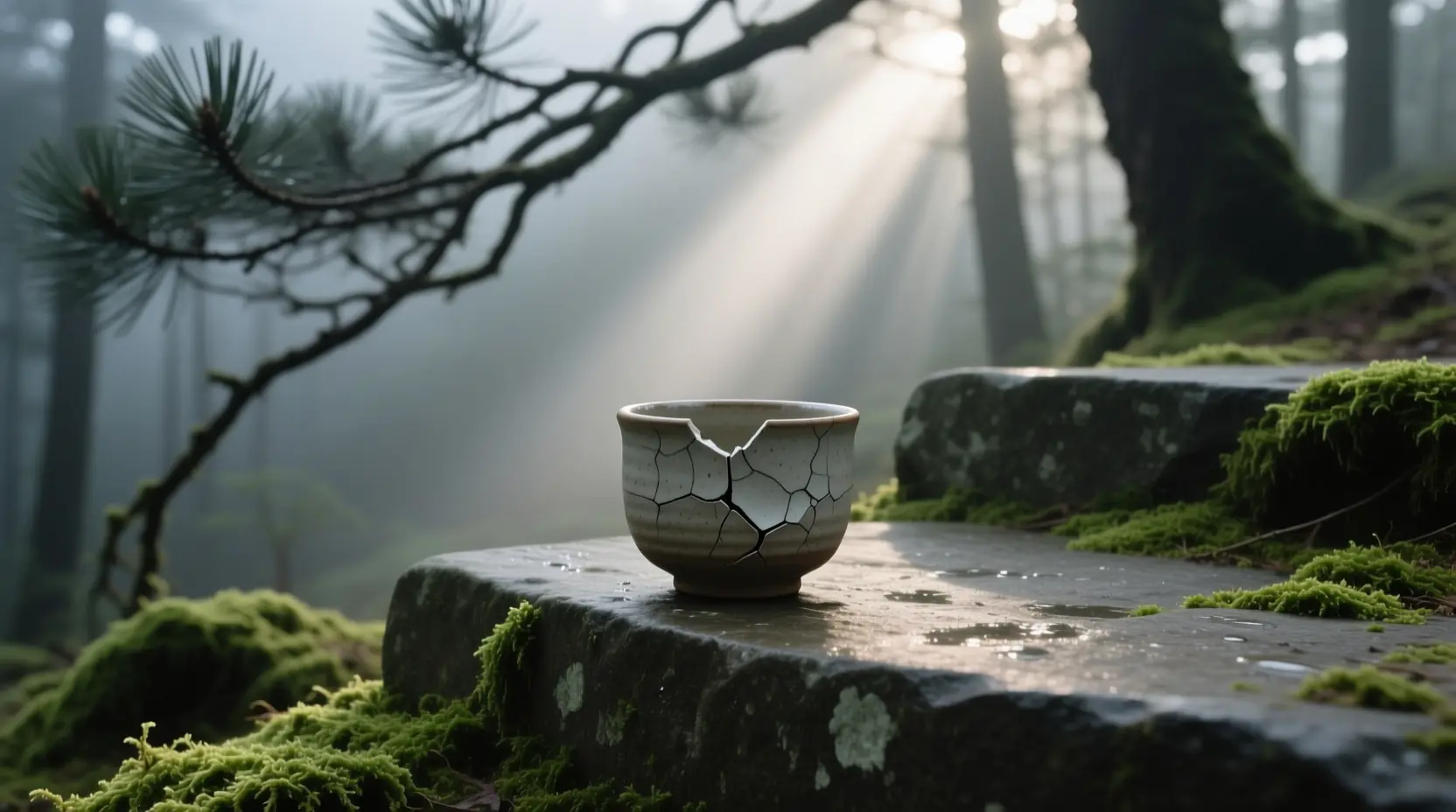
The morning air is cool. It carries the scent of damp earth. Of old pine. I sit on the smooth-worn stone of my step. A chipped clay cup warms my hands. The steam rises—a temporary ghost. I watch it vanish into the light.
Two paths to quiet the soul are often spoken of these days. Wabi-sabi. And minimalism. They are both drawn to stillness. To less. But they are not the same path.
One is a clearing in the woods, meticulously tended. The other is the mossy, sun-dappled forest floor itself.
To understand, you must listen not with the mind. But with the touch of your palm on a surface.
The Clearing and The Forest
Minimalism is the clearing. It is a space where every non-essential has been removed. The air is open. The sightlines are long. It speaks of intention. Of control. It is the breath after a deep exhalation, held for a moment in perfect stillness. The goal is clarity. Freedom from the weight of possession. It is a beautiful, purposeful emptiness.
Wabi-sabi is the forest that surrounds it. It does not seek to clear away the undergrowth. But to see the beauty in its tangle. It is the gnarled root. The mushroom growing from the fallen log. The way the light filters through leaves in a thousand broken pieces. It does not impose order. It finds a deeper, more ancient order—the order of growth. Of decay. Of constant, gentle change. It is not about emptiness. But about a different kind of fullness.
Let us walk these paths. And feel the differences underfoot.
The Hand of Time
In the minimalist clearing, time is suspended. A white wall is repainted to stay white. A steel surface is polished to repel the mark of days. The ideal is pristine. Unchanging. It is a refuge from the world’s chaos. A fortress against entropy. The object is complete the day it is made. It asks only to be kept as it is.
In the wabi-sabi forest, time is the most honored guest. It is invited to sit at the table. The clay cup is prized for its crackle glaze. The tiny lines that darken with each use. The wooden beam is loved for the way it silvers under the sun and wind. A dent in a copper pot is not a flaw. It is a memory of meals shared. Here, an object is not finished when the craftsman sets it down. That is only its birth. Its true beauty is earned. Slowly. Through a conversation with the years. It is a beauty of becoming. Not of being.
The Poetry of Imperfection
The minimalist seeks the flawless line. The right angle that is perfectly true. The surface without blemish. Imperfection is a distraction. A noise in the signal of pure form. The goal is essence. Reduced to its most potent, silent state. It is a single, clear note held in a silent room.
Wabi-sabi listens for the poetry in the stumble. It finds the divine in the asymmetrical. The bowl that wobbles slightly has a humble spirit. The fabric that is unevenly dyed holds the shadow of the artisan’s hand. This is not carelessness. It is a profound acceptance. It is the understanding that in the crack, the chip, the irregular grain, the world enters. It is the *kami*—the spirit—of the thing showing itself. Perfection is a closed door. Imperfection is an open window. Where the wind of life comes and goes.
The Soul of the Object
Walk through the minimalist space. The objects are often anonymous. They are functional sculptures. A chair is a chair. A lamp gives light. Their history is not relevant. Their purpose is king. They are beautiful tools. Serene in their utility. They speak a language of universal form.
Now, touch the wabi-sabi object. It is never anonymous. It carries its history in its body. This wood came from the old plum tree that fell in the last storm. That stain is from the tea spilled by a child long ago. The repair with gold lacquer—*kintsugi*—does not hide the break. It illuminates it. The break becomes the most important part of the story. The object is not a tool. It is a witness. It has a biography written in scars and sheen. It asks for a relationship. Not just a function.
The Warmth of the Hand
Minimalism often speaks the language of the machine. It admires precision. Replication. Cool surfaces. It is the beauty of the geometric. The planetary. The thought that exists before it is made manifest. The human hand is guided toward invisibility. The ideal is a purity that feels almost abstract. Born of the mind.
Wabi-sabi is the language of the hand. The earth. The accident. It is the roughness of hand-thrown clay. The tug of raw linen. The grain of wood that was once a living tree. You can feel the craftsman’s pressure in the curve. You can see the path of the blade in the cut. The material’s will is respected, not dominated. It is warm. Textured. Intimate. It is beauty that is felt on the skin before it is understood by the eye. It is of the body. Not just the brain.
The Embrace of Shadow
Minimalism loves the bright, even light. It reveals all. Hides nothing. Shadow is merely the absence of light. Something to be minimized. It is a philosophy of openness. Of transparency. There are no secrets.
Wabi-sabi finds profound beauty in shadow. In the half-seen. The suggested. It is the gloom in the deep corner of a room that gives depth to the sunlit alcove. It is the patina that obscures and softens. It understands that mystery is a form of depth. That not everything needs to be illuminated to be felt. It is quiet. Modest. Retiring. It does not announce itself. It waits for you to come close. To bend down. To look again. Its beauty is shy. And in that shyness, it is deeply moving.
The Cup is Empty
The steam from my cup has gone. The cup is empty. Cool to the touch now. Its rim is not quite round. A small, dark fleck in the glaze catches the light.
The minimalist in me appreciates the emptiness. The simplicity of the single vessel.
But the wabi-sabi in me loves the fleck. I love the weight of it in my palm. A weight learned from years of use. I love the memory of the heat it held.
They are not enemies, these two paths. They are different breaths. The minimalist breath is a long, slow exhale. Seeking zero. The wabi-sabi breath is the soft inhale that follows. Filled with the scent of rain on dry soil. Accepting the world as it is.
One creates a sanctuary *from* the world. The other finds a sanctuary *within* the world.
In the end, you must choose not by trend. But by the call of your own spirit. Do you seek the serene, controlled clarity of the clearing? Or do you seek the deep, accepting, ever-changing life of the forest?
Listen closely. The answer is already there. In the silence between your heartbeats. In the way your hand rests upon a weathered piece of wood.