Listen with Your Palms
Not with your ears. With the skin of your soul. There is a voice in the grain of wood. A story in the coolness of stone. A memory in the weight of clay. We have forgotten how to hear it. We live in a world of flat light. Seamless surfaces. A world that slips from touch. Leaving no trace. We are hungry for something we cannot name. It is the hunger for materiality. For the touch of the real.
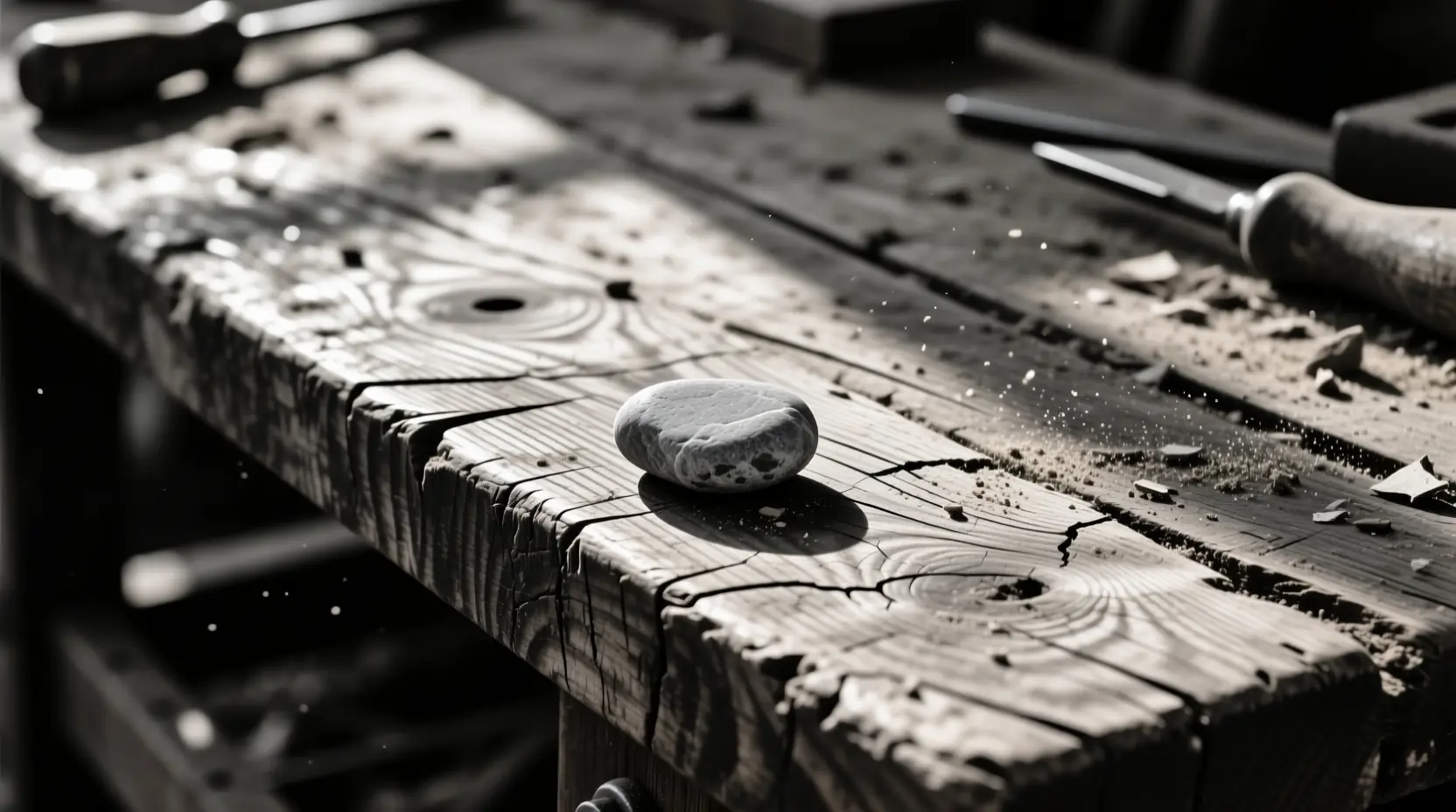
Come. Sit by this old workbench. Feel its surface. Not with a glance. With your hand.
Run your fingers across it.
The Whisper in the Wood
This bench is pine. Eighty years old. Perhaps one hundred. Its surface is not smooth. It is a landscape. Here, a valley worn by the steady drag of a plane. There, a range of tiny hills, the raised grain from a spilled cup of tea, long since dried. The wood is dark with oil. The oil of hands. My hands. The hands of the one who came before me. And the one before him.
Each groove is a sentence. A record of effort. A moment of frustration. Or concentration. Or simple, daily rhythm.
This is the first truth of raw texture. It accepts time. It does not fear the mark, the scratch, the stain. It welcomes them as a river welcomes rain. They become part of its character. Its soul. When you sand a piece of wood to a perfect, sterile sheen, you do not make it better. You make it mute. You erase its biography before it has lived. But when you let the wood be wood—when you feel its coarse grit under your thumb, follow the hard line of a knot—you are in conversation with a tree that knew wind and sun. You are touching life that has simply changed form.
Texture is the memory of origin.
The Patience of Stone
Now, take this river stone. Cool from the morning shade. Hold its weight.
It fits your palm not perfectly, but honestly. It was not made for you. It was found by you. This is a different kind of touch. Wood yields. Stone endures. But even in its endurance, it speaks. Its surface is not a single thing. Close your eyes. Feel the slick, water-worn curves. The surprising, gritty bite of a crystalline vein. The tiny, porous hollows where the softer minerals have surrendered to the stream.
To design with stone is to collaborate with geologic time. You do not command it. You listen to its fissures. You follow its faults. You reveal what is already there. A mason does not impose a shape. He liberates the shape sleeping within the rock.
In a smooth, polished granite countertop, we see only reflection. Our own face, anxious and fleeting. But in a rough-hewn hearthstone, we see the mountain. We feel the avalanche. The slow grind of the glacier. The patient caress of the river. Its texture is a map of its journey. It grounds us. In a room of soft things, a single raw stone is an anchor. A quiet reminder of an older, slower world. It teaches gravity. And humility.
The Breath of Cloth
Consider this length of linen. Shake it out. Hear it? Not a silent slide, but a soft, dry crackle. Like a distant fire. Like leaves in autumn.
Linen comes from the earth. From the flax plant. It is not invented; it is revealed. Its beauty lies in its refusal to be uniform. Hold it to the light. See the slubs? Those small, thickened nodules in the yarn? They are not flaws. They are signatures. Proof of its natural origin. A machine can make a thread perfectly smooth, perfectly even. It is dead. This linen is alive with irregularity. It has breath.
When you wrap yourself in raw linen, you do not feel swaddled. You feel cloaked. There is a dialogue between the cloth and your skin. It is cool in summer, warm in winter. It crumples. It creases. These creases are not mistakes. They are the folds of use. The record of a body resting. Working. Being. Over years, it softens. Not into weakness, but into wisdom. The starchiness leaves it. It becomes supple, forgiving, like a well-loved hand.
This is the texture of transience. It shows its age gracefully. It does not hide wear. It incorporates wear into its beauty. A frayed edge is not an end. It is a new kind of beginning. A softer, more delicate edge for light to catch.
The Clay Remembers
My bowl. Here. Cup it in both hands.
Feel how the weight settles. It is not evenly distributed. The potter’s wheel turned, yes. But her fingers pressed. They trembled slightly with the effort of centering the earth. Can you feel it? That slight, almost imperceptible ripple in the wall? That is her fingerprint. Not a metaphor. Her actual fingerprint, fired into eternity.
Clay is the most humble of materials. Mud from the riverbank. Yet, it is the most faithful. It remembers every touch. The aggressive kneading that woke it up. The gentle pull that raised its walls. The hesitant pat that shaped its base. When you hold an unglazed, raw-fired vessel, you are holding a moment of human attention, made permanent. Its surface is matte. It drinks the light. It does not shine; it glows from within, like a banked ember.
The texture is dry, slightly porous. It whispers of thirst. Of readiness to receive. To hold water, or rice, or simply to sit empty on a shelf, being exactly what it is. A raw clay pot does not dominate a space. It creates a quiet space around itself. A space of stillness. It teaches us about holding, and about being held.
The Soul of a Space
So, how do we live with these textures? We do not simply place them in a room like ornaments. We allow them to shape the room. We allow them to shape us.
A wall of rough-rendered plaster is not merely a surface. It is a horizon. As the sun moves, the texture catches the light. Long, raking shadows flow across it, deep in the afternoon, soft at dawn. The wall is never the same twice. It is a clock of shadows. A calendar of light. It makes you aware of the day’s passage. It slows your heart.
A floor of wide, unvarnished oak boards, gapped and whispering underfoot, connects you to the ground. It is not a barrier, but a bridge. You feel the solidity beneath you. The knots are like islands. The grain is like the flow of a slow river across your home.
We have been taught to seek comfort. And comfort is important. But comfort is not the same as perfection. The deep comfort of the soul comes from authenticity. From being in the presence of things that are true to their own nature. A slick, flawless surface offers no solace. It can only reflect our own anxiety back at us. But a worn wooden handrail, smoothed by generations of grip, comforts us. It says, “You are not the first. You will not be the last. Your hand here is part of the story.”
The Wisdom of the Imperfect
There is a quiet philosophy. It finds beauty in imperfection, impermanence, and incompleteness. It is the crack in the teacup that is repaired with gold lacquer. The moss on the stone garden. The faded indigo of an old farmer’s coat. It is not an aesthetic to be bought. It is a way of seeing to be cultivated.
Materiality is the physical heart of it. Raw texture is its language. When we choose the rough over the smooth, the irregular over the uniform, the time-worn over the factory-new, we are not making a mere design choice. We are making a philosophical stand. We are acknowledging transience. We are honoring the marks of life. We are embracing the quiet, beautiful truth that everything is in a state of becoming, or fading, or both.
The touch we speak of is not just tactile. It is emotional. Spiritual. It is the feeling of connection. When you touch a raw-textured material, you touch the process that formed it. You touch the hand that shaped it. You touch the passage of time itself. You are no longer separate. You are part of the grain, the grain is part of you.
The Silent Teacher
So, let your home be a teacher. Let the materials speak.
Sit on a rough-woven mat. Feel its grid. Smell its faint, sweet scent of earth. Let it teach you simplicity.
Lean against a cool, earthen wall. Let its solid, silent mass teach you stillness.
Run your hand along a piece of charred wood, its alligator skin black and crisp, protecting the soft, fragrant heart within. Let it teach you resilience. How fire can create a deeper beauty.
Use a tool with a handle of worn hickory. Let the shine of the wood where the hand rests teach you about diligence. About the sacredness of daily work.
Do not be afraid of silence. Of emptiness. A single, textured object in a still space is a poem. It needs no explanation. It simply is. And in its being, it calms the mind that is always racing. Always wanting. Always comparing.
We spend our lives seeking experiences. But the deepest experience is one of being. Of presence. Raw, textured materials call us to presence. They cannot be appreciated in a hurry. You must slow down. You must be still. You must touch, and look, and listen with your whole self.
In the end, materiality is not about decor. It is about reverence. It is understanding that the world is not a resource to be consumed, but a conversation to be joined. The stone, the wood, the clay, the fiber—they are not dead things waiting for our genius. They are ancient, patient intelligences.
They have been here long before us. They will remain long after.
Our privilege is to meet them halfway. To shape them with a respectful hand. To let them shape us in return. To build a life not of sterile surfaces, but of stories you can feel. A life with grain, and weight, and breath. A life that, like this old bench, is made more beautiful by every honest mark left upon it.
Listen.
The world is whispering beneath your fingertips. All you have to do is touch.