The Conversation Between Tree and Tool
The morning air is cool. It carries the scent of damp earth, of pine resin, of promises not yet spoken. In my hands, a piece of oak. It is not smooth. It will never be flawless. It bears the memory of its growth—knots like closed eyes, subtle shifts in grain like whispered secrets, places where the light once struggled through the dense canopy. My tools wait on the bench. Not with urgency. With a deep, abiding patience.
This is a space where two truths meet. Not in conflict. In quiet conversation. This is the essence of what some have named ‘Japandi’. A word born of two places, yet describing a single, ancient feeling. It is not a trend unearthed. It is a recognition. A slow coming home.
The Meeting of Two Silences
Far to the north, a silence is born. Born of vast, whispering forests and long, contemplative winters. It is a silence of necessity. Of conserving warmth, physical and spiritual. Of making each object, each gesture, count. They call this Scandinavian. Its breath is deep, quiet, a blanket against the cold.
To the east, across the sea of time, another silence grows. Born of contemplation amidst chaos. Of ordered space within the beautiful, untamable rush of life. They call this Japanese. Its breath is precise, mindful, a single brushstroke on an endless scroll.
For centuries, these silences lived apart. Each profound. Each complete. Then, one day, someone truly listened. They heard not difference, but a profound harmony. The deep, quiet breath of the north, meeting the precise, mindful breath of the east. In that meeting, Japandi was not created. It was simply heard. Atonement of emptiness.
The Fertile Void
It begins with space. Not barren space. Fertile space. The clear air around a single, blooming ume branch in a rough-hewn vase. The Nordic soul seeks *hygge*—a gentle comfort, a soft refuge woven from candlelight and wool. The Japanese soul seeks *ma*—the sacred pause, the resonant void between musical notes, between brushstrokes, between breaths.
Together, they ask one question, whispered so low you must lean in to hear: what do you truly need to feel both at peace, and utterly alive? The answer never arrives as a list. It is a feeling. Sunlight pooling like liquid honey on a bare, oak floorboard. The gentle, aching curve of a single chair back against a clean, mist-colored wall. Space to breathe. Space for thought to unfurl its wings. The room itself ceases to be a container. It becomes a companion.
The Soul in the Grain
Look at the wood in a Nordic home. It is often pale. Washed ash, silvery pine, bleached by light, trying to hold the fleeting summer sun within its very cells. It speaks of lakes reflecting sky, of birch trunks in snow.
Now, look at the wood in a Japanese home. It is often dark. *Shou sugi ban* cedar, charred and rain-weathered, bearing the solemn weight of history. Rich, citrus-scented hinoki, polished by generations of bare feet. It speaks of mountain paths, of patience, of temples cloaked in mist.
In Japandi, these woods sit together. The light and the dark. Not as opposites, but as family. The pale ash floor holds the dark, grounded walnut table. Each one, by its very nature, makes the other more true, more fully itself.
A Textile Memory
Touch the fabrics. Rough, undyed linen from the north. It holds the scratch of the flax plant, the kiss of the wind and the rain. Then, soft, tactile cotton from the east. It whispers of careful, rhythmic weaving, of hands that know the language of threads.
They are layered not for opulence, but for texture. For the story they tell under your fingertips, a story without words. A river stone, cool and solid, pulled from a stream, becomes a paperweight—an anchor. A woven bamboo basket, its weave imperfect, breathable, holds split firewood—a vessel. Nothing is perfect. Everything is perfect in its being. This is *wabi-sabi*—the quiet beauty of the impermanent, the imperfect, the humble. It finds its kin in the Nordic love for the well-worn, the inherited. A chipped bowl that once held your grandfather’s soup. A rug faded by decades of timid northern light. These objects are not old. They are alive. They hum with time.
A Palette Found at Dawn
Close your eyes. Breathe. Think of the fog over a Japanese mountain at first light. That gray is not one color. It is a hundred. Soft, mutable, deep as a secret. Now, think of the white of a Scandinavian snowfield under a low, hesitant winter sun. It is not a stark, shouting white. It is a blue-white, a gentle white, a white that holds the memory of twilight.
These are the colors of Japandi. Colors found in the margins of the day, in the in-between moments. A wall is the color of just-dispersed mist. A linen cloth is the color of a pebble, weathered by a slow river. A wool cushion is the color of dried moss on the north side of an ancient tree. These hues do not shout. They hum a low, steady note. They provide a resting place for the eye, a wide and quiet sky, so that the life within the space—the slow movement of a person, the unfurling leaf of a pothos vine, the daily pilgrimage of light—becomes the only necessary art.
There is no true black. Only deep charcoal, the color of wet bark after rain. There is no true, violent bright. Only the soft glow of unbleached wool, the warm, honeyed whisper of rattan. This palette is a mindful restraint. It speaks of color as a precious spice—used not for the meal itself, but to reveal the meal’s true nature. The vibrancy comes from the single branch of winter berries. From the profound, living green of that one vine. Life, in its authentic form, provides the only exclamation point needed.
Carving Breath from Light
In the north, light is a cherished, fleeting guest. Large, clear windows are flung open to it, desperate to capture every minute of the sun’s brief, precious visit. It is light that floods, that bathes, that illuminates everything equally.
In the east, light is a sculptor. A mindful artist. *Kōgenshugi*—the principle of harnessing light—is a practiced discipline. Shoji screens soften its edge, break it into soft, geometric poetry. It becomes diffuse. Gentle. It carves shapes from shadows, giving form to emptiness itself.
In a Japandi space, light is both the welcomed guest and the resident sculptor. It is invited to flood, but it is also respectfully tamed. A sheer, oatmeal-colored linen curtain diffuses the harsh, declarative blaze of noon. A single, paper-shaded pendant lamp hangs low over a table, pooling light like still water in a stone basin, leaving the room’s edges in soft, respectful shadow. We do not fight to light every corner. We honor the shadow. For it is the shadow that gives shape, depth, and meaning to the light. We move through the day aware of this silent dance. The long, deep shadow of morning. The bright, flat light of noon. The golden, horizontal sigh of evening. The room does not merely contain light. It breathes with it.
The Practice, Not the Purchase
This is not a style you can buy in a single visit. It is not a formula. It is a practice. A slow unfurling. It begins not with addition, but with a gentle, firm removal. Strip away the noise. The excess. The things that serve no purpose but to fill a void they can never, ever fill.
Look at what remains. In the new, quiet air. Does it have use? True use—not just function, but a use for the soul? Does it bring a settling calm, or a quiet joy? Does it feel honest? Does its material speak truth?
Then, and only then, you introduce. One piece at a time. A handmade ceramic mug, its glaze flowing like a river delta across its form. A solid wood stool, so sturdy and simple it feels grown from the floor, not built upon it. A hand-brushed ink painting of a single, gnarled pine, surviving on a cliffside. Each object is chosen not for its style, but for its spirit. It must carry the mark of the hand that made it, or the hand that has cared for it across years. Machine perfection is cold, silent. A slight asymmetry, a gentle warp, a patina from years of touch—this is warmth. This is a life lived.
A Sanctuary of Intention
The world outside is loud. It is fast. It is sharp-edged and demanding. A Japandi space is the deep, quiet antidote. It does not scream its philosophy from the walls. It whispers it in the grain of the wood you run your hand over. In the fall of the light across your book. In the comforting, grounded weight of a cotton blanket draped over your knees.
It is a sanctuary built not from wealth, but from intention. It is the Nordic need for a safe, warm harbor meeting the Japanese art of mindful living. Together, they create a home that is not a showcase, but a soul-scape. A reflection of an inner quietude.
It teaches us to slow the heartbeat of our days. To feel the kettle’s hum build to a boil. To watch the dust motes, like tiny universes, dance in a sudden sunbeam. To appreciate the smooth, hollow wear on a wooden step, polished by generations of passing feet. It is a deep, unwavering bow to nature—not the dramatic, untamed nature of postcards, but the quiet nature of materials, of seasons, of our own human need for simplicity, for peace, for a space where the soul can simply be.
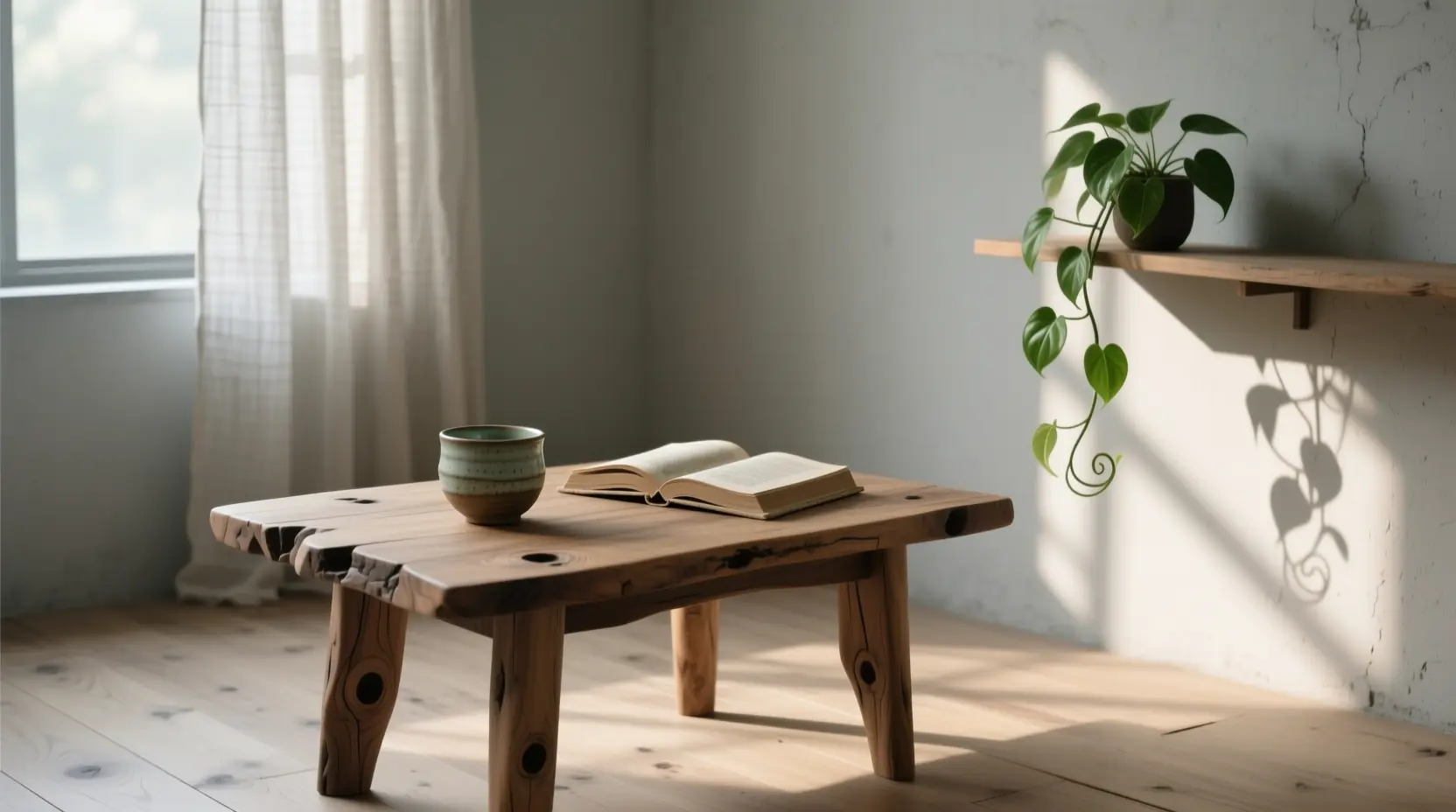
The oak in my hands is taking its shape. It is becoming a low table. Its legs are straight, honest. Its top will be smooth to the touch, but the knots will remain, like eyes looking back into the very life of the tree. It will not be Scandinavian. It will not be Japanese. It will simply be. It will sit on a floor the color of sun-bleached sand, under a window where the light enters, soft and patient as a cat. It will hold a cup of steaming hojicha. It will hold a book, its pages worn. It will hold emptiness, which is the fullest, most generous thing of all.
This is Japandi. It is not a fusion. It is a friendship. A quiet, understood pact between two ancient ways of seeing, meeting in the heart of the home. It is the perfect hybrid only because it reminds us, in whispers, of what we have always, deep down in our bones, needed: a place to be quiet. To be simple. To be whole. A place where every thing has a soul, and every soul has its place.