A Stillness in the Dust
The floor does not ask to be made new. It asks only to be seen. The grain, worn soft by generations, holds the ghost-map of a hundred thousand footsteps. A quiet topography. Here, dust settles not as an intruder, but as a soft, shifting record. A patient chronicle of sunbeam and shadow, of breath and passage. To see it this way—this is the first, the only revolution.
The light finds its way through old glass. It falls upon things. Not upon objects, but upon companions. A copper bowl, its shoulder holding a galaxy of verdigris. A wooden spoon, its handle polished to a memory by the sure curve of a hand. They do not shine. They glow from within, with the slow fire of time.
To Clean Is Not to Erase
It is to listen.
A practice of attention so deep it becomes a form of care. A form of Zen discovered not in the posture of the lotus, but in the bend of the spine over the sink. In the whisper of cloth on wood. This is the art. Not of restoration, but of revelation. To remove only what obscures the true nature of a thing—and sometimes, the true nature is its beautiful, weathered age.
Begin with the Hands, Not the Tool
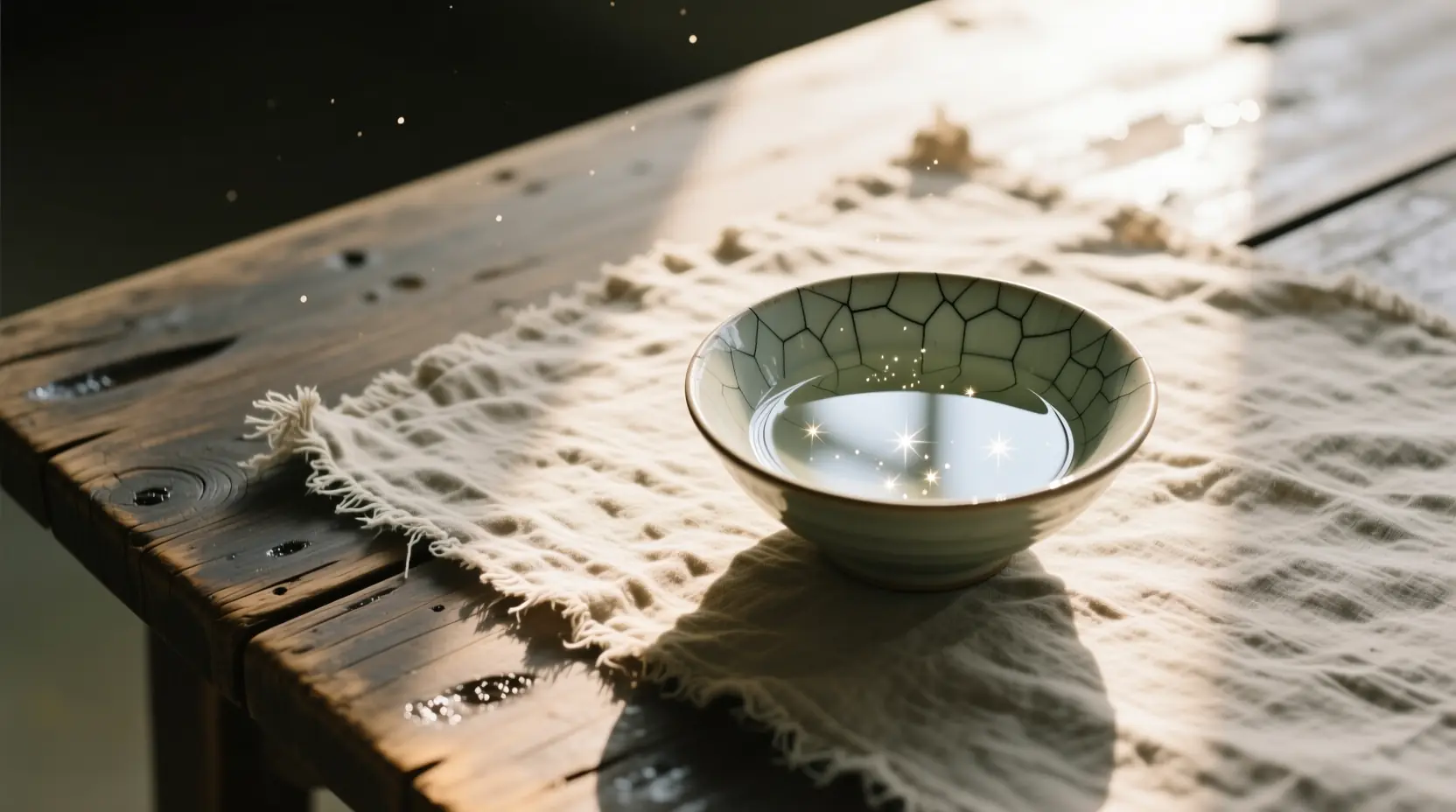
First, stillness. Do not reach. Sit with the chipped cup. Hold its absence. Trace the crackle in the glaze—a frozen river delta, a story of heat and cool. This is not a flaw. It is a suture. A mended moment. Wabi-sabi whispers here: in the break that makes the whole more precious, more real.
Then, the water. Not hot. Not cold. Tepid, like a quiet breath. Pour it slowly. Watch it embrace the clay, waking the pigment sleeping beneath the film of days. Your first tool is your thumb. Moving in slow, deliberate circles. You are not attacking. You are awakening. Reminding the surface of its own smooth song.
The Philosophy of the Cloth
Let the cloth be simple. Linen, softened by many journeys. An old cotton square, thin as a memory. It is an extension of your will, yet utterly separate. Wring it not with force, but with a firm, twisting grace. Feel the excess leave. It should be damp. Merely damp. A lesson in sufficiency.
A soaked cloth drowns. It smears. A damp cloth cleanses. It polishes. It knows its purpose.
The Rhythm of the Stroke
Now, the motion. Long. Flowing. Follow the song-line of the grain, the curve of the bowl, the long plane of the shelf. You are not wiping away. You are tracing the essence of the thing. With each pass, a revelation. The deep honey of oak emerging. The way light catches, suddenly, on the edge of glass.
Stroke. Breathe. Turn the cloth. Stroke. Breathe.
The mind that chattered like a magpie grows quiet. There is only this: the whisper of fiber on surface. The scent of wet wood and clean water. The slow, emerging clarity. The task dissolves. Only the ritual remains.
Breathing with the Room
You are not cleaning a room. You are in dialogue with a space. You kneel on the floor and become part of its expanse. You see the cobweb in the high corner—a master weaver’s abandoned palace, strung with pearl-dust. You decide, with quiet thought, to let it be. It has its place.
The dead fly on the sill. You lift it, gently, onto a leaf of paper. Carry it outside. Return it to the cycle. Even in this, there is care. There is no enemy here. Only participants in the great, slow turn.
The Soul Accumulates in Surfaces
A craftsman knows. The object absorbs the intention of the making. The careful shaving, the steady plane, the final oiling—these are prayers worked into the fibers. But an object’s life continues. Laughter sinks into the table’s grain. Quiet sorrow is absorbed by the armchair. The warm polish on a tool handle is the memory of daily, faithful use.
Mindful cleaning is how we honor this accumulation. We are not merely removing grime. We are acknowledging a history. Polishing the old pot, we polish the memory of a hundred meals. Dusting the bookcase, we care for the silent, waiting worlds upon its shelves. We say, without words: I see you. Your presence matters.
This care reciprocates. A space tended thus becomes a calm space. It holds you in return. It offers a peace you did not manufacture, but simply uncovered.
The Season of All Things
Everything has its season. The wool sweater, folded for summer, is tucked away with gratitude. A sprig of cedar laid atop it—a sentinel for its sleep. The garden tools, caked with the black gold of autumn, are cleaned not with haste, but with respect. You scrape the soil, oil the metal, hang them in their proper place. You are putting the garden itself to bed.
This is a dialogue with time. It teaches cycles. Teaches rest.
And some things are meant to fade. The painted fence, bleaching to a silver-grey under the sun’s gaze. The bright red of the wagon, softening to a dusty rose. Do not rush to repaint. Observe this surrender. It is beautiful. To clean it mindfully is to care for its truth, not to force upon it the memory of its youth.
The Silence That Follows
After, there is a silence. It is not emptiness. It is a full, humming quiet. The air moves differently. Lighter. The light rests easily, as if coming home. Each object sits in its right place—not by perfect alignment, but by a feeling of settledness. The chaotic energy of neglect has been gathered, released. What remains is order—not the stiff order of a barracks, but the natural order of a forest floor after a gentle rain.
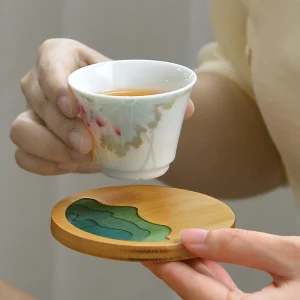
Sit in this silence. Drink tea from the cleaned cup. Feel how the heat travels through the ceramic, now fully itself. Watch new dust motes drift into the slanting light, beginning their gentle, inevitable return. This is not failure. This is the promise of continuation.
The Bowl, Empty and Ready
There is no final victory. Only the harmony of return. Tomorrow, dust will settle. A new smudge will appear. This is good. It gives you reason to return to the practice.
For in this quiet, repetitive act, you clean more than your home. You clarify the mind. Smooth the rough edges of the spirit. You care for your objects, and in doing so, remember how to care for yourself. You move from a state of doing to a state of being.
You become, for a time, like the clean, empty bowl. Ready to hold. Without judgment. Simply ready.
This is the Zen of it. Not in a temple on a distant mountain. But here. In the whisper of the cloth. In the mindful return of a thing to its own, simple, shining essence.