The Loom of the Sun, and a Smaller Tapestry
The great loom moves. It weaves the day in light, unravels it into shadow. Beneath this grand tapestry, we seek a softer one. A place to receive the unmade self. This is the quiet purpose of a bed. And the cloth that dresses it—this is not a mere covering. It is a field. A landscape for sleep.
For years, I sought this field in the wrong places. In thread counts that shouted. In sheens that glared. Cloth like polished stone—cold, impermeable. It did not breathe. Did not change. A stranger to the skin.
Then, I remembered flax.
A Plant’s Long Memory in Every Fiber
It begins as a slender stalk. A pale blue flower, a wisp of sky caught in a field. The flax plant holds a deep, cellular memory. Of wind. Of rain. Of earth yielding, resisting. When these fibers are teased apart, spun, woven… they do not forget. They become linen.
Linen is the cloth of patience. It is not born soft. It carries a whisper of the stalk. An honourable roughness. To invite linen into your bed is to begin a conversation that lasts years. A pact with time.
You agree to wear its new stiffness. Its crisp folds. You learn its language of rustle and drape.
In return, it agrees to be changed by you.
Night after night, softened by the warmth of a sleeping body. Tempered by the slow friction of dreams. With each washing, it sheds a little of its brittle youth. Grows supple. Fluid. It begins to pool like water. It learns the contours of your life.
This is not decay.
It is a becoming. The linen remembers how to be a plant—pliable, responsive, alive.
The Weight of Cloud, The Grip of Earth
Not all linen is woven with the same breath. Its weight, its *grâce*, varies like the weather.
Some linens are a mist. Light, almost translucent. The first touch of coolness on a summer evening. They lie with no pressure. A suggestion. Sleeping beneath them is floating on a still pond, held by surface tension. For the one who sleeps hot. Who chases the feel of a breeze on skin.
Others have the weight of a damp morning. A substantial, grounded drape. This linen does not float. It settles. Rests upon the shoulders with a gentle, reassuring authority. The blanket of autumn. The cloak of a slow-dawning day. It offers a deeper embrace. A sense of being anchored to the bed, to the earth. For the soul who seeks solace. A weighted calm.
The touch tells a story. Some weaves smooth as a river stone, worn by time. Others retain a nubby, tactile texture—the memory of the raw fiber, the loom’s honest song.
There is no superior. Only preference. Does your hand wish to skim? Or to linger? Does your skin seek a silent caress, or a quiet conversation?
Colors That Drink Like the Earth
The dyer’s art, on linen, is a lesson in humility. Linen does not take the shriek of synthetic dye. It drinks color as earth drinks rain. Deeply. Subtly. Changing the hue in the drinking.
Most true, perhaps, are the undyed. The palette of the flax itself: natural, oat, ecru, silver. The colors of sand. Of unbleached bone. Of morning fog on a field. They are quiet. They do not compete with dreams. A neutral, gentle ground. A canvas for sleep.
Then, the plant-dyed linens. Madder root for a dusty rose—a faded roof tile. Weld for a sun-bleached gold. Walnut hull for a deep, melancholic brown. These colors do not sit on the surface. They live within the fiber. They age like a bruise on fruit—softening, mellowing, becoming part of the cloth’s history.
A sheet dyed with indigo will slowly release its blue. Like sky fading from a washed-out shirt. You do not mourn this. You witness it.
The Seam as a Secret Pact
A humble craftsman knows the soul of an object is often in its joints. The meeting of two cloths is a solemn occasion. A harsh, bulky seam is a wall. A disruption in the field.
The finest linen bedding understands. It speaks of French seams. Raw edges folded inward, twice, and captured. A clean, enclosed channel. Smooth to the touch, inside and out. A secret seam. A private pact of durability.
Or the flat-fell seam. One edge folded over the other, creating a strong, flat ridge. The honest, exposed seam of a workman’s shirt. Unpretentious. Enduring.
The hem is the final breath. A deep, generous hem gives weight. Allows the cloth to fall properly. A narrow, hasty hem is a sentence unfinished. Look for the hand here. In the evenness of the stitch, the depth of the turn. It is the signature of care.
Canvas for the Unseen
What are we doing when we make a bed with linen? Not merely arranging cloth. We are preparing a landscape. Smoothing the soil for the seeds of the night.
Linen receives. The weight of a tired body. The salt of sweat. The oil of skin. The twists of unresolved thought. The quiet tears. Then, in morning light, it releases. It is aired. Shaken loose. Washed clean.
It holds a capacity for renewal polyester can only mimic with chemical freshness. Linen’s freshness is the freshness of a stone after rain. Elemental.
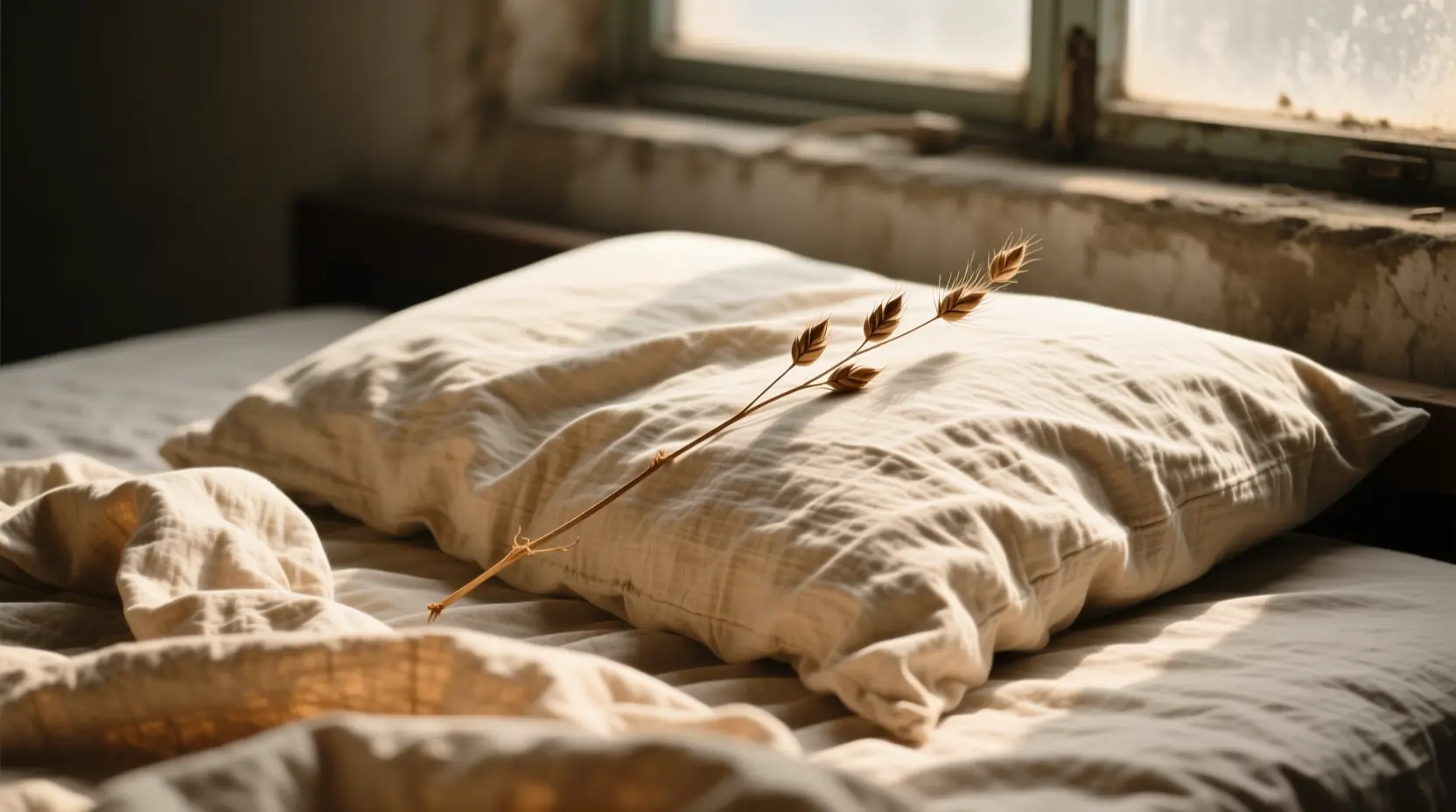
It is a canvas for the unseen. For the slow accumulation of a life’s nights. A linen pillowcase will, over years, become imprinted with the shape of a head. Softened by the oil of hair. A personal artifact.
Not worn out. Worn in. Carrying the map of your rest.
Choosing Your Field: A Question for Your Sleep
So you ask, which is the top-rated linen? The question is like asking which tree is best. The oak is strong. The willow yields. The birch is pale and bright. It depends on the landscape of your sleep.
Seek linen that speaks of its origin. Long-staple flax of France or Belgium weaves a finer, smoother thread. Eastern European linens carry a more rustic, robust character. Listen to the weave. Hold it to the light. Crumple it in your fist. Release. Does it fall with a soft sigh? Or resist with a stiff crinkle?
Bring it to your cheek. Does it feel like a cool leaf? Or sun-warmed grass?
Do not fear the initial stiffness. That is its youth. Commit to the long acquaintance. Wash in cool water, with gentle soap. Hang in the sun and wind—let it drink the elements again. Fold while still slightly damp. The creases will soften into gentle waves, not harsh lines.
With each cycle, you will feel it surrender a little more. Become yours. Lose the anonymous perfection of the new. Gain the singular beauty of the lived-in. A scuff here. A softened edge there.
These are not flaws.
They are rings in a tree. Patina on copper. The record of shared time.
The sun’s loom moves again. Light deepens to gold, then blue. The noise of the day unravels into evening quiet. You turn down the linen cover. Cool. Substantial. Familiar. It smells of air and, faintly, of the sun that dried it.
You slip into its embrace.
It is not a purchase. It is an invitation. To a long, slow conversation with cloth. With sleep. With time.
A field, prepared. Ready to receive the night, and all that grows within it.