The Stillness at the Centre of the Sea
The room is vast. A cathedral of light and quiet. A held breath of space. The floor stretches, a pale plain of possibility. In such an expanse, the instinct is to fill. To conquer with substance.
Do not fill.
Instead, place an island. A single, steadfast plateau of calm. A place for a cup to rest from its journey. For an open book to breathe. For a palm to find the cool reassurance of solidity. This is not commerce. It is invitation. A search for a quiet companion carved from the same patience as the room itself.
When Emptiness is the Most Precious Thing We Own
Wabi-sabi is not a style. It is a gaze turned inward. A reverence for the crack that lets the light in, for the patina that is time’s gentle signature. In a large room, a table that understands this does not shout into the emptiness. It listens. It becomes the still point of the turning world. The grounded heart. The altar where life lays down its small, sacred offerings.
Listening to the Grain of the World
First, be silent. Listen to your room. Hear the arc of the afternoon sun as it pools on the boards. Feel the scale of the air, the height of the ceiling. A large room can bear a great weight. It asks for a truth, not a trend.
Now, turn your ear to the materials. Not as a catalogue lists them, but as the earth knows them.
Wood That Remembers the Wind
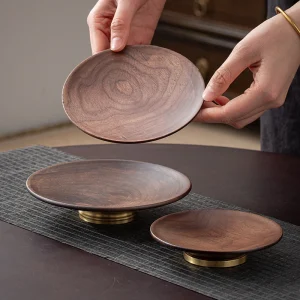
Seek the slab. The wide, unbroken story of an ancient tree. Oak, with its steadfast heart. Elm, with its lyrical grain. Walnut, deep and contemplative as old wine.
Look for the knots—eyes closed in perennial sleep. For the checks and cracks—rivers carved by the internal weather of drying. This is not defect. It is biography written in cellulose and lignin.
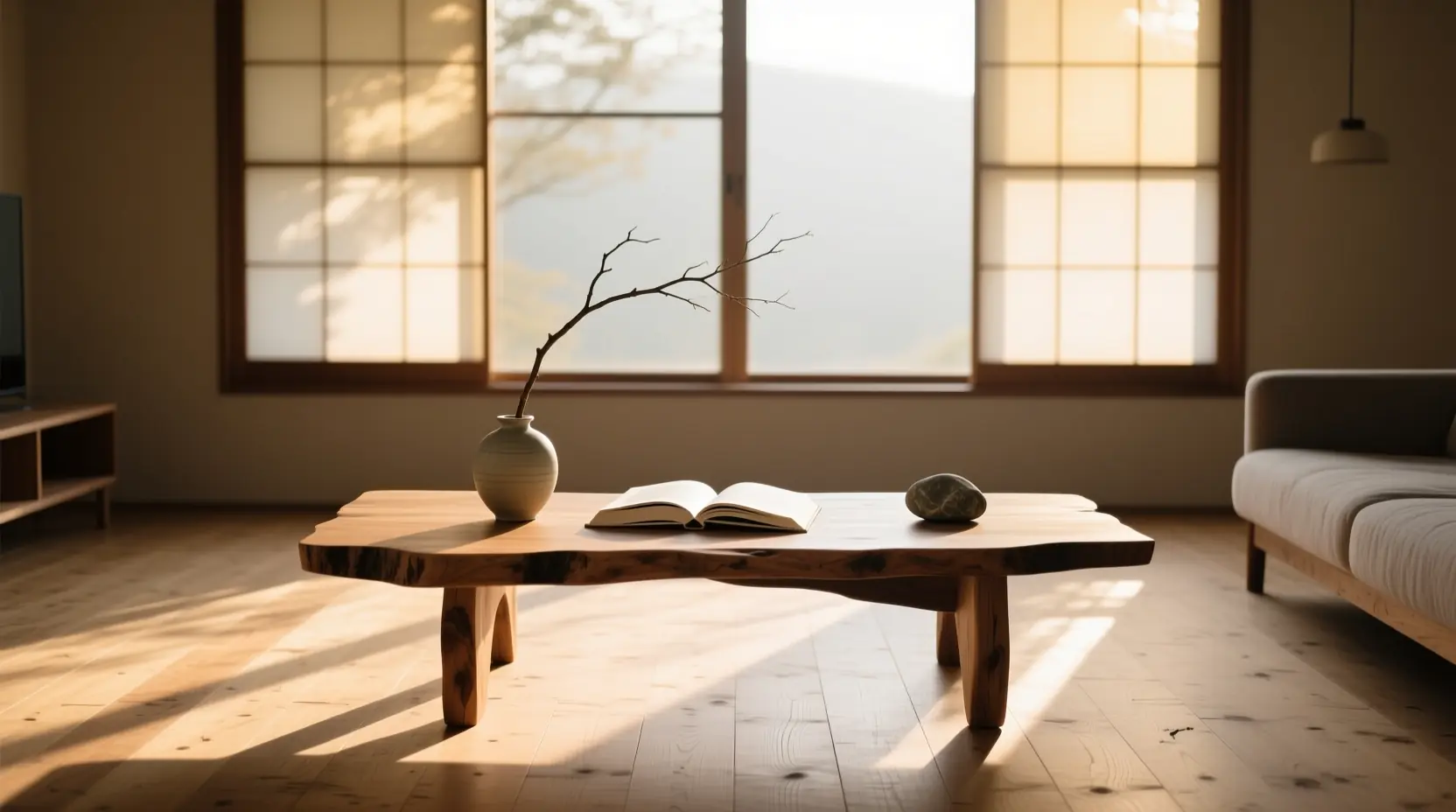
In a large room, such a slab becomes a landscape. A low, broad plateau of narrative. Finish it with a whisper. A hand-rubbed oil that invites the touch, that deepens the wood’s own voice. Over years, it will accept the ghost-rings of your cup, the soft shine where a forearm rests while reading. It will grow more beautiful, more itself, with your living.
Stone With a Mountain’s Patience
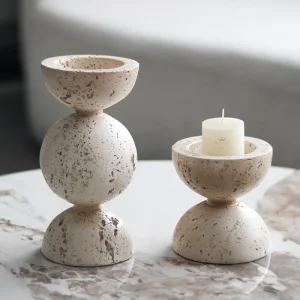
Travertine, limestone, slate. These are not mere surfaces. They are geology brought indoors. They hold the cool, slow patience of millennia. A table of pale travertine, porous and light-capturing, is an anchor to the earth’s core.
Seek the live edge—the raw, untamed contour left by the quarry. This rough border is a conversation. A dialogue between the wild, elemental world and the domestic hearth. It is the horizon line of a personal wilderness. It will hold the cool of an autumn evening, release the stored warmth of a winter morning. A gentle conductor of the home’s own atmosphere.
The Quiet Dignity of Forged Metal
Iron. Steel. Bronze. In the wabi-sabi hand, metal is not sterile. It is alive with memory. Honour the hammer’s kiss. The ripples of the forge. The warm, honourable bloom of rust that speaks not of neglect, but of an honest life exposed to air and time.
A base of blackened steel, textured like the bark of an old pine, cradling a slab of waney-edged oak. This is a marriage of elements. In a spacious room, such a construction speaks with a quiet strength. It does not glitter. It gleams from within, with a deep, sombre light.
The Soul of the Joinery: A Promise of Permanence
A true maker does not conceal. They reveal. In our age of the temporary, honest joinery is a vow. Seek the mortise and tenon—a wooden handshake held for centuries. The butterfly key, a bow-tie inlay of contrasting wood, not hiding a crack but celebrating its journey, holding its story open.
These are the signatures of care. They whisper: this union is intended to last. To weather. To become one.
In a large living room, the space beneath is as vital as the surface above. The elegant play of light through a trestle base. The long, slender shadow cast by a tapered leg. This openness allows the floor to flow through, the air to circulate. It prevents heaviness. It lets the large room breathe around the solid, silent soul of the table.
Surfaces That Welcome Time
A high-gloss lacquer fears touch. It is a barrier, a perfection that dare not be marred.
A wabi-sabi surface is an invitation. A beginning.
The first scratch on a raw oak top is not a tragedy. It is the first sentence in your shared story. A water ring on limestone is a memory fossil. A ghost of a long conversation, a shared pot of tea, a silence that needed no words.
These tables are not finished when they leave the workshop. They are begun. Their final patina—the true finish—will be applied by your days. By the specific angle of the December sun. By the weight of a sleeping cat in the corner. By the forgotten chess piece left for a week.
This acceptance is a profound liberation. In a large room meant for living—for children’s play, for haphazard gatherings, for the beautiful mess of existence—a table that ages gracefully dissolves anxiety. It carries no preciousness, only presence. It says: Here, be at ease. Live. Leave your mark. I will make it beautiful.
The Space Around the Object: A Field of Calm
Placement is a form of reverence. In a vast room, do not simply calculate the centre. Consider. Contemplate.
Perhaps it anchors one end of a long sofa, creating an intimate haven within the expanse. A private clearing in the forest of space. Perhaps it floats, a low, steady mediator between two chairs destined for conversation.
Leave generous emptiness around it. Let the floorboards show their grain, let the rug’s texture breathe. This is not under-furnishing. It is the creation of a field of calm, a halo of quiet around a sacred, useful object.
Upon it, practice a gentle economy. A single, worn book of poetry, its spine softened by rereading. An asymmetrical vase holding one forsythia branch, arching as if still reaching for the window light. A stone, perfectly oval, found on a walk and still cool from the creek.
These are not decorations. They are offerings. Each one a small, deliberate moment of attention. They echo the table’s own quiet story, each a note in the same slow, grounded song.
A Final, Lingering Observation
The right table is not the loudest. Nor the most perfect. Nor the most expensive.
It is the one whose presence you feel most deeply in its absence. It is the table that, when you enter the quiet room at dawn, seems not like an acquired thing, but a feature of the world that simply emerged. As a large, weathered stone emerges from a forest floor, part of the landscape itself.
It does not match your décor. It matches the slow turn of the maple tree outside your window. The lichen growing on the north side of the garden wall. The way the light fades in November.
It holds, in its solid, imperfect form, the beautiful, transient truth of your own life—the overfull cups of joy, the dog-eared books of sorrow, the quiet, empty spaces of peace that stretch between moments.
In the end, you are not choosing a table.
You are choosing a witness. A humble, steadfast witness to the life that will flow around it in your large, sun-filled room. Choose one that has the patience to watch, and the soul to remember.