The Dust Holds the Light
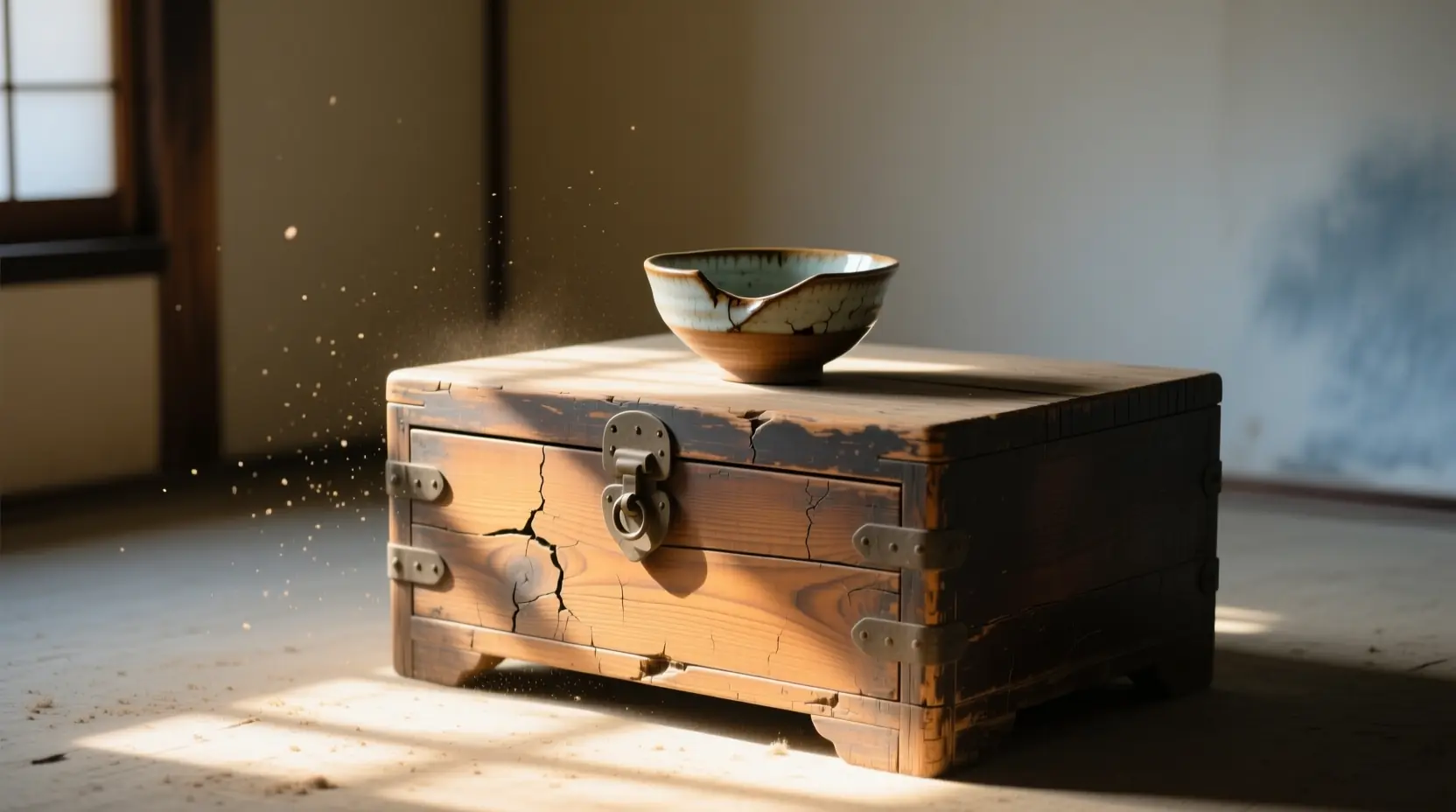
The sun is low. It finds the dust. The air is a field of slow stars. Each mote turns. Settles. On the shoulder of a clay jar, forgotten for a season. On the silent, curved lip of a wooden chest. These objects have unlearned shouting. They remember only whispers. The patience of centuries. How to hold the light. And, more importantly, how to let it go.
This is not acquisition. It is audition.
To invite an authentic piece of old Japan into your space is to host a quiet teacher. It asks you to slow your breath. To see with your palms. To understand that beauty is not a flawless veneer, but a narrative etched in cracks, in shadow, in the soft surrender to the inevitable. This is the heart of wabi-sabi. The profound grace of the imperfect, the fleeting, the incomplete.
Come. Sit by the water’s edge. Listen.
The North Side Gathers Moss: Seeing Truth in Wear
First, you must still your own wanting. Empty the cup of expectation. Forget what you wish the piece to be. Witness what it is.
Enter the space. Do not reach. Stand. Breathe the air it breathes. Observe its posture from afar. A true tansu chest does not slouch; it bears the weight of generations with a quiet, upright spine. A folk mingei pot does not aspire to symmetry; it carries the tremor of the potter’s wheel, a gentle wobble that sings of human hands, of a heart beating in clay.
Now, move closer. Listen with your eyes.
Seek the wear that tells an honest story. On a getabako, see where the lacquer has been kissed away by ten thousand humble entries and exits, right at the threshold. The wood beneath, revealed, is smooth as a river stone, dark with the oil of lived days. On an old indigo zabuton cover, trace the faded trails where knees have rested in meditation for decades. The deepest blue retreats to the seams, like twilight nestling in the folds of the hills.
False aging is a shout. It is uniform. A declaration. True aging is a murmured conversation. It is uneven. It accumulates in the places of touch, of ritual. The north side of the stone grows moss. The handle of the tea caddy wears a sheen. The interior of the bowl is stained by a lifetime of whisked green tea. This is not marring. This is a biography.
The Wood Remembers the Wind: The Language of Materials
Materials whisper their origins. You must learn the dialect.
Wood is the soul. Keyaki (zelkova), hard and fierce, its grain a wild map of swirling water—fit for chests that hold legacies. Sugi (cedar), soft and fragrant, its gentle lines whispering of mountain forests, of ceilings that held up the sky. Kuri (chestnut), steadfast and humble, for beams that sang in the wind, for farmhouse tables that bore the weight of shared meals. In an antique piece, this wood is not raw. It is a companion to smoke, to sun, to the humid breath of the land. It has darkened. Not stained, but ripened. Run your palm along it. It should feel like a seasoned hand. Like acceptance.
Then, the metal. Iron, in a hibachi or a tetsubin, wears a robe of rust. Not the orange decay of neglect, but a settled, protective patina—sabi. A deliberate allowance. A testament to change as a natural state. Examine the joinery. The nails, if present, will be square. Irregular. Hammered by a man who knew his anvil’s song. Cast iron will bear a granular, sandy skin. Never perfectly smooth. Always truthful.
And cloth. Linen. Hemp. Raw silk. Fibers that remember they lived. They grow supple with years, like a well-repeated prayer wears smooth in the mouth. Old boro patches, stitch overlaying stitch, are not a record of poverty. They are a liturgy of devotion. A reverence for the cloth’s spirit, a refusal to let it depart. The stitching itself is a topography of need, and of profound care.
The Joint Does Not Need the Nail: Intelligence in the Unseen
Look at how the piece is born. In the West, we join with force. Nails. Screws. An imposed union. In the old way, the joint is a conversation. A puzzle of mutual, grateful support.
Open a drawer. Peer into the joints of a tansu. You may find intricate, interlocking puzzles of wood—kumiko, sashimono—where the grain of one piece embraces the grain of its partner. No glue. Often, no nail. Just intelligence carved into timber. The mind of the craftsman, trusting the material to hold its own promise. Over decades, these joints will move. They will sigh. Settle. This is not failure. This is the house breathing.
Examine the back. The underside. The places not meant for the eye. Here, truth often resides. A modern reproduction is a performance for an audience. An antique, even a humble one, carries a respect for the whole. The back panel may be of a different, lesser wood—this is frugality, not deceit. But it will be fitted with the same quiet diligence. The tool marks—the gentle paring of the plane, the honest chop of the adze—may still linger there. Do not fear these marks. They are the signature. The whisper of the plane. The song of the chisel. They are not sanded away into the sterile silence of the machine.
The Spirit in the Stillness: Beyond the Object
Now, we move from the hand to the heart. What is the piece’s ma—its negative space, its presence in its absence?
A scroll in a tokonoma alcove is not merely a painting. It is a window. For a season, it holds a mountain, a stream, a single character. Then, it is rolled up. Stored away. Leaving only the empty space. The emptiness is as vital as the image. The object teaches you to cherish the void it will once again occupy.
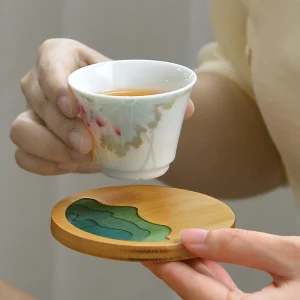
Cup a tea bowl, a chawan, in your hands. Its worth is not in its perfection, but in how it meets your palms. How the rough, unglazed foot nestles against your skin. How the glaze has crawled and cracked in the kiln—a kintsugi of its own making, a map of its fiery birth. Does it feel like a stone warmed by the sun? Does it feel as though it has been waiting for your grasp? This is a solitary communion. No guide can dictate it. You must hold it. And be still. The right piece does not feel “purchased.” It feels “met.”
Beware the piece that feels lonely. A magnificent, solitary samurai kabuto helmet in a modern room can feel like a shout in a chapel. Disconnected from its world. But a simple, soot-blackened nabe pot from a farmhouse, placed upon a bed of hearth stones, rests in peace. It remembers the fire. It remembers the shared meal. Seek objects that carry the spirit of yoki—the useful, the everyday, the quietly blessed.
The River Finds Its Course: Allowing the Discovery
Where does one find such things? You do not find them. You allow them to find you.
Be wary of the clamorous marketplace. The dealer whose words flow too quickly, too sure. Seek the quieter stalls. The older seller who gently dusts a piece as you look, his care telling a deeper story than any certificate. In the West, seek the specialist whose gaze softens when speaking of showa folk art or meiji joinery. Their space will hold a quietude. There will be air around each object. Room for it to breathe.
Do not seek a famous name. Often, the most profound pieces are mumei—unsigned. The maker erased himself, allowing the object its own voice. Your connection must be with the thing itself, not its pedigree.
When you believe you have found it, sit with it. Return. See it in the thin, grey light of morning. In the long, golden sigh of evening. Does its presence grow quieter, deeper? Or does its novelty fade, leaving only a shape? The true piece will reveal itself slowly. A crack you had not seen. A dance of grain shadow at noon. The faint, ghostly scent of old wood and tatami when the room grows warm.
The Final, Gentle Stitch
There will be a price. But understand its composition. You are not paying for aged timber and oxidized iron. You are paying for the silence in the craftsman’s heart as he chose the board. For the patience of the tree that grew for a hundred years, listening to the wind. For the countless dawns the object witnessed, being useful, being still, holding the light in a room that is now memory. You are paying for its journey across time. To this moment. To you.
When you bring it home, do not force it. Do not make it a trophy. Let it find its corner. A stone lantern in the garden, where the moss will, in time, greet it. A wooden bowl on a table, holding nothing but a single, curled leaf for a season. Let it be. Tend to it with a soft cloth. Not to make it new, but to honor its age. A quiet ritual.
It will change the room. The light will bend around its edges differently, with more respect. The air will settle, thicker. You may find yourself arranging other things with more care. You may begin to see the beauty in the chip on your own daily cup. In the hairline crack in the plaster. This is the teaching. This is the gift.
The object survived by being true to its nature. By accepting time as a partner, not an adversary. In its silent presence, it offers you the same lesson. To wear your own years like a glaze. To let your own grain show. To find beauty not in the frozen, perfect moment, but in the gentle, relentless, exquisite flow.
The stream does not cling to the stone it smoothes. The patina is not a flaw. It is the record of the water’s enduring, tender song.
Listen.