The Whisper in the Wood
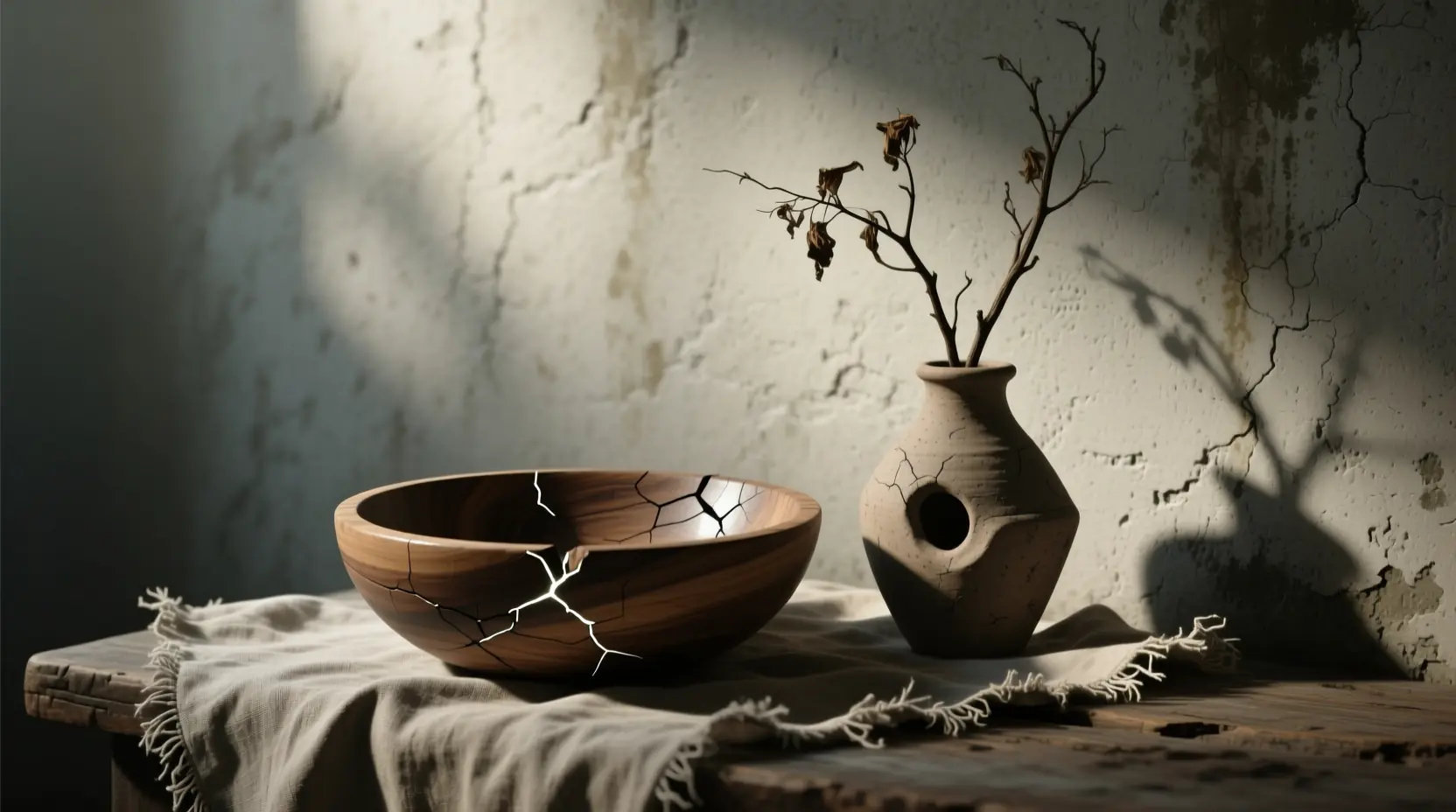
The world shouts. Gleams. Demands flawlessness. For years, my ears were tuned to that frequency. I sought the straight grain, the unmarked surface. Then, a morning. An old cedar bowl, my own making, had cracked. A fine, dark line like a river on a map. The light caught it. Not a fracture. A story. A record of holding and release. That was when I first heard the other voice. The whisper beneath the bark. The quiet, the crack, the luxury.
This is not a style you acquire. It is a way you see.
The Patina of Time
True wealth is not stored. It is accumulated. Slowly. A copper pot, its bottom kissed by a thousand flames, darkening to a soft, galactic sheen. The floorboard worn into a gentle hollow by the passage of quiet feet—a topography of domestic life. The rust on a garden trowel, a vermilion bloom against the iron gray.
We call this ‘weathering’. ‘Aged’. Sometimes, ‘worn’.
Look closer. This is not decay. This is a conversation. The object speaks with rain, with sun, with the oil of a human hand. It answers. Its answer is patina. A finish no factory can replicate. A record of being alive in the world.
The first lesson. Luxury is not resistance to time. It is a deep collaboration with it. A high-gloss surface shouts of its newness, then fades. A wall of waxed plaster, mixed with local clay and straw, drinks the light. It changes with the hour. Cool at dawn, warm at dusk. It has moods. To live within such walls is to live within a breathing organism, not a sealed container.
You accept the crack in the teacup. You trace it with your thumb. You understand it as part of the cup’s journey, and now, part of your own. The flaw is not a defect. It is a door.
The Soul of the Material
A tree does not strive to be a table. It is content to be a tree. Its beauty is in its treeness. The knot, the burl, the wild grain that twists like a river—these are not mistakes to be sanded away. They are the material’s history. Its character.
My teacher, an old joiner, would select his wood not for its perfection, but for its song. He would tap it. Listen. He sought the board that held a storm within its rings, or decades of lean towards the southern sun.
To practice this way is to listen to that song. To let the material lead. A master stone mason does not force the rock. He studies its cleavage, its nature. He finds the form waiting within. The result is a wall that looks not built, but emerged. A hearthstone that seems an outcrop of the earth itself, invited indoors.
There is an immense luxury in this restraint. It says: I have the skill to dominate, but I choose to collaborate. The object that results carries a quiet integrity. It is truthful.
So we use wood that still feels like wood. We leave it unvarnished, to be touched, to warm under the palm. We choose linen that crushes, that remembers the shape of a resting body. We welcome stone that is cool and damp, that smells faintly of the mountain. These materials do not lie. They tell you where they came from. They keep their soul.
The Beauty of the Incomplete
A Zen garden of raked gravel. It is not a picture. It is a question. The rocks are islands. The empty space is the sea. The mind must sail it. This is yohaku no bi—the beauty of the empty space. It is not about what is placed. It is about what is left out. The pause between notes that makes the music.
In a room, this is the luxury of breath. A single, seasonal branch in a clay vase. Not an arrangement, but a gesture. The vase, thrown by hand, sits slightly asymmetrical. It does not demand center stage. It simply is. The wall behind it is not cluttered. It is a field of textured plaster, catching the light like dry skin. The emptiness around the object is what frames it. What gives it meaning. It allows the eye to rest. The mind to settle.
We fill our lives with answers. This way prefers the question. An alcove with just one stone. A window framing a single, gnarled pine. It does not explain. It invites contemplation. What story does that stone hold? How many winters shaped that pine?
The luxury is in the engagement. In the act of wondering. It turns a house from a warehouse of possessions into a sanctuary for perception. The richest space is often the most austere. Because it is filled not with things, but with possibility.
The Ritual of Care
A cast iron kettle. Seasoned by decades of use. After brewing tea, it is not scrubbed harshly. It is rinsed with hot water, dried gently over the fading heat of the hearth. A thin layer of tannins remains, deepening its luster. This is not cleaning. It is a ritual of respect. The kettle is a partner. It requires care, not just use.
This is the hidden heart of quiet luxury. The relationship.
A wool blanket of raw, undyed yarn. It will shed a little. It will pill where it is loved most. You pick a stray fiber from it, not with annoyance, but with tenderness. You mend the linen sheet with a simple sashiko stitch, the repair becoming a deliberate mark of renewal, a badge of honor.
The object is not disposable. It is evolving. Your care is part of its story.
There is profound wealth in this cycle. It defies the frantic chase for the next new thing. It finds deep satisfaction in the familiar, the maintained, the cherished. The knife sharpened so many times the blade has worn into a new curve. The wooden ladle, oiled by the soups it has stirred, now dark and glassy-smooth.
These objects become extensions of the self. They are imbued with memory. They carry the quiet dignity of a long and useful life. To live with them is to be reminded daily of the value of attention, of patience, of slow accretion.
The Acceptance of Transience
Frost on the windowpane. Exquisite. Gone by noon. The cherry blossom. A breathtaking cloud of pink. Then a shower of petals on the rain-dark earth.
This philosophy does not weep for this. It sees the beauty in the cycle itself. The luxury is in the witnessing. In the acute awareness of the precious, passing moment—mono no aware, the poignant awareness of impermanence.
So the design embraces the fleeting. A vase designed to highlight the wilt of a flower, the graceful arc of the stem as it dries. The acceptance of moss growing on the north side of a garden stone, softening its edges, clothing it in velvet green. The pleasure in the way the late afternoon sun, for just ten minutes, falls exactly across a worn tatami mat, setting the dust motes dancing like gold flecks in old tea.
It is a courage, really. To build a hearth not just for fire, but for ash. To choose a fabric that will fade beautifully in the sun. To understand that the first scratch on a table is not the end of its perfection, but the beginning of its unique life. It is to make peace with entropy. To see grace in surrender.
This acceptance is the ultimate luxury. It frees you from the tyranny of perfection. It releases you from the fear of time. Your home is not a museum diorama, frozen and fragile. It is a living record. A collaboration between your breath, the sunlight, the materials, and the years. It is always becoming. Always slightly imperfect. Profoundly alive.
Finding the Stillness
In the end, this is not about owning rare things. It is about perceiving the rare in the ordinary. It is the dust of tea leaves at the bottom of a bowl. The sound of rain on a bamboo roof. The cool, uneven weight of a river stone in the hand. It is the luxury of enough. The richness of less. The elegance found in humility, in authenticity, in the raw, unadorned truth of materials and time.
It asks you to slow down. To run your hand over the rough-cut edge of the oak beam. To watch the shadow of a bare branch tremble on the wall. To taste the silence between the ticks of the old clock. It is a practice of noticing. In a world that venerates the loud, the shiny, the new, this is a rebellious act. A quiet one.
The whisper in the wood is always there. Beneath the varnish. Under the gloss. In the crack, the knot, the rust, the patina. It tells of storms endured, of seasons passed, of the honest wear of use.
To choose this path is to lean in close. To listen. And in that listening, in that acceptance of the imperfect, the incomplete, and the impermanent, you may just find something you have been seeking all along.
A deep and abiding stillness.
The quietest luxury of all.