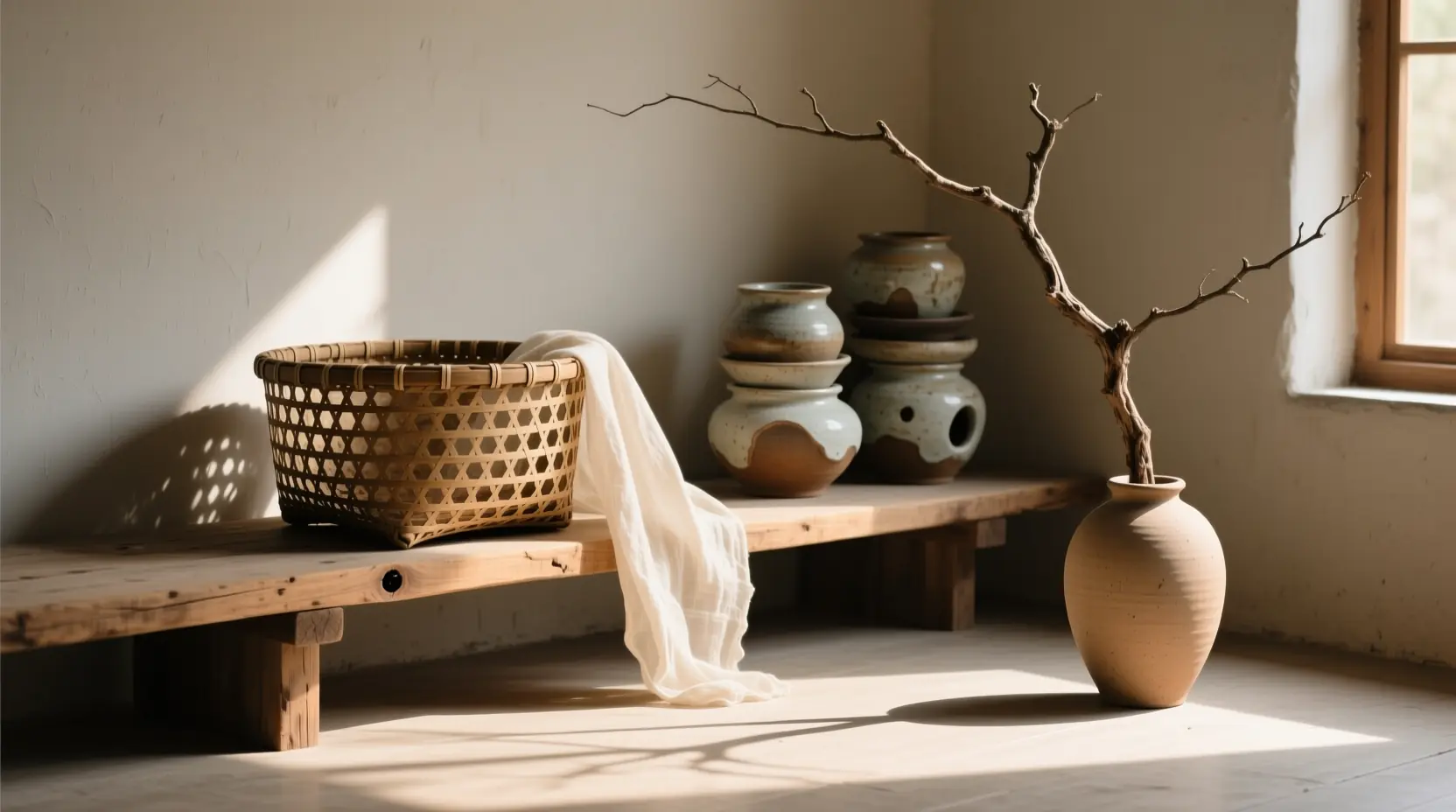
The room remembers.
The warmth of a cup, surrendered to the low table. The weight of a winter blanket, folded into a quiet square. The echo of a conversation, now settled like dust in a long, slow sunbeam. The clutter is not an enemy. It is life, lived. The art is not to wage war upon it, but to give it a place to rest. To let the room breathe without forgetting its story.
This is the path. Not of organization, but of resonance.
The Humble Vessel: A Philosophy of Held Things
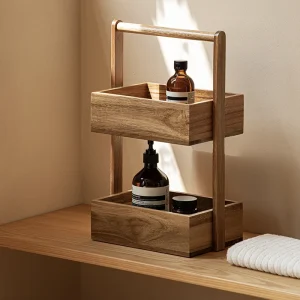
In the workshop, the wood speaks. It has knots. A history of branches. Grain that flows like slow, underground water. I do not fight it. I follow its whisper. A box. A shelf. A simple, lidded chest. These are not mere containers. They are humble vessels. Their purpose is not to shout of emptiness, but to whisper of care. To say, softly, what is inside is held. What is outside is at peace.
Modern storage shouts. It is glossy, seamless, screaming of a rigid, untouchable order. A violence to the home. Wabi-sabi asks a quieter question: can a thing be useful, and still be beautiful? Can it hold your life, and not judge it?
Consider the tsukubai, the stone basin in the temple garden. It holds water. It holds sky. It holds centuries. It does not hide its age. It is its age. A green veil of moss, a worn dip from a million cupped hands. Your storage should aspire to this. A woven basket, softening at the rim from use. A ceramic jar, glazed with the fortuitous irregularities of the potter’s fire. A shelf of timber, bearing the gentle, acquiescent warp of humidity. These are not flaws. They are a record of time. A promise. A covenant that the objects within are permitted their own imperfection.
Of Shadowed Corners and Composed Silence
Light and shadow are one dance. You cannot have a sliver of gold upon the floor without a corner of soft, receptive darkness. We crave only light. We banish shadow. We call it clutter. But in that frantic cleansing, we banish depth. We banish rest.
True storage is the art of the shadowed corner. It understands that not everything must stand in the glare. Some things are for the quiet hour. The private need. The seasonal turn. A lidded basket for the half-knitted wool, waiting for the first chill. A cloth-draped alcove for books that are resting, digesting their words. A closed cabinet of unfinished cedar for linens, which will slowly, over years, take on the soul-scent of the wood.
The beauty is in the suggestion, never the full revelation. The sliding shoji door left ajar, revealing a sliver of stacked, folded indigo within. The sheer linen curtain across a deep shelf, blurring the shapes of stored pottery into soft, geometric ghosts. This is not hiding. It is composing. It allows the eye to travel—from the vivid, present object (the single chrysanthemum in the vase) to the quiet, supportive chorus of the stored. The clutter becomes texture. It becomes part of the room’s landscape. Stones in a stream bed, seen through moving water.
Materials That Have Not Forgotten the Earth
Go to the forest. Place your palm on the bark. It is rough. Layered. A story of storms and patient sun. Go to the riverbed. Select a stone. It is smooth, but never perfectly round. Cool. Heavy with the memory of water. These are the materials that sing to the bone.
Your storage must feel of the earth. Seek the grounding weight of unglazed terracotta for pens, for tools. Feel the fibrous, forgiving strength of hand-plaited rush or bamboo. Honor the profound quiet of grey, unfinished flax linen. Of sackcloth. Of hemp. Embrace the solid, solemn presence of iron allowed to develop a patina—a silent rust that is a shield, not a decay.
And wood. Always wood. But not wood sanded to a deaf, plastic sheen. Wood that shows its grain like a topographical map of its life. Oak. Ash. Walnut. Cedar. Let it be oiled, so the grain drinks the light and glows from within. Let it be rough-sawn on the sides that face the wall—a secret texture known only to you and the tree. A knot is not a defect to be excised. It is an eye. A witness. Build your shelf around it. Let it see.
These materials age. They change. The linen softens into a mother’s touch. The wood darkens like deepening tea. The iron spot-rusts into constellations. This is not failure. This is the storage, breathing. Coming alive. Developing its own sabi—the beautiful patina of age and use—in partnership with your own. It accepts the faint oil from your hand on a drawer pull. The slight wear on the corner where you always reach. This is the bond. The silent conversation between holder and held.
The Soul of Arrangement: Spaces Between Stones
You may possess a vessel of sublime beauty, and fill it with noise. The arrangement is the final, breathing art. It is the space between objects.
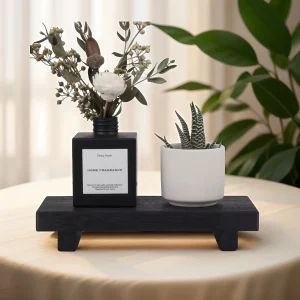
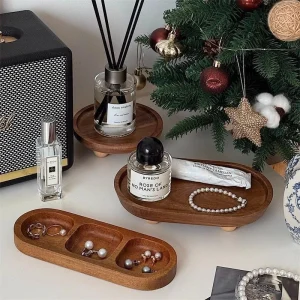
Do not line things up like soldiers. Think of stones in a karesansui, the dry garden. One is large, dominant—a stack of three worn volumes of poetry. Another is smaller, round—a single, black-glazed bowl. Another is flat—a shallow tray of river-smoothed pebbles. There is space. Ample, breathing space between them. Empty space is not wasted. It is the canvas. The silence that makes the note possible.
Group by texture, by soul, not just function. Let all the ceramic things—mugs, bowls, vases—find a shelf together. Their earthy, muted gloss will sing in a low, harmonious chord. Let the wooden objects—cutting boards, spoons, small boxes—gather in another place. Their warm, mute presence will hum a comforting bass note. The woven things. The textiles. The papers. Let each have their chorus.
And within these choruses, vary the height. Let a tall, slender bottle stand behind a low, wide dish. Let a small, precious stone—a talisman from a beach—rest before a stack of folded cloth. Create little landscapes. A shelf is not an inventory. It is a horizon line.
For that which must be closed away, practice kanso—simplicity. Use plain, unvarnished boxes. Label them with a single, brushed kanji on a tag of handmade paper, if you must label them at all. Fold linens with reverence, not just efficiency. Stack bowls with a cloth between them—a whisper of care. The inside of a drawer, the behind of a door… these are private sanctuaries. Keeping them orderly is a gift to your future self. A small, predictable island of calm in the mundane.
The Patina of a Life: Where We Leave Our Trace
One day, you will look. The basket will have a permanent, gentle dent from where it has always sat. The wooden tray will bear the pale, spectral ring from a forgotten glass. The linen covering a shelf will be softer, faded to a gentler hue by a decade of sun.
You will feel the tug. The urge to replace. To renew. To make perfect again.
Resist it.
This is the moment of deepest understanding. That dent is the shape of your life. That ghost-ring is the memory of a thirst quenched on a long-ago afternoon. That faded cloth has drunk years of morning light to keep your things in gentle shadow.
This is the heart of it. Wabi-sabi. The acceptance that beauty is not a static, polished state. It is a fleeting, fragile, ongoing process. A collaboration with time. True storage does not fight time. It walks with it. It allows your life to leave its gentle marks. To wear a smooth path on the handle. To stain the wood with memory. The clutter you once feared becomes integrated. It settles. It finds its home in the vessel, and the vessel, in turn, is shaped by the holding.
The goal is not a sterile, empty room. It is a peaceful, full one. A room where every object, seen or unseen, has a considered place. A room that holds your clutter as a stream holds its stones—letting the water of daily life flow around them, over them, in a continuous, murmuring harmony. The stones are not the obstruction. They are what gives the stream its voice.
So build your shelves with space for the air to move. Choose baskets that welcome the imperfect shape. Close a cabinet door and appreciate the plain, quiet face of it. See the profound beauty in the well-worn path to the thing you use every day.
In the end, the most profound storage is not a container at all. It is an understanding. A recognition that a life, fully lived, will always leave its traces. Our task is not to erase them, but to arrange them with a quiet heart. To create a space where the evidence of our existence is not a source of anxiety, but a testament. A quiet, ongoing poem written in the language of things, worn smooth by the gentle, relentless passage of sun, and hand, and breath, and time.