The Silence Between Heartbeats
Listen.
Not to the first sound. To the space after. The hollow a breath leaves behind. In a sun-washed workshop, an old man’s hands rested on cedar. Silvered by decades. He did not speak of décor. He spoke of listening. To the corners. To the dust motes dancing in a slanted beam. We begin there. In the listening. In the space between.
A Room That Breathes
A room must breathe. Not the shallow pant of hurry. The deep, tidal sigh of the forest floor. Most spaces are filled. Crammed with the noise of things. The meditation space is not empty. It is receptive. It holds air and light like cupped hands hold water.
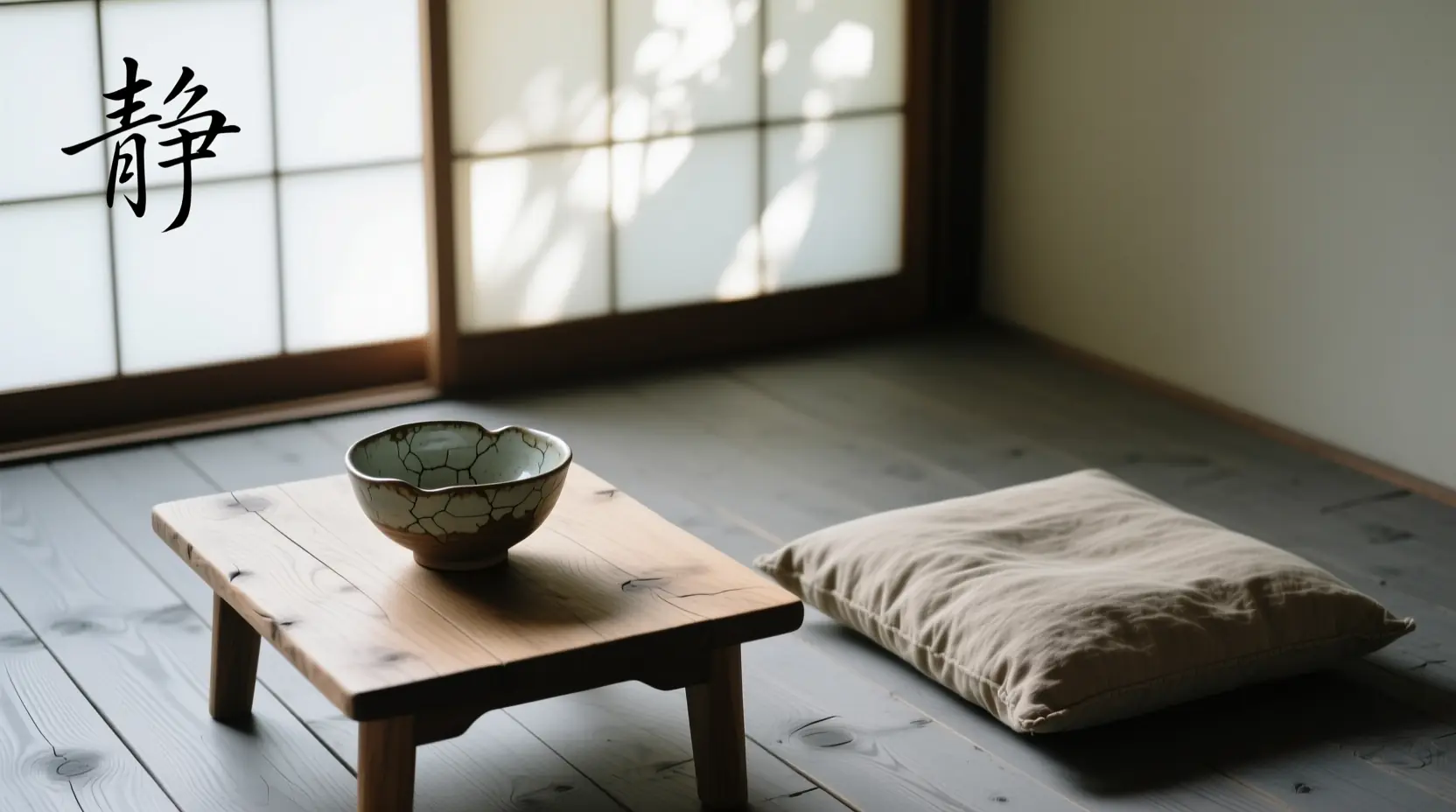
Consider a single bowl. Clay, fired long ago. A slight wobble in its foot. Around it, nothing. The emptiness is not a lack. It is the bowl’s voice. The silence where its story can be heard. Space is not what remains. Space is the invitation.
To craft this, one subtracts. With a gardener’s tenderness. You lift stones until the moss is revealed. You remove until the essential remains. A shelf holds one river stone, smoothed by a current you will never know. A wall wears only the tracings of light through paper. This emptiness is alive. It is where the cluttered mind finds rest. Finds, perhaps, the grace of not thinking at all.
The Patina of Years
Nothing beautiful fears time. My teacher’s robe was frayed. The cedar, grey as an old gull’s wing, its grain raised like a topographical map of a long life. Wabi-sabi, he whispered. The quiet honor of impermanence. The beauty of the crack, the patina, the gentle subsidence.
We often fight this. We polish away the scratch, the stain, the ghost-ring of a glass. We seek the forever-new. But the forever-new has no soul. It has not lived.
Invite the wood that shows the knot. The iron that carries a breath of rust, a memory of rain. The linen faded by the sun, soft from the weight of a sleeping cat. These are not flaws. They are diaries. They speak of tea spilled in conversation, of sunlight falling in the same square, day after day, year after year. To touch a weathered bench is to touch all the mornings that have dawned upon it.
Let your materials be honest. Let stone feel cool and of the earth. Let wood smell resinous, of the tree. Do not disguise them in glossy veneers. This honesty grounds us. In a world of plastic and pixels, the rough texture of a clay wall calls the wandering mind home. To this breath. To this body. To this moment.
The Way of Arrangement
There is a flow. A river does not force its path. It finds the way, wearing smooth the stubborn rock over millennia. So it is with placement. Look not to a grid, but to a stream.
Where does the light pool in the afternoon? Place your chair there, facing that golden puddle. Let the arrangement follow the sun’s pilgrimage.
Do not bolt things down. Let a small table be light enough to move nearer the fire on a winter’s eve. Let a cushion be carried to the window when the moon is full. This flexibility is mindfulness. It is a conversation with your environment, not a decree.
And in that arrangement, seek balance. Not the cold symmetry of mirrored halves. The balance of a riverbank. A large, mossy stone on one side, a cluster of smaller pebbles downstream. A heavy, dark wood chest on a floor of pale tatami. It feels right. It feels settled. It does not shout. It simply is. This is shizen—naturalness. It is deeply intentional, yet utterly unforced. The art that hides art.
The Light That Falls
All light is borrowed. It is a guest. We do not own it. We can only receive it. Harsh, electric light is a demand. It says, “See this! Now!”
The light we seek asks permission.
It is the light that seeps through handmade paper, diffuse and milky. The light that flickers from a single candle, dancing with the draft. The light of dawn, hesitant and blue.
Shape your openings for this light. A window is not just a hole. It is a frame for the sky. A skylight, a lens for the moon. Let them be bare, or dressed in the sheerest linen, so the world outside remains a soft, living painting.
Watch. The light paints a slow stripe across the floor. Climbs the wall. Fades. Your room is not static. It is a sundial. It tells the time in light and shadow. To sit in a room that marks the sun’s passage is to remember we are part of a larger, older cycle. It is deeply calming. It lays our small worries upon the vast, beautiful altar of the turning earth.
The Soul of an Object
Nothing should enter without a reason. Not a decorative reason. A soul reason.
The cup from a dusty market, its handle shaped for your thumb. The feather your child gave you. The worn book, its pages soft as fabric. These are not decorations. They are companions. They carry memory, intention, a fragment of a story.
This is the opposite of acquisitiveness. It is curation of the heart. Each object is chosen not for its trend, but for its resonance. Does it bring peace? Does its presence fill the space, rather than clutter it? A true object does not need explanation. It simply belongs. Its energy contributes to the silence.
When you sit to meditate in such a room, you are not alone. You are held by these silent witnesses. The bowl that holds the water. The worn spot on the mat. The single flower in its season. They are participants in your stillness. They have absorbed the quiet of your practice, and now they reflect it back. The room becomes a partner in your inner work.
Letting the Outside In
Erase the hard line. The wall is not a barrier. It is a membrane.
A view of a branching tree is better than any masterpiece. The sound of rain on leaves, the finest music. Place your seat where you can see a sliver of sky. If you have no garden, bring in a single branch. A stalk of wheat. A vessel of water.
Nature is the ultimate teacher of impermanence. The branch will dry. The leaves will fall. This is not a cause for sorrow, but for contemplation. It reminds us that we, too, are part of this rising and falling. Our homes should not be fortresses against this truth, but shelters within it. A room that honors the seasonal shift, that welcomes the changing light, that makes space for a found stone… this is a room that breathes with the world. It is alive.
The Final Silence
So we return. To the silence. The space between.
A room woven with this spirit is not a showcase. It is a sanctuary. It does not impress the guest. It embraces the inhabitant. It is the physical manifestation of a quiet mind.
The weathered wood. The textured linen. The pool of floor. The patient light. These are not merely aesthetic choices. They are ethical ones. A commitment to slowness. To authenticity. To the beauty of the imperfect and the passing.
To sit in such a space is to meditate before you even close your eyes. The room itself has done half the work. It has stilled the clamor. It has offered a canvas of calm for your restless spirit.
It whispers, through the grain of its wood and the cool of its stone, the oldest lesson.
Be here. Now. In this breath. In this sliver of light.
This is the deepest connection. It is not that meditation and interior design are related. It is that, at their truest, they are the same thing. The careful, loving creation of a space—within four walls, and within oneself—where the soul can finally sit down.
And listen.