Where the Sun Catches the Dust: A Bench as Altar
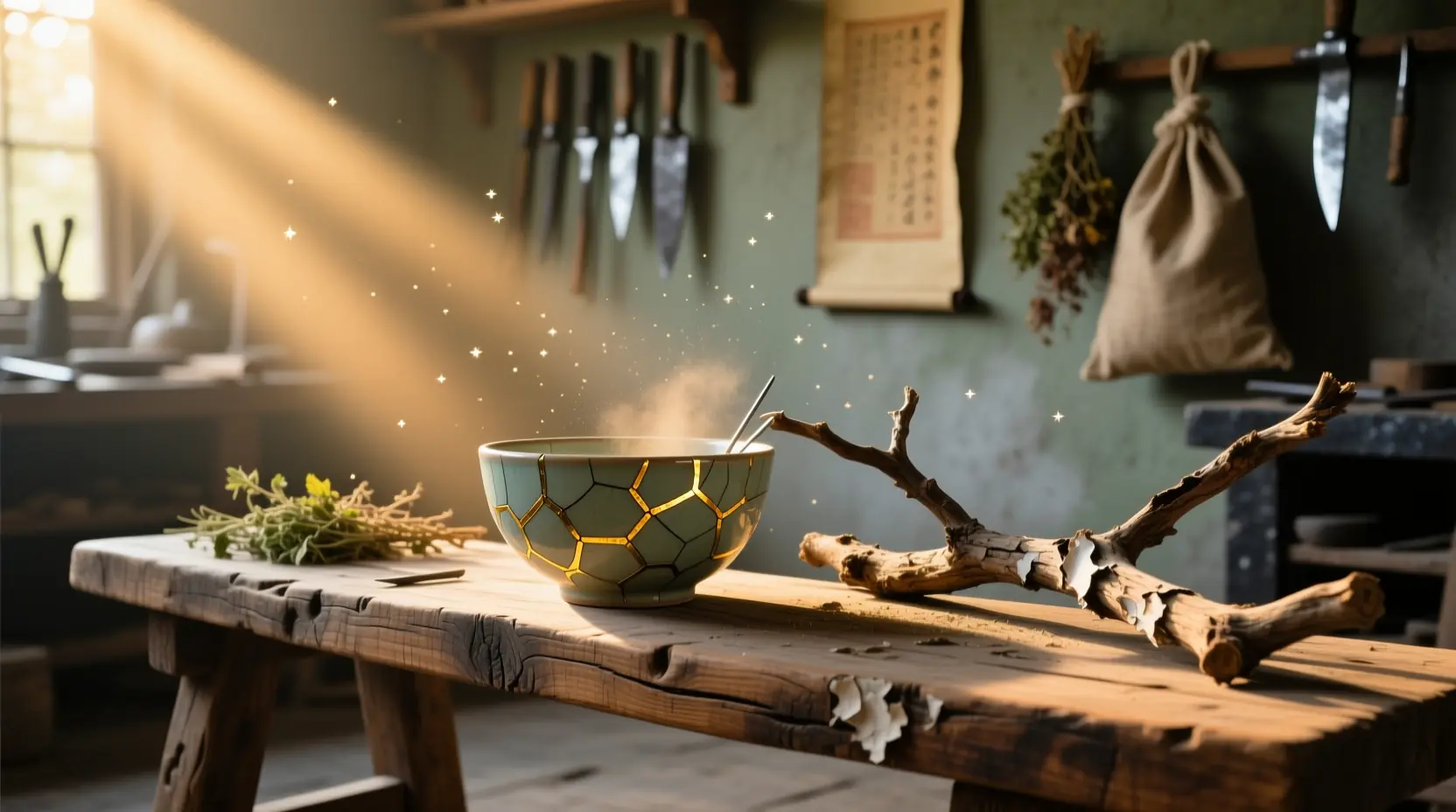
The morning sun, thin and pale as old paper, slants. It does not flood. It fingers its way through the glass, slow and particular. It finds the dust motes suspended above a rough-hewn bench. They dance there, in that column of light, not as filth but as gold—a galaxy of tiny, turning worlds. On the bench: a saw with a tooth missing. A chisel, its bevel dark with old resin. A pot of simple paste, skin forming on its surface. The materials are not brought. They are gathered. A cracked bowl. A branch, still wearing its bark like a memory of the wind that brought it down. A length of faded cloth, soft as a sigh. They wait. Not with the impatience of commodities, but with the infinite patience of things that have already lived a life. This is where we begin. Not with a purchase. With a seeing.
This is the way of wabi-sabi. It is not a style. It is the slow exhalation after the world’s shout for newness. A breath to be practiced. A whisper of acceptance for the flawed, the weathered, the quietly impermanent. And the most beautiful vessel for this practice is not a museum. It is the cup of your own two hands.
To Sit With a Crack: The Patina of Attention
First, you must learn to see. This is the deepest work. Sit. With the thing. Let your eyes soften. A clay pot, its glaze pooled too thick on one side. A floorboard, hollowed by a century of footsteps traveling the same hopeful path. See not the flaw. See the story. The crack is where the clay’s spirit stretched, then yielded. The wear is the map of lives lived. Your projects begin here, in this silent communion. Do not rush to fix. Rush to understand. In an age deafened by the new, your first act of creation is a reverence so deep it is almost mourning. Hold the object. Feel its weight—the gravity of its history. Feel its texture—the language of its making. This seeing, this holding, is the only true foundation. All else is ornament.
Mending the Seam of Time: Kintsugi of the Everyday
There is an art. In Japan, they call it kintsugi. The repair of broken pottery with lacquer dusted with precious powder. Gold. Silver. It does not hide the break. It illuminates it. The fracture becomes a river of light across the form. You need not the precious metal. The philosophy is the treasure. A cherished cup slips. From a drowsy hand, from a moment of distraction. Gather the pieces. Do not curse the moment. Honor it. The breaking is now part of its story. Use a clear, strong adhesive. Fit the fragments together with a care that is a form of love. The seam will be visible. A ridge. A spiderweb of memory across the clay skin.
Now, take a pigment—mica dust, ground charcoal, turmeric from the kitchen shelf. Mix it with a little more adhesive. With a fine brush, or just a fingertip, trace the break. You are not hiding. You are highlighting. You are saying, quietly, to the cup and to yourself: this hurt, this fracture, is now part of its beauty. It has known loss and is whole again, differently. More soulfully. Set it aside. Let it dry under the same sun that warmed it before its fall. The light will find the new seam. It will glow.
The Wood’s Whisper: Bringing the Storm Inside
Walk in the woods after a gale. Listen. The wind has done the pruning. There, on the path: a branch. Twisted. Graceful in its surrender. It is not deadwood. It is potential, resting. Bring it home. Strip not its bark, if it still clings. Let its skin tell its age. Feel the sandpaper texture, the grooves where insects made their pilgrimages. You may simply place it in a corner. A sculptural ghost of the tree. Or you may give it a simple task. Flatten one side with a plane, just enough to let it sit steady. It becomes a shelf for a single, chosen stone. A resting place for a candle whose flame will flicker as if still in the forest.
Do not varnish it to a high, shouting shine. Perhaps a gentle rub with beeswax. To deepen its voice. To honor the grain that flows like a slow river. The wood will continue to breathe. It may split further. This is not failure. This is the wood, still living its life in your care. A nail hole from a long-vanished fence. A dark stain from decades of rain. These are its medals. Do not strip them away.
The Quiet Canvas of Cloth: Faded Songs in Thread
Find a fabric that has known use. A linen shirt, faded to the softness of a dove’s breast. A cotton sack, its stamped letters now faint, illegible ghosts. Its strength is in its yielding. Cut it with intention, but not with rigid precision. Let the shears follow the thread’s own inclination. To hem it with perfect, tiny stitches is one beauty. To leave a fringe, allowing threads to loosen and stray, is another. It speaks of release.
You might bundle dried lavender from the garden into a square of this cloth. Tie it with a strand of jute. The bundle will sag. It will become lumpy, asymmetrical with time. This is its charm. Or you might layer scraps. A faded blue singing of sky to an earth-brown patch. Stitch them, slowly, into a small cushion. Stuff it with clipped wool, or with more scraps. It will be imperfectly plump. It will settle into the shape of being sat upon. Of being leaned against by a weary head. It accepts, willingly, the imprint of life.
The Stillness of Stone and Moss: A World in a Dish
Go to a stream. Kneel. Let the cold seep into your knees. Select not the perfect, round stone. Select the one with a striking band of quartz like a lightning bolt frozen. Or one with a peculiar hollow, worn by the water’s eternal, patient tongue. Carry it home. Its weight in your palm is its wisdom. Place it on the mended wood. Beside the cracked cup.
Now, for the moss. In a shaded, damp place, a velvet patch grows on a north-facing stone. Green so deep it is almost black. Gently, with a trowel, take a small piece. Place it in a shallow, unglazed clay dish. A bowl that was too warped for the potter’s liking is perfect. Add a few pebbles. A sprinkle of soil. Mist it with water. Place it where the light is soft, indirect.
This is not a project to be finished. It is a relationship to be tended. The moss will grow. It may brown at the edges. It will thrive and recede with the humidity of your home, your breath. It is a living breath of the forest floor, now sharing your roof. It teaches the slowest rhythm. The rhythm of green.
The Poetry of Empty Space: The Art of Removal
This is the most difficult project. It asks for removal, not addition. Look at a shelf. A mantel. A windowsill. It is crowded with intention. See which object speaks the least now. Whose voice has become a murmur. Put it away. In a dark cupboard. Not with disdain. With gratitude for its past service.
Now, observe the space left behind. That emptiness is not blank. It is a stage. It allows the remaining few objects—the mended cup, the branch, the stone—to sing their true, clear notes. The space between them is as important as the things themselves. It is the ma, the pregnant pause. Dust will settle in this space. Light will pool in it. This, too, is part of the composition. Do not rush to fill it. Let the emptiness be. It is the room for thought. For breath. For the eye to rest. A single leaf on a wide, clean sill holds more power than a crowded collection. It speaks of choice. Of breath.
The Soul of the Tool: Collaborating with History
Your hands are the primary instruments. But they are guided. Do not seek the shiny, the new. A well-used brush, its bristles fanning out like an old man’s beard, will apply a stain with more character. A hammer with a darkened oak handle, shaped by the grip of another, connects you to a lineage of makers. Feel the balance. Clean them with care. Store them where they can be seen. The rust on a chisel is not neglect. It is a record of moisture and time. A patina of use.
When you pick up such a tool, you do not command it. You collaborate with its history. It teaches your hand patience. A sharp blade, cared for, is an act of respect—for the material it will meet, and for the hands that honed it before yours.
The Acceptance of Decay: Beauty as a Path, Not a Peak
This is the final lesson, woven into every project. What you make will not last. The mended seam may yellow. The wood will crack further, singing a new song. The moss may retreat into its dish. The fabric will fade more, into a tone no dyer could name.
This is not a cause for grief. It is a cause for deeper attention. Each small change is a chapter. A wabi-sabi object is a companion in transience. It ages with you. It shows you, day by day, that beauty is not a peak to be reached and frozen, but a path to be walked. A path with gradual shifts in light, with soft edges, with the quiet acknowledgment of the turning world.
When the cushion cover finally wears through, perhaps you will patch it with a cloth from a child’s outgrown garment. The story continues. The lineage of care extends, visible in every stitch.
The sun is lower now. Its light is warmer, richer, honey-thick. It fills the repaired crack with liquid gold. The dust motes still dance, but more slowly, as if tired from their day’s silent celebration. On the bench, the objects you have communed with seem to rest. They are not loud. They do not declare their cost or their brand. They simply are. A quiet testament to the beauty of time, the grace of use, the dignity of repair.
This is the heart of it. Not a list of instructions to follow, but a manner of seeing to cultivate. Your home becomes not a showroom, but a diary written in objects. A slow, patient, lifelong conversation between your hands and the soul of things. Begin where you are. With the cracked, the faded, the fallen. Listen. Then, with gentle hands, join the conversation.