The wood remembers the wind.
It holds the tilt of the branch. The slow pull of gravity. The hush before rain.
We do not ask it to forget.
This is where Mav begins
Not in a boardroom.
Not in a trend report.
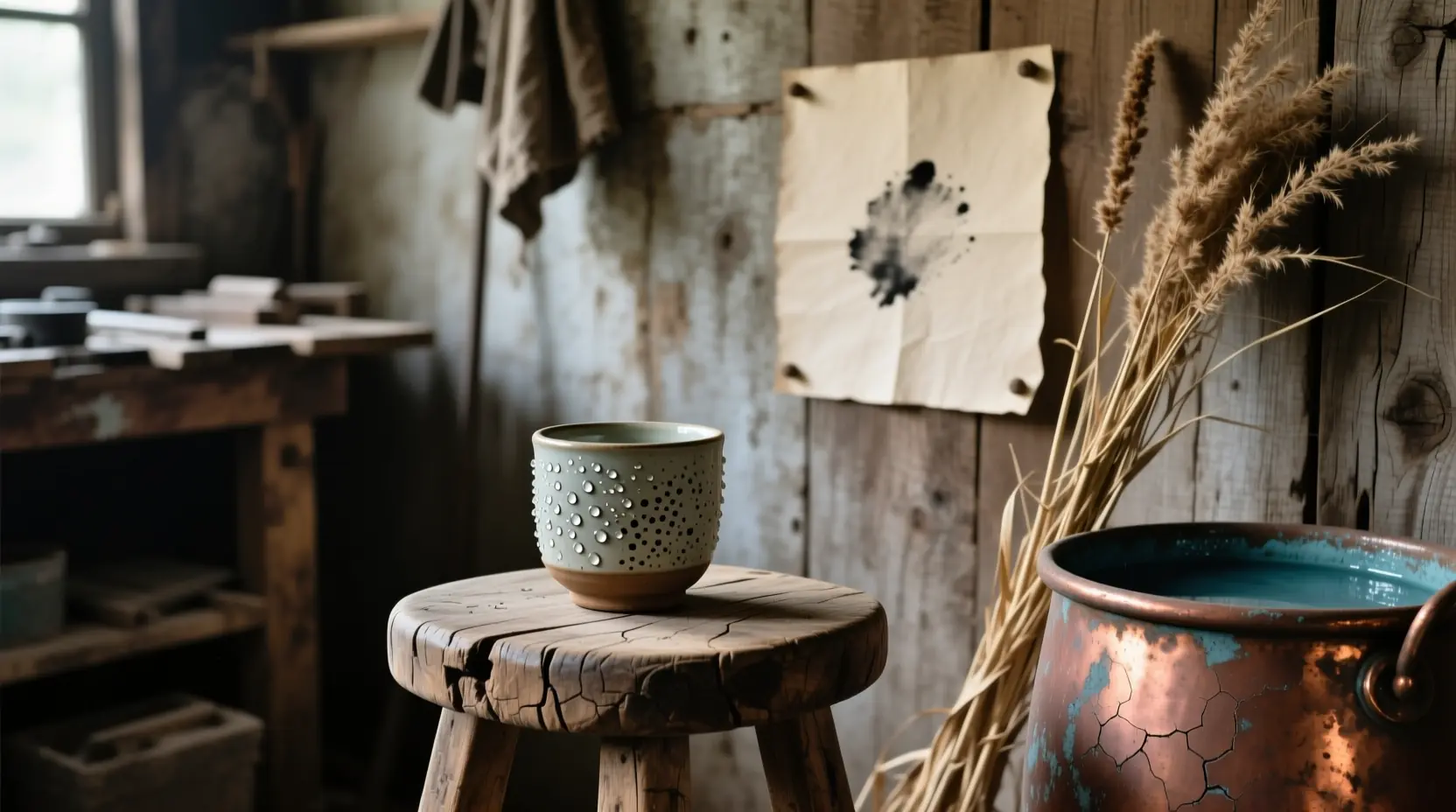
But here—on a stool carved from fallen ash.
Its grain darkened by time.
Its edges softened—not by sandpaper—but by decades of palm, elbow, knee.
The seat is cool.
Slightly uneven.
Honest.
What grows must first be rooted.
Roots do not shout.
They twist downward—unseen—gripping clay and loam.
Drawing mineral memory from deep earth.
So too does Mav root itself—not in novelty—but in continuity.
In the same hand-stitched saddle stitch used by my grandfather’s teacher,
who learned it from a woman in Kyoto
whose fingers bled ink and indigo into cloth.
In the same iron-rich clay dug from the same hillside near Ōita,
fired in kilns built from river stones gathered by sons now grown,
now gray.
Sustainability is not a metric.
It is the quiet certainty that the cedar shingle we lay today
will still shed rain in eighty years—
and that the tree it came from was thinned, not felled;
tended, not taken.
It is knowing the wool we spin
was sheared in spring—when the sheep themselves chose to shed.
That the dye comes from madder roots pulled only after the plant has seeded three times.
That the loom’s shuttle passes back and forth—not for speed—but for rhythm:
the same rhythm as tide,
as pulse,
as breath.
There is no ‘greenwashing’ in soil.
No virtue-signaling in bark.
Only reciprocity.
Only listening.
The hand knows what the eye forgets.
Watch a potter’s thumb press into wet clay.
Not force—invitation.
Not correction—companionship.
The vessel forms not because it is willed into being,
but because the clay yields to presence.
To patience.
To the weight of a steady wrist.
We welcome the slight warp.
In a woven basket—evidence of humidity,
of season,
of life moving through fibre.
We leave the burnish on a bronze bowl unpolished,
so light catches its micro-scratches like ripples on pond water.
We let linen fray at the hem—not as flaw,
but as echo:
of wear,
of use,
of belonging.
This is not negligence.
It is devotion—to the truth of material.
To the dignity of decay.
To the quiet grace of objects that age with us,
not against us.
A chair made for eternity is a lie.
A chair made to hold you—truly—for thirty years,
its joints settling,
its finish mellowing,
its wood breathing—is an act of love.
We do not design for obsolescence.
We design for companionship.
Time is not spent. It is kept.
In the workshop, clocks are absent.
There is only the sun’s arc across the north-facing window.
Only the scent of beeswax warming on a shelf.
Only the low hum of the foot-treadle lathe—a sound older than electricity,
older than steam.
We measure time not in quarterly reports,
but in layers:
- The patina on copper that takes seven years to deepen from blush to dusk.
- The slow ambering of raw linseed oil on oak—each coat drying under winter light,
each layer waiting its turn. - The way a hand-thrown cup, fired once, then twice, then thrice,
gains depth—not in colour, but in silence.
Modern speed is a kind of violence.
It severs cause from effect.
It divorces making from meaning.
It asks the hand to outrun the heart.
At Mav, we move at the pace of cellulose.
Of keratin.
Of lignin.
We wait for glue to cure—not because we lack urgency,
but because urgency without reverence is noise.
When a young apprentice asked me,“How do you know when it’s ready?”
I placed his palm flat upon a drying slab of walnut.
“Feel the shift,” I said.
“Not in the wood—but in your wrist.
In your breath.
In the space between one heartbeat and the next.”
That pause—that sacred interval—is where craft lives.
The soul is not added. It is uncovered.
No object arrives soulless.
It carries the resonance of its origin—the vibration of the loom’s warp,
the tremor of the chisel’s bite,
the warmth of the kiln’s breath,
the quiet grief of the tree’s release.
Our work is not to imprint soul—but to remove what obscures it.
The varnish that deadens grain.
The seam that hides tension.
The symmetry that denies asymmetry—the very signature of life.
Look closely at a Mav textile:
you’ll see where the weft caught slightly,
where the shuttle paused mid-pass,
where the dyer’s thumb left a faint, irregular smudge.
These are not mistakes.
They are signatures—of attention.
Of humility.
Of the human hand refusing to erase itself.
We do not mass-produce.
We accompany—each piece,
each person,
each season—through its natural unfolding.
A scarf is not finished when the last thread is knotted.
It is finished when it has been folded,
pressed,
held,
whispered over—and when the maker bows,
not to the object,
but to the lineage that made it possible:
the sheep,
the plant,
the rain,
the soil,
the ancestors whose hands shaped the first spindle,
the first needle,
the first fire.
What endures is what accepts ending.
Nothing lasts forever—not the finest silk,
not the hardest steel,
not the deepest root.
And this is not loss.
It is alignment.
The cracked glaze on a sake cup?
That is kintsugi not as repair,
but as recognition:
the break was part of its story before it ever met lips.
The faded indigo on a work apron?
That is not erosion—it is absorption:
of sweat,
of soil,
of sunlight,
of decades of quiet labour.
Sustainability, at its truest, is surrender—to cycles.
To endings.
To the gentle, inevitable return.
We do not seek immortality for our objects.
We seek integrity:
that they serve fully while they live,
and return wholly when they rest.
That their fibres feed new growth.
That their metal re-enters the earth’s slow alchemy.
That their memory lingers—not in archives,
but in the muscle memory of hands that remember how to hold,
how to mend,
how to pass on.
This is our commitment—not to permanence,
but to presence.
Not to dominance over nature,
but to dialogue with it.
Not to conquest,
but to kinship.
The future is already here—just quieter than we’re used to hearing.
It is in the rustle of dried reed bundles stacked beside the dye vat.
In the slow drip of rainwater collected in the copper basin beneath the eave.
In the single candle lit each morning—not for light,
but for witness—before the first tool is lifted.
It is in the child who watches her grandmother wind flax,
her small fingers mimicking the twist,
her breath syncing with the rhythm of the distaff.
It is in the student who spends six months learning to split bamboo—not to make a basket,
but to feel the grain’s direction,
to understand refusal,
to honour flexibility.
The future of Mav is not a destination.
It is this: a widening circle of care—
extending from soil to seed,
from hand to heart,
from object to owner,
from owner to heir.
We do not scale up.
We deepen down.
We do not chase reach.
We cultivate resonance.
We do not speak loudly.
We listen—deeply—to the whisper of fibre,
the sigh of clay,
the murmur of sap,
the silence between hammer and anvil.
And when someone holds a Mav piece—
whether it is a bowl cradling morning rice,
a comb smoothing damp hair,
a lantern casting soft gold on a winter wall—
they do not hold a product.
They hold a covenant.
A covenant with time.
With tactility.
With transience.
With the quiet, unbroken line of human hands reaching back—not for glory,
but for grounding—and forward—not for control,
but for continuity.
So if you ask me, “What is the future of Mav?”
I will not point to charts or forecasts.
I will lift a cup—unglazed, unvarnished, warm from the kiln’s final breath—
and pour you water drawn from the spring behind the workshop.
Taste it.
Feel the roughness of the base where the potter’s thumb pressed in final blessing.
Notice how the water beads, then settles, then seeps slowly into the porous clay—
like time itself,
like memory,
like grace.
This is the future.
Not ahead.
But here.
In the cup.
In the water.
In the quiet between sips.
It has no logo.
No slogan.
No expiry date.
Only this:
A promise kept—not with words,
but with weight.
With texture.
With truth worn smooth, not by time alone—but by touch.
By use.
By love.
We do not build monuments.
We tend thresholds.
And every threshold begins—always—with a single, unhurried breath.