Beneath the Mirror, the Dream
Listen.
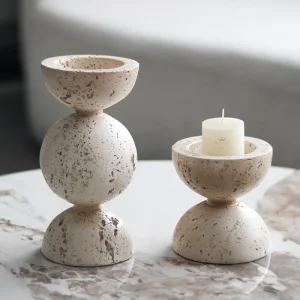
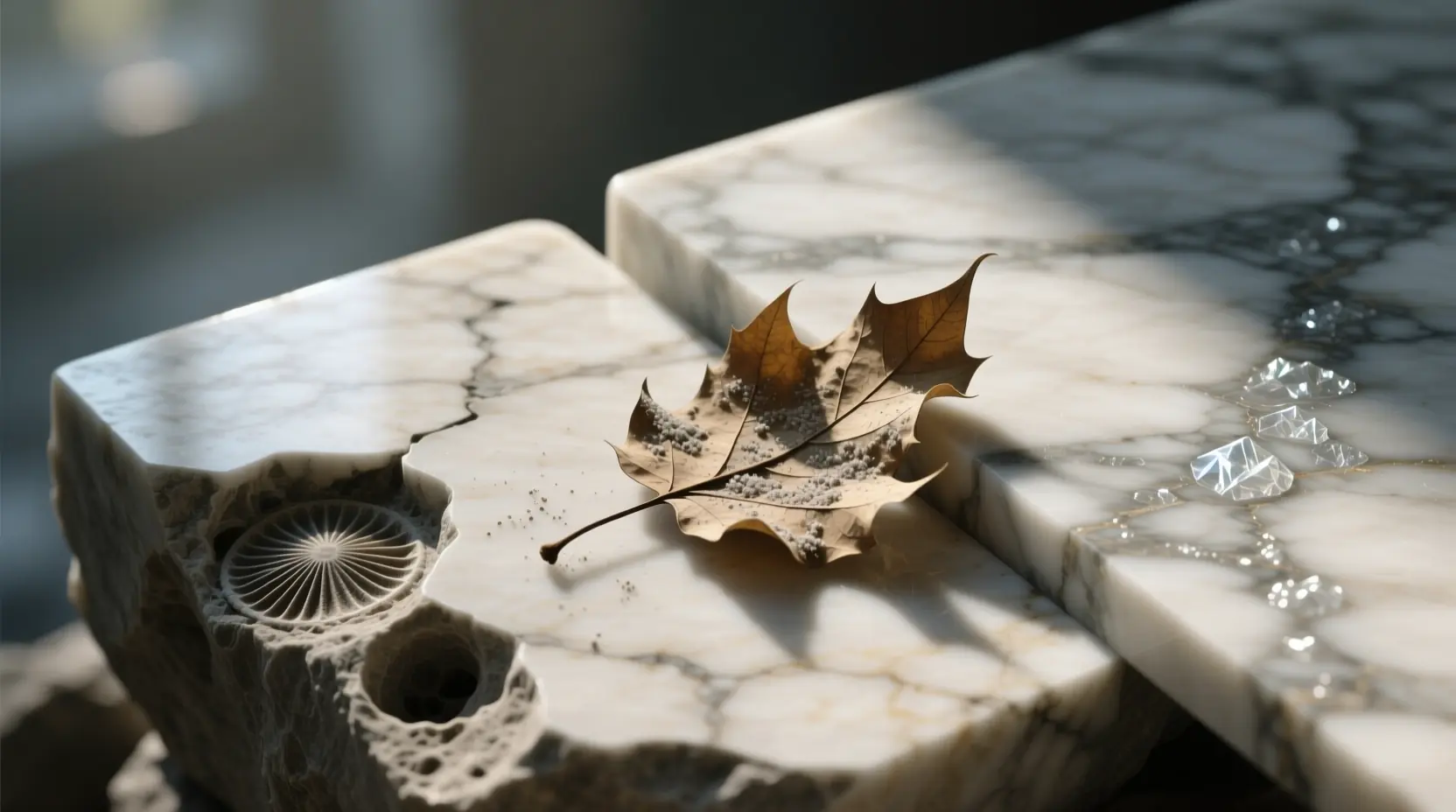
Past the shine we are told to covet. Past the flawless plane. A deeper sleep. An older patient. Travertine, in its bones, holds the memory of mineral springs. A slow exhale of earth. Of bubble and seep. Marble, a tightened sigh. A remembrance of weight, of heat, of profound and silent change.
We have tried to wake them with a shout. With grind and polish. To force a perfect, silent reflection. A surface that speaks only of our own image.
There is another path. A quieter one. It does not command. It attends. It kneels.
This is the way of wabi-sabi. Not a style. A posture of the soul. A reverence for the authentic narrative—the crack, the weathered face, the asymmetry that echoes a river-worn stone. To bring these stones home is not an installation. It is an invitation. To host a fragment of geological time. To begin a slow dialogue between the enduring and the ephemeral. Between earth and light.
The Skin of the World, Unadorned
First, you must feel the truth of it. Not as a slab. As a skin. As the honest hide of the planet.
Go to the yard. Let your hand rest on a honed travertine. Feel its gentle abrasion. Its porous breath. These are not defects. They are the stone’s history. Each cavity, a fossilized bubble. A tiny cathedral left by fleeing water. To fill every void, to sand it into mute flatness, is to erase half its story. Perhaps we leave them open. To breathe. Perhaps we choose a filled and honed finish, where the texture remains—a quiet, tactile topography. Here, light does not glare. It sinks. It pools. It warms the stone from within.
And marble. Its veins are not stains. They are memories. Echoes of other stones, other times, swallowed and transformed in the earth’s dark crucible. A brushed finish coaxes this inner life forward. The surface grows softly hazy. Like mist on pre-dawn water. It possesses a nap, a whisper of suede. It catches light obliquely, glows from its deep heart. You see the crystal, the cloud of calcite. It feels touched. Alive.
This is the first, quiet rebellion. To choose not for perfection, but for presence. To select a finish not for shine, but for sincerity. You are not covering a surface. You are laying down a piece of the world’s slow history. And leaving its story spoken.
Where Stone Finds Its Kin
Alone, the stone is a lone note. Held. In kinship, it becomes a chord. A harmony.
Wabi-sabi turns from the matched set. It seeks conversation, not uniformity. It listens for the dialogue between materials.
Imagine a broad travertine hearth, honed and fossil-ridden. Against it, the charcoal-textured grain of shou sugi ban cedar. One cool, born of water and millennia. One warm, shaped by fire and a human hand. Both marked. Both true. They do not match. They resonate.
A brushed marble counter, clouded like a winter sky. Beneath it, cabinets of rough-sawn oak, oiled to a silvery grey. The wild vein in the stone finds its echo in the wild grain of the wood. They speak the same ancient language of growth and pressure, with different dialects.
The metal here is not sterile. It is blackened iron, forge-scale still clinging. Or unlacquered brass, waiting to accept the patina of touch—the darkening of fingerprints, the soft dimpling of use. The metal is a bridge. A humble artifact of craft that confesses its own mortality.
And then, the silent partner: light. Raw stone is its instrument. Morning sun, low and gold, will flood a leathered marble floor, turn it to a pool of honeyed quartz. Afternoon light will catch every pit in a travertine wall, throw long, dancing shadows—a silent clock of hours. In lamplight, the stone recedes. Becomes a soft, dark presence. A cool shadow against the warmth of wool and wood.
You do not light the room. You listen to how the stone receives the day. And you learn to see anew.
The Grace of the Mark: Patina as Memory
Here lies the quiet heart. The deepest surrender.
The stone is not to be preserved in amber. It is to be lived alongside. The great fear with marble is the etch. The stain. The scratch. We are taught to flinch. To seal it away from life.
But what if we see it otherwise?
A honed marble surface will cloud where lemon juice falls. Where wine touches. This is not destruction. It is the beginning of its patina. Its personal history. Over years, these soft etches gather. They become a cloud-map of meals prepared, of conversations held at dusk, of a life lived at that plane. It is no longer a product. It is a chronicle. A companion, aging with you, recording with gentle honesty the passage of your days.
Travertine, under a table, will wear softly in the paths of chairs. The filled holes may deepen in relief. This is not damage. It is a record of gathering. Of movement. Like the worn hollow in a stone step, shaped by centuries of pilgrim feet, it gains soul through gentle attrition.
This requires a letting go. A release of the forever-new. You are not acquiring a static object. You are entering a covenant. You care for it—with gentle cloths, with simple soaps—but you do not fear its life. You honor its participation in yours. The fine scratch from a moved pot is a sentence in its story. The faint water ring is a breath caught in time.
This is how an object becomes sacred. Not by remaining untouched. But by being intimately, faithfully touched.
Crafting the Vessel for Stillness
Weave these threads. The honest stone. The poetic conversation. The acceptance of time’s gentle hand. What emerges is not merely a room. It is an atmosphere. A vessel for stillness.
A space centered on raw travertine and marble, seen through this lens, becomes a haven of quiet. The textures absorb sound. They soften the hard edges of the world. The light is felt, not seen—a diffused, modulating presence. The palette is that of the found world: stone grey, linen white, wood-smoke brown, iron black, the mute green of moss on north stone. No shout exists here. Only a long, whispered breath.
You will find your pace slowing. You will notice the lacework of a tree’s shadow as it travels the pitted face of a travertine wall. You will feel the cool constancy underfoot not as a chill, but as a grounding. An anchor.
The room does not demand. It offers. It offers presence. It feels ancient, yet acutely alive. A sanctuary from the cacophony of newness. A testament that beauty resides not in flawlessness, but in integrity. In the quiet, magnificent narrative of time, written in crack, in vein, in soft wear, and in patient, receptive light.
The stone breathes. It always has. We had only forgotten how to listen. To kneel. To place a hand upon its cool skin and hear the long, slow story of the world. To choose it this way is a homecoming. It is to allow our own transient, imperfect stories to gently intertwine with its eternal one. A long, slow exhale. In a world that is always, desperately, holding its breath.