The Architecture of Longing
It began as so many things now do. A geometry of disconnection. Sharp angles and unyielding planes. A sealed white vessel, floating, observing a verdant world through a glass membrane it could not feel. The two souls within felt the quiet ache of it. Their hearts beat to a slower rhythm—the rhythm of root systems, of grain expanding in summer heat, of stone cooling under a setting sun. Their dwelling spoke a sterile, frictionless tongue. It knew nothing of patina. It had never held a shadow long enough to learn its name. They did not call for builders. They called for listeners. To hear the hollows. To find the ghost in the machine.
We entered as one enters a forest clearing. Palms flat on cold, monolithic walls. Listening to the thin resonance of polished floor—a sound with no history, no echo of rain or footfall. The space was not empty. It was expectant. A held breath. A pond before the first leaf falls.
The Window as a Threshold, Not a Barrier
The first gesture was one of surrender. Not an addition, but a subtraction of resistance. The great window, that towering sheet of perfect clarity, became our elder. ‘The view is not a painting to be hung,’ murmured the one with hands worn smooth by wood. ‘It is a presence. Let it occupy.’ We ceased to frame it. We invited it to dwell.
And with that, light became our primary material. Unfiltered. Uncompromising. It asked for surfaces that would not reflect, but would respond. We laid down oak planks, wide and unrushed. Not stained, but simply opened with oil. Each board a chronicle—a knot where a branch once reached, a dark vein of ancient struggle, a soft plane of gentle growth. Underfoot, they would speak. They would absorb the sun’s slow journey and, in time, the faint map of a life lived upon them.
Beneath the Finish, a History
A wall of flawless plaster was gently, patiently undone. The power tool’s whine gave way to the chip of a hand chisel. Beneath the manufactured skin, we found a blessing: the building’s raw substrate. A landscape of rough aggregate and crumbling binder. We left its truth exposed. Not as a rustic motif, but as a necessary memory. A reminder that stability is born of granular, imperfect union. Over this, we floated a coat of clay plaster, the color of forest floor after rain. Applied by human hand, it dried in gentle, undulating tides. It was a surface that breathed. It welcomed the humidity of a breath, the dampness of a touch.
The Nobility of the Split Stone
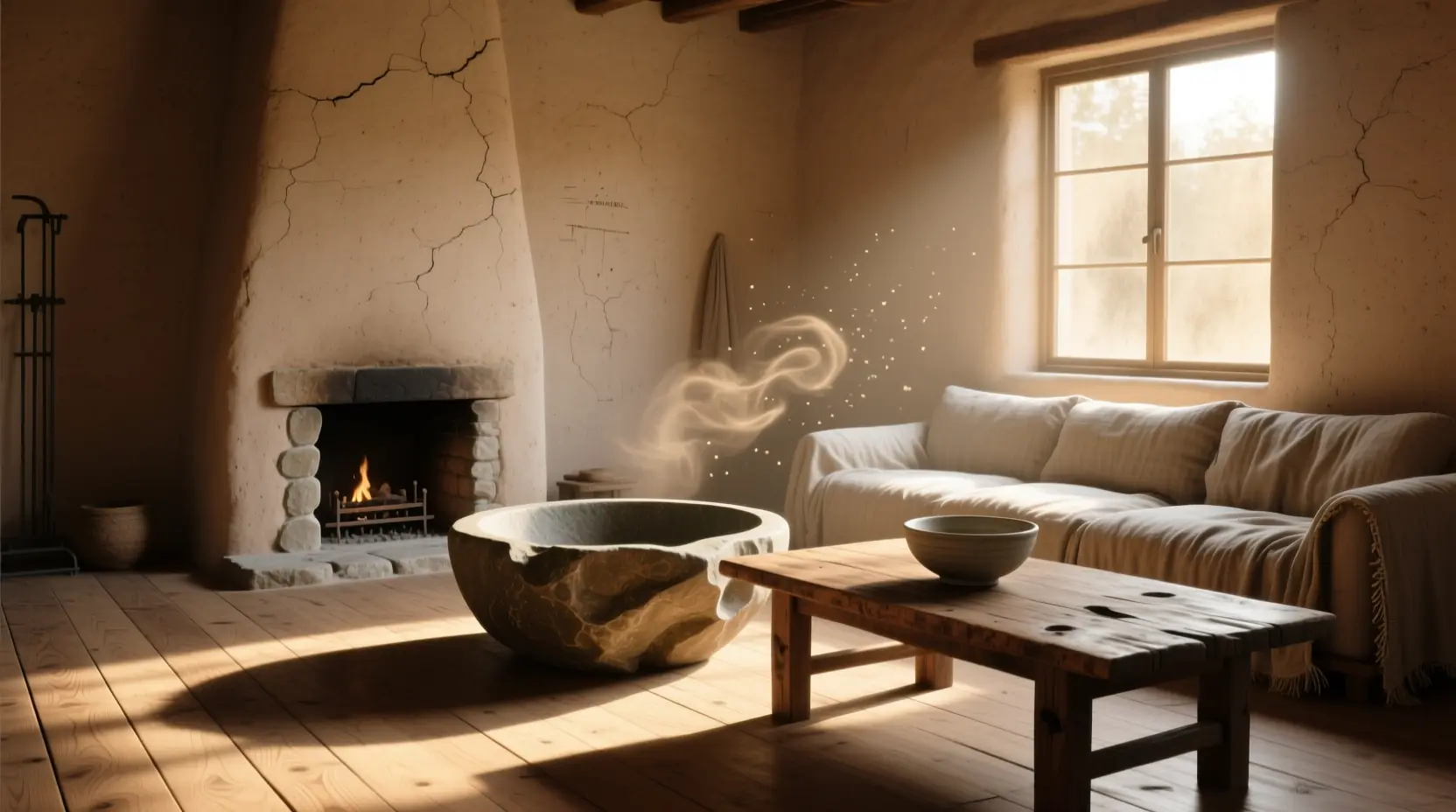
Where the hand hesitates, the soul attends. We brought in a hearthstone. Not quarried and polished to geometric obedience, but cleaved from a larger silence. Its face was a record of terrestrial fracture. A jagged, timeless coastline. It would never lie flush. It would never satisfy a ruler. It simply was. We set this ancient fragment upon a plinth of reclaimed brick, each unit softened by a century of weather, its story told in rounded edges. They asked for no further adornment.
Furnishings arrived bearing the patina of elsewhere. A table of old pine, its surface a softened atlas of forgotten workshops and shared loaves. We strengthened its joints but honored every stain, every shadow of oil. A chair woven from hickory, its seat polished to a sheen by generations of repose. A sofa dressed in undyed linen, awaiting the impression of a body, willing to soften, to yield, to remember.
A conversation of textures began, whispered. The stone’s chill met the supple warmth of a leather-bound journal. The crispness of raw linen brushed against the oily depth of the oak. The transient cold of the window glass was gathered in the deep, forest-floor pile of a wool rug.
Kintsugi of the Everyday
A space is not a noun. It is a verb in constant conjugation. We designed for the gentle attrition of living—the kintsugi of the commonplace. The philosophy was not preservation, but dignified accretion.
Shelves That Welcome Use
Kitchen shelves were left open, their edges softened by the gentle pass of a hand plane, never the ruthless spin of a router. Dishes would not be concealed, but composed—the humble mug, the bowl with a hairline fissure sealed with gold-laced lacquer. Each vessel, chosen for the hand it fits, would bear witness to dawn tea, to evening broth. Their eventual chips would be verses added to an ongoing song.
In the place for bathing, we set a deep stone basin. Filling it became ceremony. The pour of water, a measured cadence. Steam would rise, over decades, to softly bloom against the clay-tiled wall, encouraging a gentle, living patina of moisture. This was not defect. This was symbiosis.
The writing desk was built around a window, so the thinker sat within the view, not against it. The desktop would accept the ghost-ring of a cup, the faint, meandering scratch of a searching pen. It would become a parchment for thought, for daydreams, for watching a single leaf detach and spiral down.
The Final Touch is Time
One afternoon, the work simply ceased. The last whisper of a cloth over oiled wood. The final tool set down. We sat on the floor of what was no longer an apartment unit, but a resonator. The air had weight. It held notes of beeswax, of dry clay, of paper slowly surrendering to age. It was a profound and listening stillness.
The inhabitants returned. They entered without words. Moving slowly, barefoot. Her fingertips traced the landscape of the wall. His palm rested on the cool, silent face of the hearthstone. They did not see renovation. They felt recollection. A home that had ceased battling chronology and had instead opened a door to it.
The Afternoon Light Inhabits
The slanting light of late day entered. It illuminated dust motes dancing their slow, silent waltz. It grazed the gentle hills and valleys of the clay plaster, casting long, soft shadows. It warmed the woven fibers of a basket, the textured wool of a throw. Nothing shouted. Everything murmured. The rigid, contemporary shell had not been demolished. It had been unveiled. Revealed as a quiet vessel, whose purpose was not to hold objects, but to hold time itself.
Sanctuary, Not Spectacle
This is not an aesthetic to be bought. It is a posture to be practiced. It is the choosing of the wear over the wipe. The reverence for the watermark as much as the page. It is understanding that a home’s deepest comfort lies not in what it withholds, but in what it permits to occur.
Moss finds the damp hollow on the stone. Lichen claims the shaded crack. So it is with a space that has soul. It offers the fertile ground for life to take root. For routines to wear smooth their own paths across the floorboards. For peace to gather in the corners like dust.
The project was complete. And yet, it was only beginning. For the true artisan knows the final finish is not applied by the hand, but by the years. The silvering of the oak, the yielding of the linen, the darkening of the stone from ten thousand touches—these are the concluding, breath-held stanzas of the poem.
The white box in the sky is gone. In its place, a vessel of calm. A haven that does not declare its beauty, but embodies it. A sanctuary that whispers, in the language of grain, of shadow, of all things gently aging: You have arrived. You may rest. You are here. And in that deep, unspoken allowance, the weary soul finally finds its landing.