Where the Clay Meets the Kiln
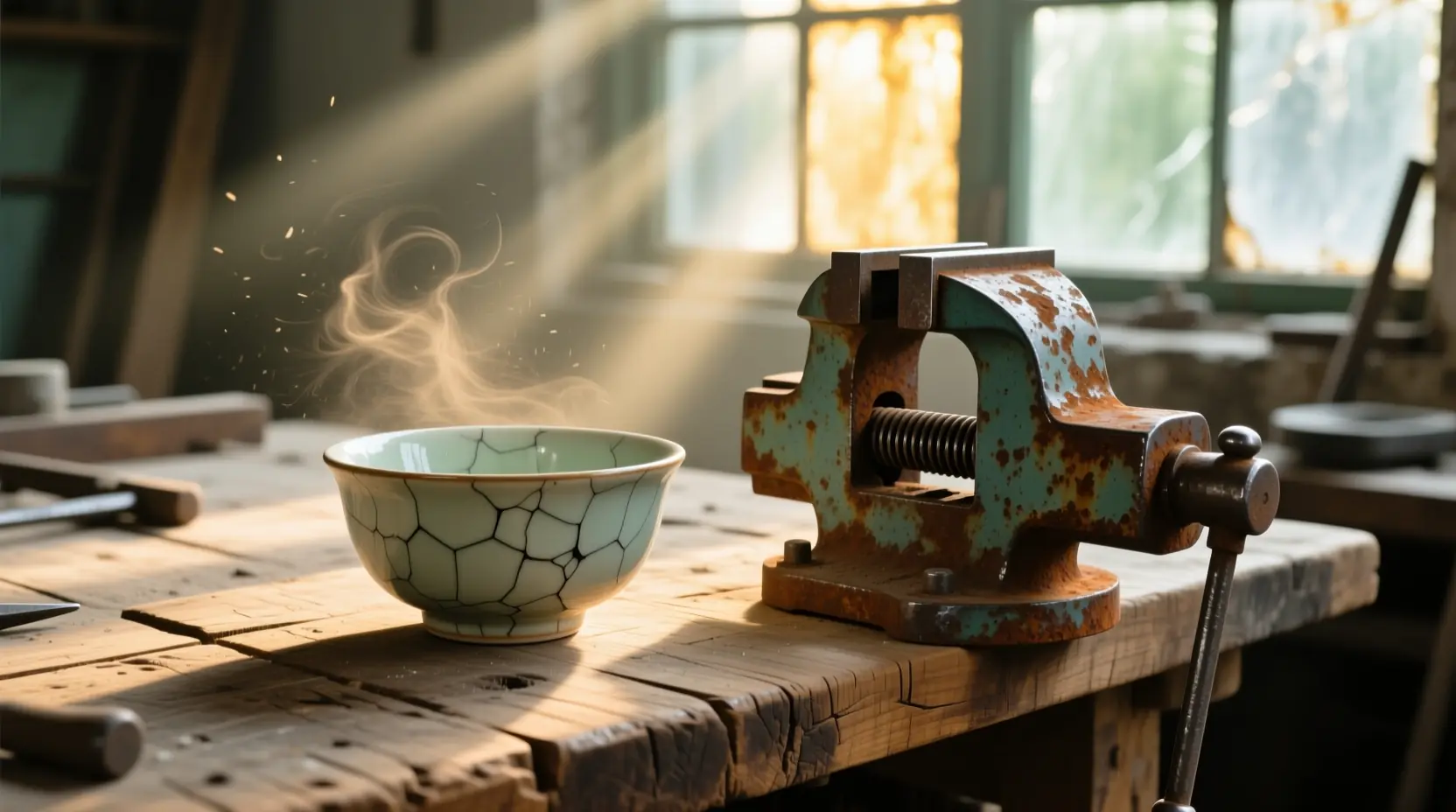
A thumb finds the crack. A journey of a finger, tracing the memory of heat and stress. The kiln was too eager. Or the clay, too fragile. It is a river on a map of glazed darkness. A story the perfect bowls will never tell.
This is not a flaw. It is a record. A quiet acceptance.
Across the valley, bones of glass and iron stand against the sky. Lines drawn straight, under a ruthless sun. A geometry of purpose. Unadorned. Unapologetic. It is a different truth. The truth of the bolt, the weld, the bearing.
They seem to oppose.
The soft and the hard.
The whispered decay. The declared permanence.
And yet.
In this slanted morning light, through old, warped glass, I see them as two banks of the same river. Both seek a beauty that does not lie. One listens to the story the material already holds. The other listens to the truth the material can become. The river does not choose between the mossy bank and the sheer slate. It flows between them. It is the middle ground.
The Soul That Wears Its History
In the Grain, In the Weld
To work with wabi-sabi is to listen. The wood speaks through its knots, its wild grain, its resistance to the plane. A sanded surface is silent. A hand-planed surface sings. You leave the tool marks. Not as a signature, but as proof of a dialogue. You did not impose a shape. You discovered one.
Industrial design listens, too. But to a different potential. To the steel’s will under tension. To the glass’s longing for fluidity. It strips away until only the essential remains. A cast iron pipe, a bare bulb, a concrete plinth. Their beauty is in their unflinching purpose. The soul of the machine, laid bare.
So we begin in the soul.
A wabi-sabi soul is a palimpsest. A record of all it has touched—sun, rain, the oil of a human hand.
An industrial soul is a declaration. A pure statement of its making and its use.
Can one object hold both?
It is the anvil, worn smooth by generations of hammers.
It is the steel wool, rusting gently in a ceramic bowl.
It is the concrete floor that, over decades, accepts the soft patina of countless footsteps. It becomes warmer. A record of life lived.
The Poetry of the Ephemeral, the Honesty of Now
A Dialogue in Time
Wabi-sabi is intimate with impermanence. The moss on the stone. The crack in the plaster. The fading of cloth in the sun. These are not failures. They are cherished notes in a slow song of return. They whisper a quiet truth: we, too, are in a state of gentle decay. There is peace in this. The peace of the autumn field.
Industrial style seems to stand against the current. It speaks of endurance. Of lines meant to defy the years.
And yet.
Is it not also brutally honest about time? It shows the moment of creation, frozen. The weld bead, the formwork marks on concrete, the brush strokes on metal—they are all instants captured. They do not pretend to be ancient. They proclaim, “I was made now.” It is a different kind of transience: the stark, beautiful truth of the present.
The middle ground is where these times converse.
It is a raw steel beam, left to rust, allowing the weather to write its poetry over human intention.
It is a slab of green oak, heavy and true, left to split and sigh as it dries beside a hot radiator pipe.
It does not fight age. It designs a stage for it. The industrial bones provide the trellis. The wabi-sabi life grows upon it.
A Language of Touch
Reading a Room With Your Fingertips
Feel this wood. Cedar, weathered to the grey of a dove’s wing. Soft. Fibrous.
Now, feel this blasted steel. Pitted. Granular. Cold.
Both are rough. But their roughness speaks in different tongues. One tells of wind and long afternoons. The other speaks of fire and instant force.
A room in the middle ground is a room you read with your skin.
It is the smooth, worn leather of a chair, set against a wall of rammed earth.
It is the crisp, cool linen of a curtain, moving in a breeze that has slipped past a heavy, iron-framed window.
The juxtaposition makes each texture sing. The industrial element—hard, cool, anchored—provides the silence. The wabi-sabi element—warm, soft, breathing—provides the note.
Think of a handmade paper lantern. It glows, warm and uneven. It casts its light upon a reclaimed timber table. Below, a concrete floor, polished to a soft sheen, holds the light like still water. The light is gentle (wabi-sabi). The surface is hard (industrial). They need each other. The hard surface gives the light a place to pool and dance. The soft light gives the hard surface a soul.
The Path, Not the Room
Flowing Like a Garden
Do not think in rooms. Think in moments.
A space should be a path. A discovery.
You turn a corner. A black steel doorway frames a sight line. You pause. There, on a raw stone plinth, an asymmetrical vase holds a single branch. The view is composed. The materials are in quiet conversation.
Let the space flow.
Use the industrial elements—a beam, a duct, a column—as the trees in this garden. They structure the view. They give it rhythm.
Then, let the wabi-sabi elements be the natural life. A vine trailing near a conduit. A worn blanket draped over a sleek frame. The strict geometry provides a calming order. The organic irregularity provides the human breath.
The light is your most important tool.
Industrial spaces love the sharp, the direct—a single pendant over a table.
Wabi-sabi loves the diffused, the gentle—light filtered through paper, reflected off unpolished stone.
The middle ground uses both. A sharp, focused light to honour a task. To celebrate an edge. And pockets of soft, shadowed light for rest. For contemplation. For the gentle acceptance of things as they are.
The Practice, Not the Purchase
Mending the Crack With Gold
This is not a style you buy. It is a practice you begin.
It starts with seeing.
Sit. Look. Does that factory lamp have a beautiful, simple form? Can you see its soul? Keep it. Let its cord be a dark line against a plaster wall. Now, find it a companion. A stone from the river. A bowl that warped in the firing. Place them together. Listen to their conversation.
When you bring something new, ask two questions.
“What is your truth?” (The industrial question).
“What will your story be?” (The wabi-sabi question).
A machined aluminum stool answers the first with clarity. It is light. Strong. Functional.
But let it be used. Let it gather scratches. Let the finish wear where a hand rests. Now it begins to answer the second. It is acquiring a story. It is becoming unique. It is entering the flow of time.
Repair, do not replace. This is the heart of it.
The industrial object breaks. Do not hide the repair. Honour it. Use a contrasting metal stitch, like the gold of kintsugi. The break becomes the most beautiful part. It is a record of care. It is the perfect fusion: the honesty of the fracture (industrial) and the reverence for its history (wabi-sabi).
A Quiet Harmony
In the end, it is not about balance. It is about harmony.
Like the sound of water over stone.
The water is fluid, soft, transient (wabi-sabi). The stone is eternal, hard, unchanging (industrial). Together, they make a sound that soothes the world.
Your home should be that sound.
A place where the rationality of the human mind—our industry, our clarity—makes a pact with the tender, crumbling, beautiful reality of the natural world. It does not fear the passage of time. It invites it in for tea. It acknowledges the straight line, then lets the curve of a gnarled branch play against it. It finds warmth in the cold, and strength in the soft.
The sun is lower now. The light in the workshop is long and gold. It catches the dust, and the dust, for a moment, looks like stars. It falls on the chipped tea bowl. It falls on the old iron vise bolted to the bench. They are both glowing.
One, a record of a quiet accident.
The other, a record of a thousand days of work.
They do not clash.
They rest together in the fading light, waiting for tomorrow’s stories.
This is the middle ground.
It is not a destination.
It is a way of walking. A slow, attentive path between the forest and the forge.