The Whisper in the Fracture
A single line. A clean, sharp deviation in the clay. Your bowl—the one that knew the weight of dawn steam, the one that held warmth on a bone-cold night—bears a new topography. A shelf sighs. A hand forgets its grace. And there it is: the verdict. Broken. The pieces rest on the table, sharp-edged memories of a former whole. The instinct is to clear away the evidence. To mourn, and replace.
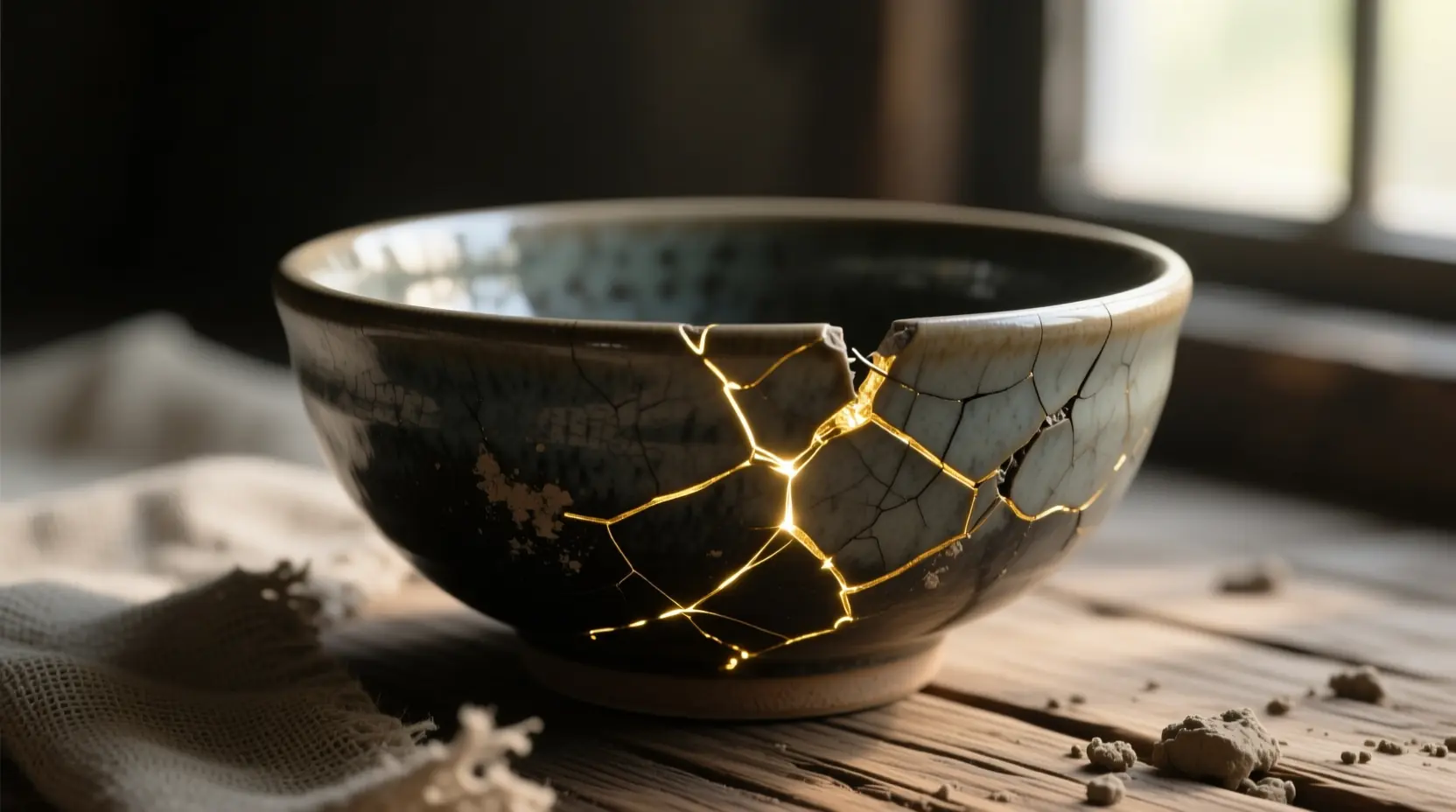
But in the silence that follows the sound of breaking, an older truth can be heard. It comes from a land where petals are most cherished as they fall. There, they learned to speak a different word over the fracture. Not broken. Not ended. Transformed. They called this understanding Kintsugi—the golden joinery. The art of mending broken pottery with lacquer and precious dust. Not to disguise. To adorn. To make the mended flaw a river of light.
You need not be a master. Only willing to sit with the pieces. To listen. This is the path.
Gathering the Quiet Tools
First, you must simply sit. Lay the fragments on a plain cloth. Let your fingers read the edges. This is the first language of the repair: a tactile cartography of what was.
The tools you gather should feel honest in the hand.
- Urushi Lacquer, or a Humble Kin: The true path walks with urushi, the sap of the lacquer tree. It cures with the slowness of a season, asking for damp air and a patient breath. For a first step, a two-part epoxy, tinted with earth-toned mica, can be a bridge. A simpler dialect of the same deep language.
- Dust of the Sun, Powder of the Moon: Gold. Palladium. The silver of a winter-fed stream. This is not ornament. This is the light you will coax to fill the shadow of the break.
- A Flat Sliver of Something Natural: Bamboo, sanded to a silent edge. A popsicle stick, whittled down to its earnest grain. Something that remembers being rooted.
- A Brush, Soft as a Sigh: To gently sweep away what does not belong.
- Patience: The essential tool, carried within. It is the still pool at your center. You cannot buy it. You can only find it, and then give it.
The First Embrace: Joining in the Dark
Clean the edges. Not with violence, but with a cloth dipped in warm water. You are preparing a surface, yes, but also a ceremony. A meeting place for two parted shores.
Mix your adhesive. If epoxy, fold the two parts into one another slowly, a deliberate marriage. If the traditional path, you combine urushi with wheat flour—a paste as ancient as harvest. The scent is deep, vegetal, of soil and time.
Apply a slender line along one fracture edge. Not a flood. A whisper. Press the pieces together. Hold. Feel the ceramic grow warm in your cup-shaped palms. This is the first pulse of remembrance. The bowl recalling its own wholeness.
Wrap it gently. A bandage of cloth or paper tape. Place it in a dark, quiet cupboard. This is the time of gestation. The join sets not to your clock, but to its own inherent rhythm. A day. Two. More. In this waiting, you learn. The most profound healing often happens unseen, in the dark.
Filling the Voids: Where Absence Becomes Form
Unwrap the bowl. The primary break is sealed, but a hairline gap may linger. Or a tiny chip, lost forever to some unseen corner. Do not see this as failure. See it as an invitation.
Mix a thicker paste. The same adhesive, now heartier. With your bamboo tool, press this nourishment into the gaps. Overfill them slightly, creating a gentle ridge along the fault line. Do not seek the smooth oblivion of the original surface. You are building a new terrain here. A riverbed, awaiting its gold. Let this, too, cure. Slowly. Like the settling of dust in a sunbeam.
The Unveiling of the Golden River
The final cure is complete. The bowl is one, but the scar is raised, a rough-textured narrative on its skin. Take fine sandpaper. Feel its grit, like the tongue of a river stone. With a touch lighter than a thought, sand. Only the dried adhesive. Only the ridge. Until it flows, seamless, from the original glaze.
You are not erasing the story. You are smoothing the page for the final, luminous word.
Now, the alchemy.
Paint a fine, careful line of fresh adhesive directly over the mended seam. Then, while it is still vulnerably wet, take your brush to the pot of gold dust. Dust it over the line. A gentle snowfall. The metal clings only to the sticky path—the path of the break. It is a revelation. A negative space becoming solid light. A constellation drawn by the fracture itself.
Let it sit. An hour. Then, with the softest brush, sweep away the excess. It falls like pollen, like spent stars.
And there it is.
The crack, once a mark of damage, now shines. A delicate, gleaming river courses through the familiar landscape of the bowl. It is more beautiful now. Because it holds a story. Your story of attention.
A Deeper Grain: The Philosophy in Your Hands
You hold the bowl. It has a new weight—the weight of its history. The gold catches the light and throws it back, softened. This practice, this quiet act of DIY Kintsugi, is a philosophy you can hold.
It is Mushin—the acceptance of impermanence. The bowl was never eternal. Its breaking was a stanza in its poem, not the final period. To mend it is to nod to the truth of all things: they change. They wear. They fracture. And in that change, a deeper, more resonant beauty can resonate.
It is an act of profound respect. We live surrounded by the disposable. A flaw appears, and into the void it goes. But this object held your sustenance. It witnessed your solitude, your solace. It has a presence. To mend it is to honor that silent dialogue. To say, “I see you. You are not forgotten.”
And perhaps, most intimately, it is a practice of self-compassion. For are we not all, in some way, cracked? Bearing the hairline fractures of loss, of mistake, of time lived? The modern instinct is to hide these seams, to present a flawless, factory-finished surface. Kintsugi whispers a different, older truth. It says: Do not conceal your repairs. Do not be ashamed of the places where you were put back together. Those are the places where the light finds a way in. They are your unique rivers of gold. They are what make you, you.
The Bowl Returned to the Shelf
So you place the mended bowl back. It will hold your tea again. But now, when you drink, you will feel more than the warmth of the liquid. You will feel the memory in the ceramic. The patience of the wait. The care of the join. The moment the gold revealed itself, a secret told in daylight.
You will taste your tea, and you will taste a second, quieter flavor beneath it: the taste of impermanence, lovingly accepted. The taste of a thing made whole, not by being made new, but by being made true.
The crack is no longer a flaw. It is a fingerprint of history. A map of a journey taken, side-by-side with the broken, toward a different, more radiant kind of completeness. And in its golden light, you might just see your own reflection. Mended. Glowing. Holding the world, one quiet, imperfect, luminous bowl at a time.