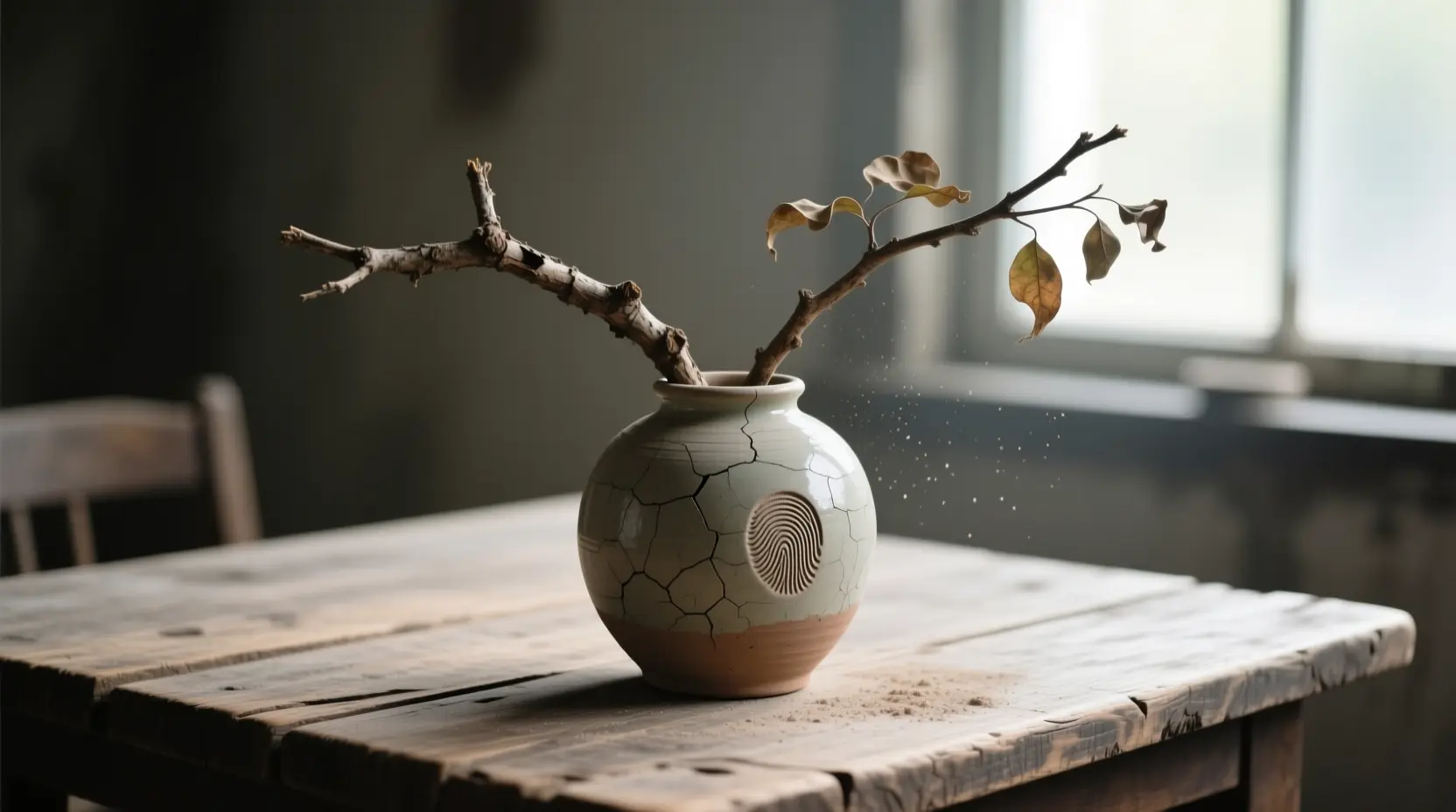
A Thumbprint in the Clay, a Breath in the Glass
The clay remembers the riverbank. The slow, silty water. The press of roots. The glass holds the ghost of the furnace, the maker’s held breath suspended forever in its curve. To speak of a vessel shaped by this view is not to catalogue objects. It is to trace the shadow of a philosophy with your fingertips. To find the sublime in the fleeting, the cracked, the quietly incomplete. A vase, in this understanding, is not a container. It is a companion to the bloom and the wilt. A silent monument to a single, passing season of light.
Come. Sit by the hearth of this thought. Let the warmth of the making wash over you. Feel the cool truth of time settle in your bones.
The Whisper of Unrefined Earth
Begin with the clay. The humblest of beginnings. Mud. Dust. Water. A memory of the riverbed given form by human hands. The rustic vase does not hide its origin. It is of the earth, earthy.
The wheel turns, a perfect, spinning symmetry. But the wabi-sabi spirit often steps away from the wheel. It chooses the hand-built vessel. Pinched. Coiled. Slab-formed. Here, you will see the marks. The gentle pressure of a thumb, a Tuesday afternoon indelibly recorded. The trailing scrape of a tool, a moment of distraction made permanent. These are not flaws to be smoothed away. They are the signature of a lived day. A mood. A fleeting thought hardened in the kiln’s fierce embrace.
The glaze, if one is used, may run like a slow tear down the side. It might pool in the foot, a deep, unexpected lake of color. Or it may be absent altogether, leaving the raw clay to breathe. To drink from the water you offer, darkening at the rim like a stone kissed by rain. It asks for a single, wind-bent branch of hawthorn. A sprig of dried meadow grass. It asks for nothing more. It is complete in its lack.
The Rhythm of Captured Air
Now, turn from the solid ground to the element of air. To handblown glass. Here, wabi-sabi is not in the pursuit of flawless clarity. It is in the dance with impossibility—the capturing of a breath, a rhythm, in solid form.
Watch the gather of molten glass at the pipe’s end. A living, glowing seed. The breath enters. The vessel begins as a bubble, a mere possibility. The turning. The stretching. The gentle, swaying dance—this rhythm is imprinted upon the material. In the truest of these vases, you can still see that rhythm frozen.
Seek the piece with a slight undulation in its wall. A place where the glass thickens, like a deep thought, or thins to the transparency of a dragonfly’s wing. Look for the tiny, trapped star of an air bubble. The pontil mark at the base—the scar where the rod was detached—is never ground perfectly smooth. It remains. A proud navel. This glass vase speaks of fluidity arrested. It holds light as the clay holds water. It is perfect because it confesses its making.
The Grace of the Worn Edge
A true wabi-sabi vase does not fear time. It invites time as a collaborator. This is where the soul deepens.
Imagine an old peasant jug. Its once-glossy glaze now crazed with a million fine lines. A spiderweb map of its thermal history. Of winters in a cool cellar. Of summers on a sunlit sill. This is kintsugi of the most subtle kind—not repair with gold, but adornment by the passage of days. The wood ash that drifted into the glaze during a long-ago firing, creating a rough, pebbled texture. These are not accidents. They are the text of the object’s life.
Perhaps there is a chip. Not a violent break, but a soft departure. Like a leaf letting go. The edge is worn silken by the caress of decades. Your thumb finds its home there. A tactile memory of all the other hands that have held this vessel. You do not see damage. You see endurance. You see a story of survival. This vase has absorbed silence. It has witnessed generations of peonies, of morning light slanting across wooden tables. It is no longer just a vase. It is a repository of quiet.
Choosing Not with the Eye, But with the Palm
How, then, does one choose such a companion? You do not choose with the eye alone. You choose with the palm of your hand. Feel its weight. Does it sit with grounded certainty? Does it lift with ethereal hope? Listen. Tap the clay with a fingernail. Does it ring a clear, high bell? Does it murmur a low, earthy thud? Hold the glass to the window. Watch what story the light tells as it passes through.
Do not seek a “set.” Harmony here is not found in matching. It is found in resonance. A rough-hewn, dark clay vase might resonate with the smooth, grey driftwood on your shelf. A bulbous, blue-glass vessel might sing the same song as a bowl of river-worn stones. Let them converse. A single vase, alone on an empty shelf, can be a haiku. Three, of different heights and origins, can be a quiet dialogue between old friends.
The Flower as a Passing Guest, The Vase as the Steady Host
And the flowers? In this view, the flower is not a decoration for the vase. Nor is the vase a mere stand for the flower. They are fellow travelers. Brief companions in the season of their existence.
The vase of rugged, crackled clay is the mountain. The single, towering stem of delphinium is the weather that dances upon it. The delicate, thin-blown glass vase is the morning dew. The sprig of cherry blossom within it is the brief, pink sun of dawn. You arrange not for fullness, but for space. For asymmetry. For the graceful line that echoes the branch outside your window. You honor the bud, the full bloom, and the first curling brown edge of the petal with equal reverence. The vase holds them all. It remains. A calm, steadfast witness to the cycle.
The Soul of the Object, An Anchor in the Current
In the end, we are not speaking of decor. We are speaking of kinship. A wabi-sabi vase is an anchor in a world of noise and ceaseless replacement. It teaches without words. It teaches you about the beauty of a quiet corner. About the dignity in a well-earned scar. About the profound elegance of enough.
It whispers: I was made by a hand, not a machine. That hand knew joy, or fatigue, and you can feel the difference. It murmurs: Time has touched me, and I am more beautiful for it. It states, without sound: I will be here, steady, as the flowers come and go.
To live with such an object is to let its philosophy seep into your skin. A crack in a cup becomes a memory, not a reason to discard. The fading of cloth becomes the softness of twilight. The silent vase on your table is a daily, gentle reminder. A reminder that beauty is not a polished surface, but a deep resonance. That perfection is a frozen state, but completeness can be found in a thing that has lived. That bears the honest marks of its journey. That offers itself not as a final statement, but as a quiet, ongoing conversation. A conversation between the earth, the maker, time, and you.
So find your vase. Not the most perfect one. But the one that feels like it has always been waiting. The one with the thumbprint you somehow recognize. The one that holds the light in a way that makes the afternoon slow, deepen, and settle. Bring it home. Let it sit empty for a while. Listen to its silence. Then, go gather a single branch from the storm-damaged tree at the edge of the field. Place it inside.
And understand. This is not decoration. This is a quiet agreement with the nature of things. This is the beginning of seeing the world, at last, as it truly is. Perfectly imperfect. Eternally transient. And profoundly, quietly beautiful.