The question arrives on the edge of a thought. A morning exhale. Why linen? It does not arrive with the clamour of a manifesto. It is the soft, persistent sound of a thread pulling through a needle’s eye in a quiet room.
In a world of sealed silks and shouting synthetics, linen is a whisper. It is a grammar of breath and grain. To choose it—for the bed where you dream, for the window that frames your sky—is to learn a different language. One spoken by seed and stone, by rain and loom. It is to invite not a décor, but a slow, weathering presence into the heart of your dwelling.
The Unhurried Genesis: From Rock to Loom
It begins in poor soil. The flax plant is a study in quiet ambition. It asks little. Takes less. It grows where other things might not, its roots gripping rocky earth, drawing a kind of stern vitality from scarcity. Its bloom is a brief, blue ecstasy—a single day’s confession of colour before it returns to its green resolve. This is the first, silent lesson woven into its fibre: beauty is not an escape from struggle, but its most patient expression.
The making is a liturgy of time. The plants are pulled, not cut, a careful uprooting that honours the full length of the thread-to-be. Then, the surrender. Retting. They are laid in fields for the dew to knead, or sunk in the slow breath of a creek. Water and microbe work in concert. A gentle rotting. A collaboration with decay, which is only another name for transformation. The soft parts fall away, leaving behind the enduring.
Then, the ancient, rhythmic verbs: beating, scutching, hackling. Labour that sounds like the land itself. What emerges is not a uniform filament, but a collection of individualities. Thick and thin. Long and short. A community of fibres, each with its own character. This inherent irregularity is not a flaw to be corrected. It is the soul of the cloth. The source of its slubbed, living texture. The seed of its whisper.
A Grammar of Breath and Shadow
Lay your palm upon it. It offers a coolness. Not the dead chill of metal, but the cool of a stone in deep forest shade, or the underside of a leaf. This is its primary language: thermic wisdom. Its hollow fibres are tiny channels for air, for moisture. They wick, they breathe, they release. In heat, it is a dry sigh of relief. In cool, a gentle, breath-warm embrace. It does not insulate you from the world. It mediates. A translator between skin and air.
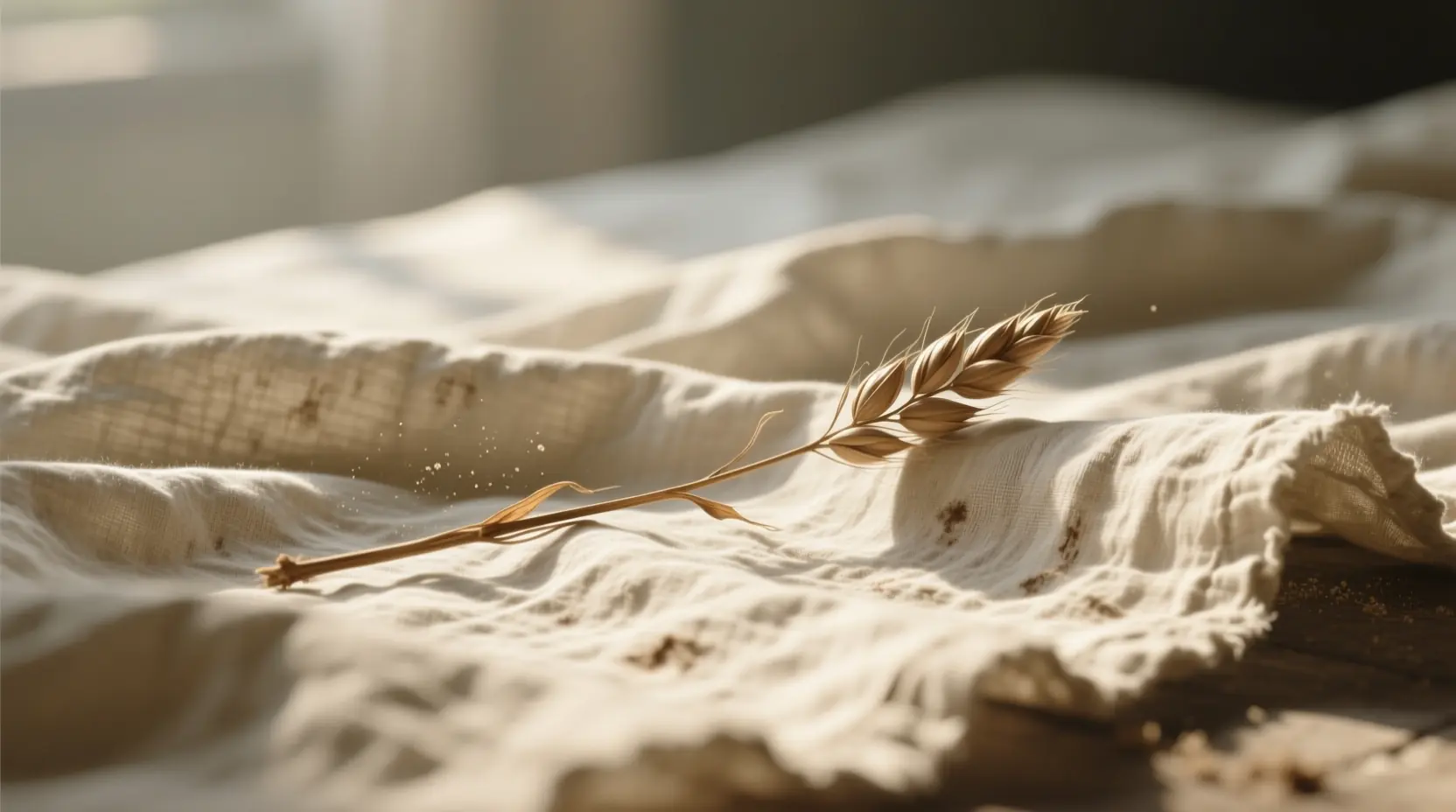
To sleep under linen is to sleep within a cloud of atmosphere. The fabric moves. It sighs. It crumples with a soft, leaf-litter rustle. The creases are not imperfections to be ironed into submission. They are the cloth’s memory of the body. A topography of rest. In the low morning light, a linen-covered bed does not look staged. It looks lived. It holds the shape of absence, the beautiful rumple of a human having been truly, deeply at peace.
And at the window? A linen curtain is a different kind of boundary. It does not shout ‘privacy’ with a stiff, opaque wall. It breathes with the day. A breeze enters it, fills it like a lung, lets it fall. It filters light, transforming the insistent glare of noon into a soft, diffused glow—the light of old parchment, of dust motes in a cathedral. Sun reveals the weave: each slub, each variation, becomes a tiny hill or valley catching the light, making the whole surface shimmer like moving water. At night, from a path, a lamp behind a linen curtain does not glare. It glows. A humble, golden beacon. A held breath of light.
The Patina of Days: An Earned Softness
Here lies the deepest magic. The heart of the matter. Most things age toward decay. Linen ages toward character. It submits to a slow, beautiful metamorphosis—a patina earned through cycles of use and care, of sun and water.
New linen has a crispness. A certain austerity. It is strong, a little stubborn. But with each wash, with every night of sleep, it softens. Not into limpness, but into a profound, pliable strength. It becomes like the palm of a gardener’s hand—tough, yet supple; marked, yet deeply capable. The colours, often born of earth and root, gentled by time. An iron-rich ochre softens to the tone of sun-baked clay. A deep weld yellow mellows to the pale gold of late-season grass. A stark white becomes ivory, then cream—the colour of old sunlight in a room.
The stains, the faint marks, the softened hems… these are not failures. They are the scripture of a life lived within this cloth. They are its narrative. A drop of tea, a line of salt from dried sweat, the subtle thinness where a foot rests nightly. This is the cloth’s kintsugi. Its golden repair. But the gold here is not lacquer. It is memory. It is evidence. Proof of companionship.
Weaving a Sanctuary of the Imperfect
Wabi-sabi is the art of perceiving beauty in the transient, the imperfect, the humble. Linen is its natural apostle. What is more transient than sleep? More imperfect than the vulnerable human form at rest? Linen does not disguise this truth. It hallows it. It provides a cradle that whispers: Here, you may be as you are. Weary, tangled, unfinished. I will hold you, and in my folds, your rumpled humanity will look like grace.
To choose linen is to cast a vote for slowness. For a tangible authenticity. It is a quiet resistance to the frictionless, the disposable, the mute. In an era of noise and gloss, it offers a sanctuary of texture. A tactile poetry.
It connects the most intimate ritual—sleep—to the old cycles of field and season. Your bed becomes a small, personal landscape. Your curtain, a responsive skin between you and the world. The ecology of this choice is profound. After a long life, a life that can span generations, softening and sweetening with time, linen completes the circle. It returns to the earth. Biodegradable. A final, silent offering. From dust to dust, having served with a humble, graceful integrity.
So. Why linen?
Because it breathes with you. Because it remembers. Because it grows more beautiful not in spite of the years, but because of them. It does not aspire to perfection. Only to truth. It is the fabric of weathered cedar and rain-smooth stone. It is the companion to the quiet mind.
It is not a commodity. It is a collaborator in the art of living. It asks for your patience, and in return, it gives you a daily, tangible meditation. In its rumpled embrace, under its whispering veil, we are reminded of a quiet, essential thing. Beauty dwells not in the flawless, but in the lived-in. Not in the pristine, but in the beloved. Not in forever, but in the graceful, gentle, and exquisite art of letting go.