The Space Between Breaths
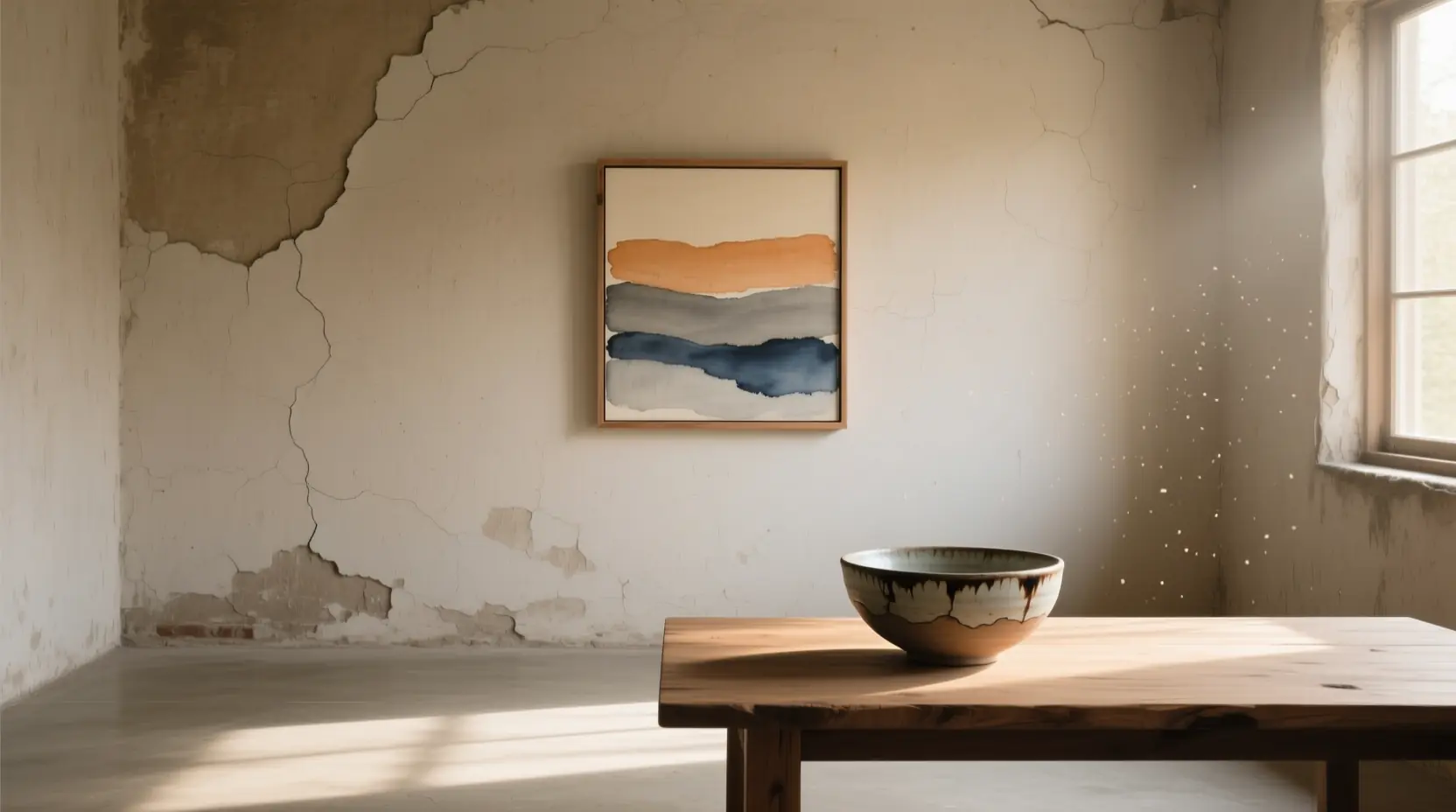
A room, stripped. Not of life, but of noise. The floorboards, naked. Their grain a topography of years. The wall, a plain of waiting light. The window, a geometry of sky. You have swept the dust of wanting. What remains is not emptiness. It is potential. A vessel, not for filling, but for holding. A bowl of quiet.
This is the fertile void. The beginning.
To place art here is not to decorate. It is to complete a sentence the room has already begun to whisper. It is to drop a single, smooth stone into still water. The ripples must be true. They will touch every shore.
On Listening to the Light
Do not bring the object first. Bring your breath. Your patience. Sit in the corner when dawn is a slow bleed. Watch the wall receive it. A gentle suffusion. A lover’s touch. Return at noon. The light is flat, honest. A clear-eyed gaze. Come again at dusk. When shadow is not absence, but a soft presence. A deepening.
The wall is already speaking. It speaks in the language of texture. The ghost of hand-troweled plaster. The cool kiss of gypsum. The rough honesty of limewash, swallowing light. Your art will join this chorus. It must harmonize, or hold a respectful, solitary note. A rough-hewn canvas might find its echo here. A pane of polished silver might lie silent, a cold moon on warm earth. Listen. The light will tell you. The shadow will show you where the weight should fall.
The Object That Has Lived
In a space of breath, every object carries the gravity of a world. Its soul is laid bare. Here, beauty is not a shout of color, a demand for admiration. It is a quiet revelation in a cracked glaze. A revelation in the warp of wood that remembers the wind. In the frayed edge of linen, whispering of touch.
Seek the piece that feels found. As if you uncovered it beneath roots, or pulled it from a riverbed. A fragment. A shard charged with time.
A single branch, posture perfect in its asymmetry. A piece of sea-worn glass, its edges softened by a thousand tides. A weaving, the undyed wool holding the scent of field and animal. A photograph where the blacks are deep pools, and the subject is secondary to the feeling of the moment suspended.
Avoid the flawless. The virginal. Perfection is a closed door. Seek instead the beauty of the open hand, the weathered face. The wabi-sabi truth. A bowl with a kintsugi seam of gold—the repair more precious than the whole. A painting where the weave of the canvas breathes through the pigment, a reminder of its humble ground. These pieces do not boast. They simply are. They have accepted their history. In your silent room, they become anchors. Stones of realness in a sea of air.
The Frame as a Horizon
The frame is the final breath of the object before it meets the world. It is the shoreline. In this quiet place, it must be a transition, not a barrier.
Consider the courage of no frame. Let the paper, fragile and bold, meet the wall. A direct communion. Or choose wood that remembers it was a tree. Knots like eyes. Grain like flowing water. Blackened steel, thin as a line of ink at dusk. A float frame, granting the art a halo of space, a moment of levitation.
The mat, if there is one, should be a field. A wide, silent plain around a small, potent well. Its color: the grey of dawn fog. The pale oat of winter grass. The soft white of sun-bleached bone. This space is not passive. It is active silence. It is where the eye rests, gathers itself, before returning to the heart of the thing.
The Act of Suspension: Not Hanging, but Offering
The nail. The hook. The wire. A moment of violence, transformed into ceremony. This is the final gesture. It must feel inevitable. As if the art has always been there, waiting to be discovered.
Forget the measured gallery standard. That is for passing glances. You are crafting an encounter for a soul at rest. Sit in your chair. The one worn to the shape of you. Stand where you pause to watch the evening come. Hold the piece against the wall. Feel. There is a point where the tension dissolves. Where the object settles into the field of the wall as a seed settles into soil. It is not about height. It is about relationship. To the floor. To the light from the window. To the line of a table below.
Often, lower is truer. Let the art rise from the earth of the room. Let it commune with the low table, the stack of books, the solitary cup. Create a constellation, not a parade. Two pieces… ah, two pieces are a conversation. Hang them close. Intimate. Let them share a secret. Align them by their spirit’s center, not their manufactured edges. One may be a vertical prayer, the other a horizontal sigh. Together, they are a haiku.
The Emptiness That Holds Everything
This is the heart of it. The secret the minimalist room guards. The art is not the object. The art is the dialogue between the object and the space that cradles it. The emptiness is not a void. It is the most essential element. It is the silence between notes that makes the music.
Do not fear the vast, blank wall stretching beyond your small, potent stone. That blankness is its counterpart. Its reason for being. It is the stillness that gives the note its resonance. A tiny ink drawing on a wide, white wall is not a mistake of scale. It is an act of profound focus. A single star in a dark sky. The emptiness is where you, the viewer, are invited in. Where your own thoughts become part of the composition. You are not building an altar to be seen. You are framing a silence to be felt.
Patina and the Passing of Days
Then, you live. The art ceases to be a thing you placed. It becomes part of the room’s breath. The morning sun will find its edge, tracing a line of fire that slowly retreats. The damp afternoon will soften its colors. The deep night will absorb it whole, leaving only a memory of shape. Dust, the softest of patinas, will alight. This is not neglect. This is integration. The art and the room, aging in concert. Telling time together.
The urge will come. To add another piece. To fill a perceived lack. Wait. Sit with the lack. Let a full cycle of seasons pass. See how the stone feels in the hard, angular light of January. See how it sleeps in the humid green glow of August. A room like this is not a statement. It is a living, breathing organism. Each object is a vital organ. To add another is not decoration; it is surgery. It must be a necessity born of deep listening.
In the end, a single, well-placed object in a quiet room performs the simplest, most ancient magic. It stills the inner tide. For a breath, for a glance, it gathers the scattered self. It asks nothing. It offers only its own quiet being. It becomes, then, more than an object. It is a mirror reflecting your own stillness. A window into a deeper layer of the day. A companion in the graceful, slow unraveling of hours.
This is the true craft. Not of arrangement, but of attention. Not of possession, but of stewardship. You are not a curator. You are a keeper of silence. A tender of space. And in this vessel of light and air, you have placed not a commodity, but a touchstone. A single, enduring note in the quiet, ongoing song of home.