The Wood’s Whisper, The Light’s Arrival
For years, I sat with wood. Not to command it, but to listen. In the workshop’s morning hush, I watched. Not the hard, declarative light of noon—that flattener of grain, that bleacher of story. I waited for the oblique guest. The early light. The late light. The light that comes not from above, but from the side, moving with the patience of a season. It would whisper along the oak’s ridges, pool in the ash’s open pores. It revealed a topography the glare could never see. A map of drought and rain, of struggle and stillness. A soul.
And So It Is With Rooms
We have been taught a tyranny of the single source. A central sun, hung from a wire. A switch flipped, a conquest declared. ‘Let there be light,’ we say, and believe the matter settled. We have not banished the dark. We have only illuminated our own poverty of seeing. Traded a universe of subtlety for a single, dead sentence.
Consider the Clearing, Not the Command
There is no main light in a forest clearing. No central sun in a cave. Light, there, is a pilgrim. It filters. It dapples. It is caught, reflected, given second life on the skin of a pond, the underside of a leaf. It glows from the heart of decaying wood. It is never one thing. It is a murmuring conversation between substance and air. Between what is solid and what is possible.
A room should be no different.
To live under a main light is to stand forever at a harsh noon. Shadows are short, unforgiving. Secrets are impossible. Everything is offered, nothing is revealed. There is no rest in such a place. Only exposure.
The Tyranny of the Single Shadow
One light begets one shadow. A hard, desperate twin pinned to the floor. It flattens a face into a mask. It makes a book, a bowl, the curve of a shoulder, seem common. Stark. This is the light of interrogation. It demands, ‘What are you?’ but has no patience for the depth of the answer. It forgets. It forgets that beauty is not a surface, but a dimension. A soul has layers. It must be approached from angles, with a sidelong glance, in the kindness of partial revelation.
Instead, Invite the Glow
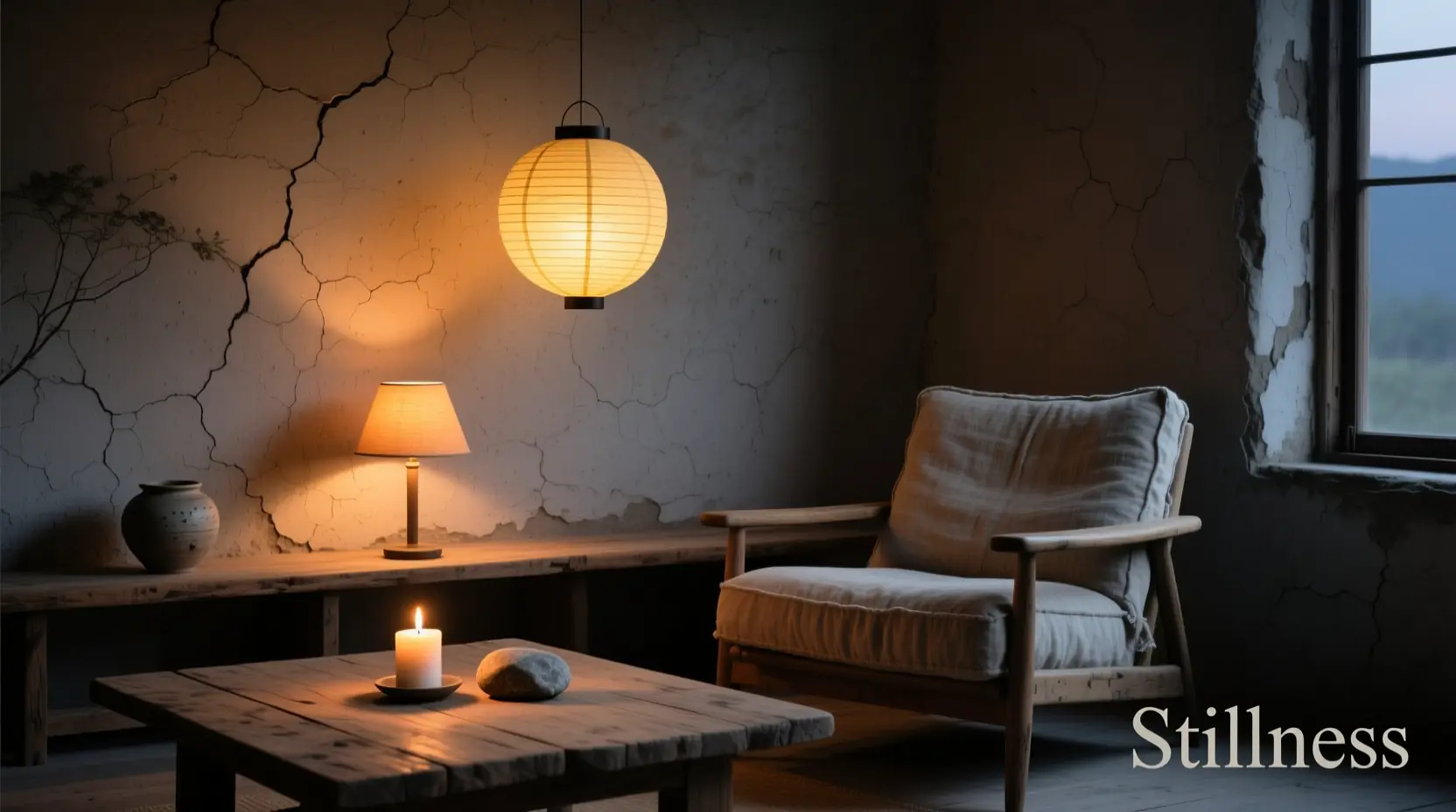
A glow does not announce. It arrives. It is light that has touched something else first. A wall of rough clay. A sheet of handmade paper, fragile as a moth’s wing. The weathered linen of a shade. Light softened by encounter. Weathered by it.
You find it in the low, steady breath of a lamp behind a chair—its light lapping at the walls like gentle water. In the modest halo of a sconce, washing the texture of plaster into being. In the humble dedication of a small clay lamp on a shelf, illuminating not the room, but the single, perfect silence of a stone.
This is the light of the in-between hours. Of dawn and dusk, when the world is held in a velvet pause. The air, ripe with becoming. This is the light that does not command you to look. It whispers, ‘Sit. Stay. Simply be.’
The Alchemy of the Indirect
Place a light where you cannot see its source. Let it graze a wall, a slow caress. Let it spill upward onto a ceiling, a memory of sky. This is the oldest magic. It turns the architecture of your room from a boundary into a collaborator. The wall becomes a canvas. A reflector. A secondary sun, warm and muted.
The light becomes ambient. It fills without pointing. It is the difference between shouting a name and whispering it into a quiet room. The whisper travels farther. It lingers in the corners. It invites the shadows closer.
Embrace the Pool of Darkness
To cherish light, you must first cherish shadow. A perfectly, evenly lit room is a soul without mystery. A story with no pauses. It is exhausting.
Allow corners to recede. Let a deep pool of darkness sit beside a lit one. In that darkness, the mind can rest. The eye finds respite. The illuminated object—a single stem in water, the gilded edge of a page—becomes sacred. Chosen. It is pulled from the void.
The Japanese have a word: yūgen. The profound, mysterious beauty of the hinted-at. The suggestion that lies beyond what can be seen. A room lit only by glows is a room full of yūgen. It suggests more than it reveals. It honors the unseen.
Vessels That Remember
The light is only half. The vessel that holds it carries equal weight. Seek materials that age. That tell their own story in the light they filter.
- Weathered Paper. Like the skin of a wise one. It holds a memory of sun within its fibres. A paper lantern does not transmit light; it glows from within. A soft, cellular radiance.
- Textured Linen. It breathes. It lets light pass through in a gentle, diffused sigh. No hard edge. Only a field of warmth, like dust in a sunbeam.
- Unfinished Wood. The grain drinks the light and gives it back, warmer, richer. Over years, the base darkens where hands have touched it. A record of presence. A patina of life.
- Hand-Thrown Clay. Imperfect. Slightly irregular. It cradles the light, gives it weight and substance. As if the glow itself was pulled from the earth, still damp and quiet.
- Tarnished Metal. Copper, brass, pewter. They do not reflect so much as they respond. Offering a muted, complex answer to the flame within. A conversation in oxidation and time.
These are not fixtures. They are companions. They gather patina. They soften. They prove that the best light is light that has lived.
The Ritual, Not The Reflex
With many small glows, lighting becomes ceremony. Not a reflex. You do not ‘turn on the room’. You awaken it. In stages.
As evening deepens, you might first light the lamp by the chair. A small island in the gathering tide. Then, perhaps, a candle on the table. Later, a low light in the hall to guide the way to sleep. You are not flooding a space. You are tending to it. Answering the growing dark with specific, intentional gifts. This ritual slows the evening. It honours the transition. It marks the passage from day to night not as a defeat, but as a gentle turning.
A Quiet Ecology
In the end, this is the cultivation of a quiet ecology. Each light source is a species with its own niche. The floor lamp, a tall tree offering canopy light. The shelf light, a low plant with its own bioluminescence. The candle, the campfire. The primal, beating heart.
Together, they create an ecosystem. It breathes. It has depth, and rhythm, and pockets of restorative shadow. It is a living space. Not a lit one.
The main light is a statement. It shouts, ‘Here I am.’
A gathering of glows is a conversation. It murmurs, ‘Come. Sit. Look here, where the light just found this curve. Now rest here, in this softness. See how the wall remembers?’ It is a lifelong dialogue between dark and light. Between object and emptiness. Between person and place.
Carving the Darkness
I no longer work only with wood. I work with darkness. I carve it away—not with chisels, but with gentle, considered light. I shape the shadows until the room feels not like a box under a sun, but like a forest clearing at twilight. Or the quiet interior of an old temple, where the air itself holds a soft, golden memory of all the prayers ever whispered there.
Ditch the main light. Not from lack, but from abundance. For in its absence, a hundred quieter, kinder suns may rise and set in your own home. Each one a revelation. Each one an invitation to truly, finally, see.