The Arrival of a World Unfinished
A new soul enters a universe of edges.
Light, a shard. Sound, a tide. Breath, a tempest in a miniature sea. All is first. All is etched. We, the keepers of the threshold, reach for softness. We gather the lamb’s wool, the down. Yet in our haste to cushion, we build a fortress of noise. Plastic parades in garish hues. Walls that hum with false cheer. We offer a carnival where the deepest need is for a chapel. A sanctuary of silence.
There is an older whisper. A path worn smooth by patience, not purchase. It honors the crack in the bowl. The moss on the stone. The silvered driftwood, shaped only by sea and time. It is wabi-sabi. Not a style, but a way of seeing. A reverence for the transient, the imperfect, the quietly incomplete. This is the welcome a new soul deserves. Not a shout, but a hushed invitation into the beautiful, imperfect real.
A Canvas of Almost-Dawn
Begin with the vessel of air. The walls.
Do not bind them with the colors of certainty. Think instead of the moment before definition. The grey-blue sigh of a sky just remembering the sun. The pale, milky green of lichen sleeping on north-facing stone. The soft, warm breath of unbleached paper. These are colors that carry memory. They have absorbed light and softened it. They do not reflect glare, but a glow. A lullaby for the eyes.
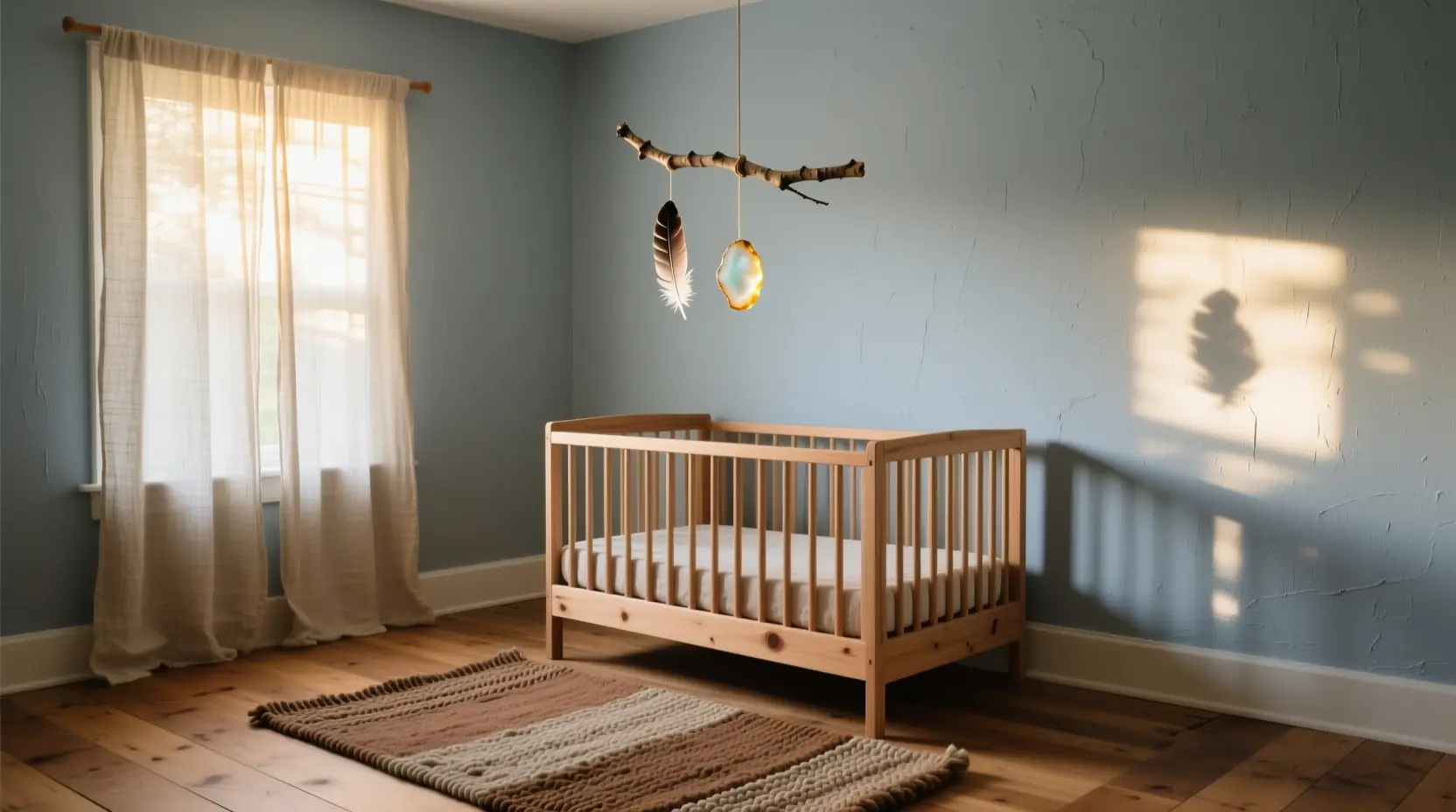
Consider the touch of earth. Clay or chalk upon the plaster. They bring a subtle grit, a breathability. A wall ceases to be a flat plane; it becomes a skin. A quiet landscape that changes with the angle of the sun, casting soft, wandering shadows. It asks no attention. It simply provides a gentle horizon.
The Poetry of Things That Remember
Into this quiet sky, we place objects. But not just any objects.
Seek the ones that hold a silent narrative in their fibers, their grain. Wood that has not forgotten the forest. A crib of oak, its surface whispering of rings and rainfall. Feel for the slight undulation where a handplane passed, a human rhythm caught in the surface. This is not a flaw. It is a signature. A heartbeat.
Choose a woven basket of willow over a sealed container. It speaks of riverbanks and flexibility. It has a scent. A give. It will creak softly as it ages, a companionable sound. A rug of undyed wool, thick and nubby, its weave slightly irregular—this is a field for tiny hands to traverse. A topography of comfort.
For cloth, seek the breath of the field. Raw linen, still carrying the scent of flax. Organic cotton, softened by countless suns. Their colors are not injected, but inherent: oat, fog, dried moss, twilight. They welcome washings. They grow supple, like a beloved palm. A stain here is not a disaster, but a footnote. A memory of peach, of grass, of life being lived. To demand sterile perfection is to wage war against the gentle evidence of existence.
Gateways of Felt Knowing
A newborn knows through the portals of skin, ear, and mouth. The room must be a tender tutor.
Touch is the primal tongue. Let every surface be an invitation. The cool, profound smoothness of a single river stone, kept for its quiet weight. The nubby, forgiving texture of a hand-knit woolen square. The silken interior of a found seashell. The rough, honest weave of a rush mat. These are a child’s first geography—lessons in the world’s diverse caress.
Sound is an atmosphere. Resist the mechanical lullaby. Listen instead to the natural orchestra. The low, rhythmic creak of a rocking chair—a wooden heartbeat. The faint rustle of a philodendron’s leaves. The distant sigh of wind in the eaves. The soft, solid clunk of one wooden block meeting another. Above all, the human voice: reading, humming, whispering. It needs no accompaniment. And between these sounds, allow the sacred space of silence. The fertile void where the soul can root itself.
Sight learns to focus in the subtle. Forgo the spinning circus of a plastic mobile. Suspend instead a slender, barren branch of birch. From it, hang a single feather, a slice of geode that holds captured light, a smooth ring of horn. Its movement is the slow, unpredictable dance of a leaf on a pond’s surface. It teaches the eye patience. It casts fleeting, poetic shadows upon the wall. It is a fragment of the wild world, invited in as an honored guest.
The Grace of Enough, The Dignity of Use
The modern cradle is often buried under an avalanche of the anticipated. The wabi-sabi way is the way of the essential. And to see the essential as profoundly sufficient.
A low futon upon the floor, encircled by sheepskin, is a nest for dream and discovery. It asks the adult to descend. To kneel. To meet the child’s world on its own terms. It has no bars. It is a landscape, not a cage. A changing place is simply a padded mat upon a wide, low chest of drawers. The chest holds the few, necessary things. Muslin cloths. Simple garments. A ceramic pot of balm.
There is space. Glorious, empty space to roll, to gaze at a shaft of sunlight, to simply be. The room is not shouting with the potential of tomorrow. It is whispering the sufficiency of now. Each object, chosen with deliberation, has room to breathe. This emptiness is not austerity. It is generosity. It is the blank page upon which a child’s imagination will write its first, wordless stories.
When a toy is called for, let it be an open question. A set of ashwood bowls that nest, hide, become a mountain. A doll of linen, its face a few stitches of thread, leaving expression to the heart of the holder. A handful of wooden blocks, their surfaces bare, ready to be a fortress, a train, a treasure clutched in sleep. They do nothing. Therefore, they can become everything. They are partners in exploration, not pre-programmed directors of it.
Time’s Gentle Signature
This philosophy does not flinch from the passage of days. It welcomes the soft trace of their passage.
The pale wood of the crib will deepen to honey-gold, kissed by years of light. The linen curtain will fade at its hem, a memory of countless sunrises. The wool blanket will gather pills at its edges, a testament to nights of solace. A book of poems, read and re-read, will soften at the spine, its pages growing supple with love.
Do not rush to erase every scratch. Do not conceal the darned tear. These are the quiet autographs of a life being lived. They are the antithesis of the shiny, the disposable. They speak of care, of continuity. They whisper to the child, long before words are understood, that things can be cherished, that they carry their history within them, and that this is where their deepest beauty resides. That nothing is flawless, and nothing is permanent, and there is a profound, quiet grace in this truth.
This room is not a diorama. It is an ecosystem. A potted fern, thriving on the shared breath of its tiny companion. A shallow dish of water evaporating to soften the air. A single camellia blossom in a humble vase, its fleeting perfection a lesson in the poetry of ephemerality. It teaches, without a single syllable, the cycles of all things: growth, bloom, decay, and rest.
The True Hearth
In the end, the most vital element of a wabi-sabi nursery is not an object you can place.
It is you.
Your calm presence is its truest warmth. Your unhurried hands are its softest fabric. Your steady breath is its most reliable rhythm. The room is merely a vessel—a bowl shaped to hold the sacred, chaotic reality of early life: the spilled milk, the tear-stained cheek, the weary, wondrous love—and to frame it not as mess to be cleared, but as evidence of a life being fervently lived.
It whispers, to the raw new soul and to your own: Here, you are safe. Here, you are sufficient. Here, in this quiet corner of an imperfect world, you may be perfectly unfinished, and utterly beloved. We will watch the dust motes spiral in a sunbeam. That will be our grand spectacle. We will listen to the rain’s percussion on the roof. That will be our symphony.
This is the deepest peace. Not the absence of all sound, but the presence of a profound harmony. A harmony found in the whisper of grain, the sigh of cloth, the cool solidity of stone, worn smooth by a river’s patience. A harmony that murmurs to the arriving spirit: Welcome. The world is vast, and bright, and sharp. But here, you may begin. In the gentle, enduring arms of all that is simple, and real, and quietly, imperfectly true.