Not an Engine, but an Altar
The kitchen is the heart’s hearth. Not its engine. This is the first forgetting, and the deepest. We mistake the room for a crucible of efficiency. A place of shrieking steel, of frantic light on polished chrome, of tasks that multiply like whispers in a cavern. We fill the air with the noise of doing. And in the clamor, the true purpose grows quiet, recedes. It becomes a ghost in its own home.
This is a place of alchemy. The most fundamental kind. Grain surrenders to become bread. Leaf bleeds into water to become tea. Bone and time conspire to create broth. This transformation is sacred. It deserves a vessel of peace. Not haste.
We must listen. Beneath the hum of the refrigerator, there is a slower rhythm. The patient rhythm of dough rising. Of broth simmering. Of tea steeping. To hear it, we must unmake the noise. We must consider the shore upon which this quiet life washes up: the countertop.
The Long, Blank Shore
We treat it as a battlefield. Or a display. We crowd it with machines of promised convenience, their blank faces and sterile curves. We conquer the emptiness. And then we wonder why the room feels brittle. Anxious. Why our own breath feels short within it.
There is another path. A slower one. It does not begin with acquisition, but with removal. And then, with a different kind of invitation. It begins not with silicon and circuitry, but with earth. With memory. It begins with clay.
The Clay Remembers the Silence
All true things begin in silence. The clay remembers this. Its first memory is the cool, dark press of the riverbed. The weight of millennia. The print of a passing root, the slow turn of sediment. The potter’s wheel is not creation, but evocation. A summoning of form from the formless mass. A remembering of curve and containment.
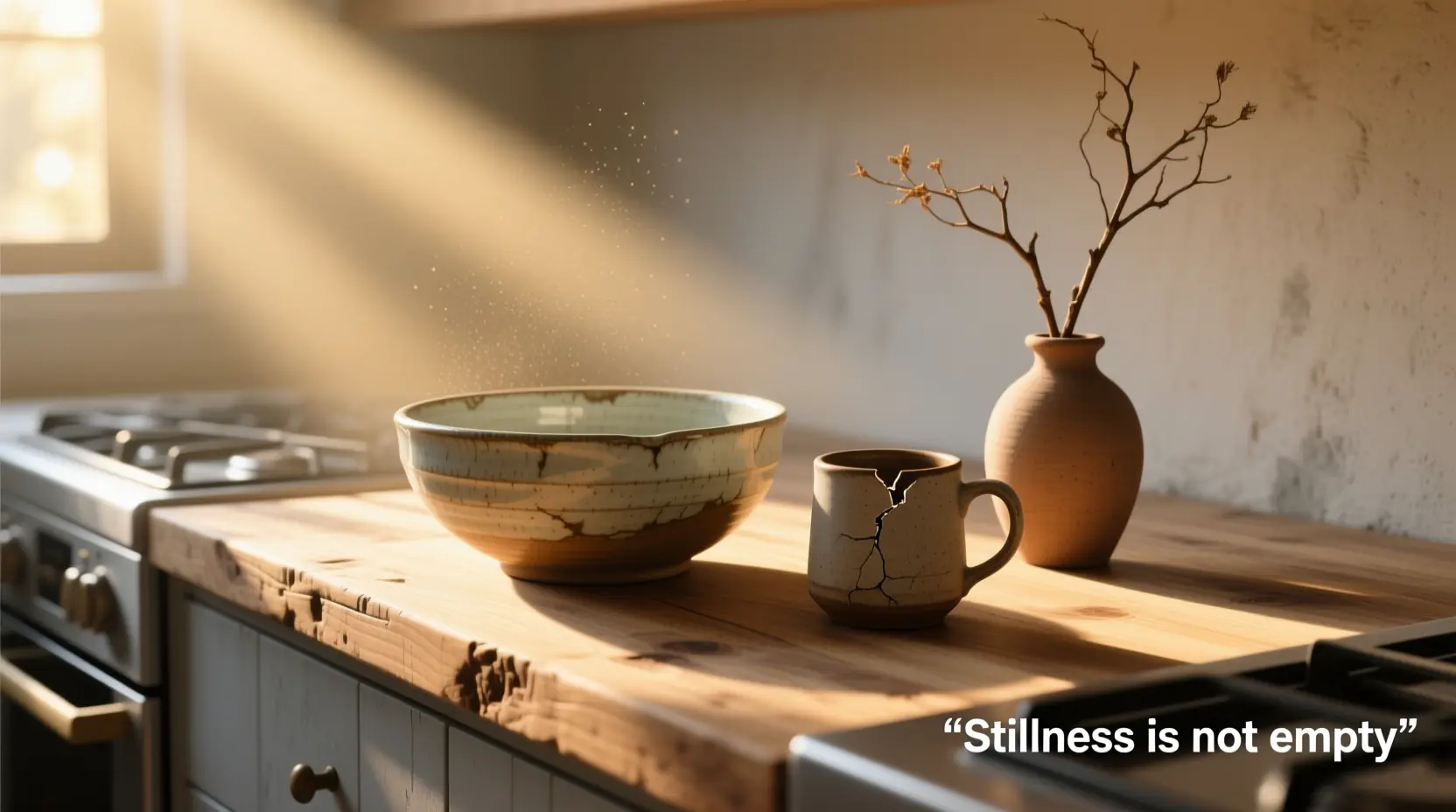
To bring a ceramic piece into your kitchen is not to bring an object. It is to bring a fragment of that primordial silence. A captured stillness. Feel the weight of a large, glazed mixing bowl as you set it on worn wood. It does not clatter. It settles. It submits to gravity with a gentle finality. I am here to hold. For your batter, yes. But also for the slant of morning light. It will hold that, too. See how the light, unlike on steel, does not scream away in a sharp glare. It enters the curve. It pools. It becomes soft, liquid gold. It becomes part of the bowl’s story. This is the first, whispered lesson: choose vessels willing to hold more than their function. Vessels that hold the light, the gaze, the lingering moment.
A Communion of the Imperfect
Do not seek a matching set. That is the language of the catalogue, the showroom floor. It speaks of a fear of difference. The mindful kitchen listens to a different, older tongue. It is not a set, but a gathering. A communion.
Like stones in a creek bed. Each one worn smooth by a different current, a unique journey. A pitcher from a country fair, its glaze running like a single, frozen tear. A mug shaped by a student’s hands—uncertain, earnest, and therefore profoundly beautiful. A plate passed down, its surface a web of fine cracks mapping a hundred shared meals, a thousand careful washings.
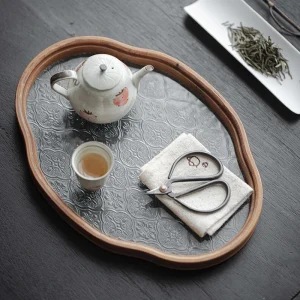
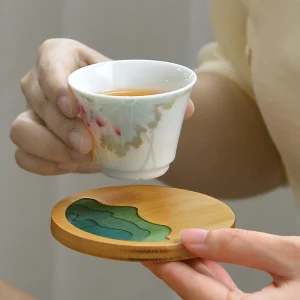
Let them converse. Not in the loud, uniform chorus of a marching band. But in the quiet, nuanced harmony of a string quartet. The rough, thirsty texture of an unglazed sake cup. The profound, oceanic depth of a celadon glaze. The warm, rusty blush of a terracotta teapot. Place them near one another. Let rough converse with smooth. Let matte sit beside glossy. Let dark rest against pale. This is not mere decoration. It is the creation of a miniature landscape. A world in itself: mountain and valley, riverbank and stone.
The Sacred Pause: Ma
We are afraid of emptiness. We rush to fill it with noise, with stuff, with intention. But the quiet kitchen understands ma. The Japanese concept of the sacred pause. The potent, pregnant space between. The countertop is not a canvas to be covered. It is a meditation to be composed, note by note, with silence as the most essential element.
Leave generous stretches of bare wood. Let the grain speak. Let the pale stone of the windowsill hold nothing but the day’s slow-moving shadow. These empty spaces are the silence around the music. They are where the composition breathes.
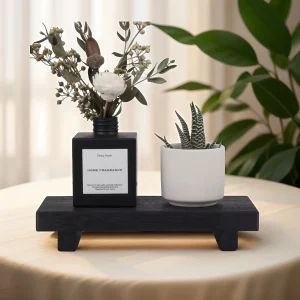
A single, small vase. A single, leafy branch of maple, taken on a walk. This is enough. The branch arcs, a calligraphy of life against the air. The vase, solid and grounded, provides the anchor. The space between them—that is where the magic hums. That is where the eye rests and the mind is invited to wander. Group three objects: a worn cutting board, a granite mortar, a round-bellied oil jug. Arrange them in a loose triangle. Not touching. Their relationship is defined not by contact, but by respect. By the space they consciously choose to honor between them. This space is not empty. It is full of potential. It is the breath before the word.
The Grace of the Mark
Nothing that is lived with avoids the gentle wounding of time. A kitchen that fears this mark becomes a museum. A brittle, anxious place. The mindful kitchen does not just accept this trace; it reveres it. It sees the story.
The chip on the rim of the favorite soup bowl. Do not discard it. Do not even regret it. That chip is a fossil. A memory of a lively table, a story told with grand gestures, a careless moment in the deep sink. It is a testament to use. To love, even. It renders the bowl singular. Unmistakably yours.
The fine, spider-web crackle in the glaze of an old cup. This is not a flaw. It is a cartography of process. A map of the intense heat of the kiln and the slow, patient cooling. It is the piece’s history written on its very skin. The water stain on the unglazed foot. The patina on a hand-thrown spoon rest, darkened by oil and time. These are not blemishes to be scrubbed into oblivion. They are the soul of the object, rising quietly to the surface. To honor them is to honor transience. It is to understand that beauty is not a state of static perfection, but a graceful, ever-evolving dance with change.
A Still Life That Breathes
This arrangement you tend is not a diorama behind glass. It is a still life that must live. And breathe. And serve. It must be fluid, adaptable. Like the creek outside your window, it is never the same water twice.
In the blue quiet of morning, let the ceramic French press take the stage. Position it where the first sun will find it. Watch the steam curl from its spout like a silent, rising prayer. By noon, clear the stage. Let the drama subside. Leave only a shallow, wide bowl. In it, place three lemons. Their yellow is a sudden, bright chord in the quiet room. A song without sound.
As evening gathers, set out the small, companionable dishes. One for coarse salt, like grey beach sand. Another for golden oil. Their simple readiness is an invitation. The ritual of use is the highest form of reverence. To lift the jug, to feel its cool, substantial weight in your palm, to pour a slow, glistening stream—this is a dialogue. A conversation between your hand and the earth that formed it. It is in this daily, tactile poetry that the kitchen becomes mindful. Not a place you pass through on the way to something else. But a place you inhabit, fully, with all your senses.
The Anchor and the Feather
Every peaceful landscape requires an anchor. A deep, still presence. In your kitchen, let this be something of immutable weight. A heavy, unglazed dough crock, its surface like ancient skin. It stays in its corner, a patient, quiet guardian. Or a row of five identical storage jars for dry goods—rice, oats, lentils, beans, tea. Their serene uniformity provides a baseline. A visual breath held long and deep. A foundation of calm.
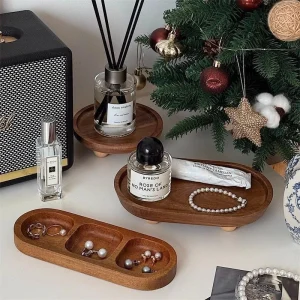
And against this anchor, allow a wanderer. A feather-weight spirit. A small, whimsical dish that is meant to travel. Let it hold the day’s found treasures: a smooth stone still cold from the stream bank, a pinecone stripped by squirrels, a single, perfect feather of a jay. Today it sits by the kettle. Tomorrow, on the windowsill to catch the light. The anchor grounds you. The wanderer reminds you that curiosity is a form of prayer, and that the soul, in its essence, is nomadic.
To Listen is to Arrange
In the end, this is not about styling. That word is too clever, too fraught with intention. It is about listening. A deep, patient listening.
Listen to the clay. It will tell you where it wishes to sit. Some pieces crave the center, to hold the light. Others seek the shadowy edge, a place of quiet observation. Listen to the light itself, that most ancient of visitors. Note its path across the day. Place a bowl where it will be grazed, for just ten minutes, by the long, low amber of the late afternoon sun. That is a gift. To the object. To you.
Listen to your own hands. What do they want to reach for? The smooth, round belly of a mug. The satisfying, generous scoop of a pasta bowl. Arrange for the hand’s journey. For the pleasure of the grasp, the fit of the palm. This is ergonomics of the soul.
The mindful kitchen is never finished. It is a practice. Like sitting by that creek. You observe. You see how the water wears the stone smooth over centuries. You notice how the dappled light filters through the oak leaves and dances on the moving surface. You may, occasionally, add a stone. You may lift a fallen branch. But mostly, you learn to be still within it. To let it be.
So begin.
Begin with one piece. The simplest you have. A plain, empty bowl. Fire it if you wish. Or leave it bare. Place it on your cleared counter. In the center. Or off to the side. It does not matter.
Leave it empty.
See how it holds the silence. See how it gathers the very breath of the room into its gentle curve. That emptiness is not a lack. It is a plenitude. It is the beginning of everything. It is the quiet from which the meal, the moment, the mindful life, will slowly, patiently, rise.