In the Stillness, a Different Kind of Listening
The air is not empty here. It is full. Heavy with a quiet that settles in the bones, like moss on north-facing stone. You feel it. A tug in the chest. Not for accumulation, but for erosion. A wearing away of the artificial, to reveal a shape that fits the hand of the spirit. It is a longing to remember the cadence of root and rivulet, the scent of damp earth after first rain. To weave the living world into the walls not as motif, but as marrow. As breath. Let us not speak of design, then. Let us speak of remembrance. An old, slow wisdom. Biophilia, seen through the cracked lens of wabi-sabi.
This is not construction. It is listening.
The Threshold Where Seeing Begins
Begin at your own door. Step out. Do not search the horizon. Kneel. The first text is written in the pavement’s fracture, where a seed spelled ‘life’ in green defiance. It is in the lichen’s slow, blue-gray cartography on stone. It is the grain of your wooden sill, weathered soft by sun and storm. This is the fundamental lesson. Nature is not a destination. It is the crack. The insistence. The quiet weathering of all things. Your space must first become a place that sees this. That bows to this persistent, whispering truth.
Bring this sight inside. Carry it over the threshold like a found stone, still cool from the stream.
The Patina of Light, the Breath of Air
Light is the first architect. Refuse the flat, unblinking glare. Seek the hesitant light. The light that has passed through leaves. That dances. Mournful and joyful by turns. Drape a harsh bulb with handmade paper—its fibers a map, a memory of pulp and tree. Let your windows be clear, but frame them with undyed linen, and watch. The morning sun will paint a slow, golden path across the floor. It will find the knot in the pine, the gentle swell in the reed mat, and call it altar. In the afternoon, allow the shadows to pool in corners. A shadow is not void. It is depth. A space for the mind to rest from the constant seeing.
And the air. It must move. It must carry tales. A window, cracked open, is a lung. Still air is a closed book. Moving air is a narrative—of coming rain, of night-chilled stone, of a blooming thing two gardens over. A single leaf, floating in a bowl of water, alters the soul of a room. Not through beauty alone. Through the slow, invisible gift of transpiration. A offering of moisture to the dryness. This is the beginning of reciprocity. Breathing with the world.
Let the Materials Speak Their Age
Now, attend to the bones. The floor, the walls, the vessels that hold your days.
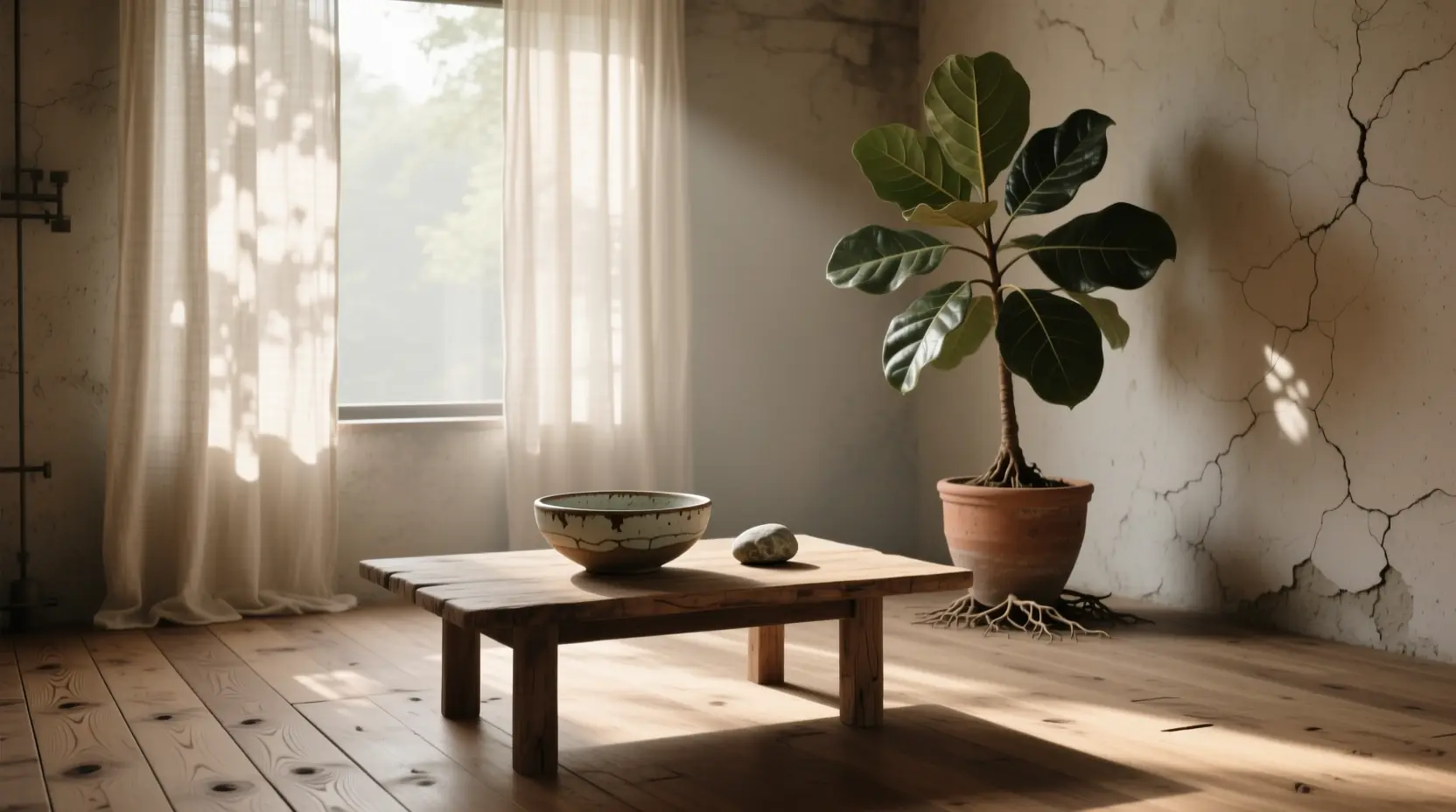
Forgo the perfect, the lacquered, the inert. Seek the grain. The story. A floor of wide-plank oak, each board a chronicle of drought and plenty, sung in rings. Do not sand its scars into oblivion. Oil them. Let your bare feet read its history. A wall of clay plaster, mixed with the very earth from which you live. A human hand troweled it. It will never be smooth. It will have topographies—hills, valleys, the imprint of a passing thumb. This wall breathes. It drinks the light and exhales a warmth that is soft, almost auditory.
Choose a bowl. Let it be from a potter’s wheel. Feel its heft. See the faint spiral left by the parting cord, the subtle warp bestowed by the kiln’s fierce breath. This is wabi-sabi. The beauty of the unintended, the transient, the quietly asymmetric. Place inside it a single river stone, smoothed by centuries of water. Here, a conversation: the stone’s age measured in millennia, the bowl’s in a single afternoon of fire. A dialogue across the abyss of time.
Let wood show its weathering. A tabletop bearing the ghost of a wine glass, the pale kiss of sunlight. Do not strip this memory. Honor it. This is its life, written on its skin. A chair of rattan, woven by hands that understood the material’s will. It will sigh when you sit. It will remember you. This is not decay. It is companionship.
The Green Thread: Life as Quiet Companion
Plants are not accessories. They are occupants. They are silent tutors in the art of being.
Do not crowd them. Grant each its own solitude. A solitary rubber plant in a coarse, terracotta pot, its broad leaves collecting sunlight and dust in equal measure. A shallow dish holding a miniature world: moss and one gnarled branch of driftwood, a landscape in repose. Water it. Witness the moss transform from thirsty grey to a grateful, profound green. This is a lesson in attention. In nuanced care.
Consider a kokedama. A ball of earth and moss, cradling a humble fern, suspended by jute. A planet of green hanging in space. It demands a specific tenderness. You must mist it. You must cradle its earthy weight in your palms to water it. This small, repeated ritual is a covenant. You are responsible for this small, spinning world. This is biophilia’s core. Not observation, but relationship.
Sometimes, the green thread is not a plant at all. It is the quivering reflection of a sycamore on the ceiling, cast through a window. It is the ghost of fern fronds on linen, printed not by ink but by the slow alchemy of rust. It is the deep, mineral green of a ceramic glaze, holding nothing but captured light.
Emptiness is the Vessel That Holds Everything
This is the deepest whisper. The space between objects is not empty. It is potent. It is ma.
Wabi-sabi understands ma—the profound silence between notes that gives music its meaning. Do not clutter every surface. Let a shelf hold one thing. A crow’s feather, found on a path. A stone cleaved through with a vein of quartz. A fragment of bark, curled into a scroll. Leave the space around it vast. Let it breathe. Let your gaze settle there, and rest.
This cultivated emptiness invites change. It makes room for the seasonal altar. A sprig of cherry blossom in spring, its fleeting fury amplified by the bareness that frames it. One persimmon in autumn, its skin a taught leather map of deep orange. In winter, a bare branch, its architecture of survival finally revealed. The room now turns with the earth. It is a participant in the cycle, not a museum.
The Sound of Water Finding Its Way, the Weight of Ancient Stone
Invite the elements. Not as spectacle, but as sensation.
A small water feature. Not a roaring fountain, but a bamboo shishi-odoshi. The slow fill. The patient tip. The soft clack of bamboo on stone. A rhythm older than human time. It speaks of hidden mountain seeps and forest drips. It humidifies the air. It gives the ear a resting place, softening the sharp edges of the mechanical world with the ancient, looping song of water seeking its level.
Stone is the anchor. A heavy, river-tumbled stone by the hearth. Cool to the touch on a humid afternoon, still holding the day’s warmth deep into the night. Its solidity is a comfort. It will be here long after. It speaks of geologic time. It shrinks the self to its proper, beautiful scale. Place it where a hand might fall upon it absentmindedly. This connection is primal. It is grounding.
The Final, Deepest Practice: Allowing the Fade
This may be the most difficult teaching for a mind trained in preservation. To permit the fade. The tarnish. The gentle decay.
The linen curtain, sun-bleached at the hem to the pale gold of old bone. Let it be. It has absorbed a hundred mornings. The copper basin, developing a soft, mottled patina of verdegris. Do not polish it. This is its earned wisdom. The paper of the shoji screen, yellowing gently, its fibrous skeleton becoming its beauty.
Your wabi-sabi, biophilic space is not a finished image. It is a living diary, written in dust motes and light tracks. It will bear water rings. It will acquire scratches. It will gather a fine silt of pollen on the sill. Do not wage war on this. This is the design working. It is integrating not merely the image of nature, but its fundamental, inexorable processes: growth, dormancy, decay, and transformation.
Sit in this room you are tending. On the floor, perhaps. Feel the quiet, thick as velvet. The dappled light shifts its pattern. The bamboo clacks its soft, wooden heartbeat. The air, scented with clay and the faint chlorophyll of leaf, moves across your skin. You are not in a box that excludes the world. You are in a vessel that is of the forest, the field, the streambed. You have built not a fortress against time, but a collaboration with it.
The peace that finds you here is not a product of interior design. It is a memory, unearthed. The memory of stone, wood, water, and leaf. The memory of your own breath, meeting the breath of the world. This is the true integration. Not of objects, but of being.
You are, finally, home.