The world shouts. This page whispers.
Sit. Not to do. Simply to be. Let the breath find its own depth, a tide pulling back to reveal the quiet shore of this moment.
Listen past the clamor. To the sigh of old timber, bearing its load with grace. To the paper-thin rustle of a single leaf, curled in a bowl of river clay. To the profound silence held in the palm of a sun-warmed stone.
This is not a space constructed. It is a space received. A hollowed-out pause in the chatter of becoming. Here, we do not worship at the altar of the new, the polished, the flawlessly replicated. We have forgotten that tongue. Here, we learn an older grammar. One spoken in patina. In gentle wear. In the elegant, inevitable surrender of all things to the caress and claw of time.
This grammar is Wabi-Sabi. It is not a style one buys. It is a way of seeing one unlearns into. A quiet recognition. Beauty is not a static perfection. It is a transient, imperfect, incomplete story. Told in cracks. In stains. In fading light.
And so, it never goes out of style. Because it was never *in* style. It exists outside that frantic current. It is the riverbed, not the rushing water. The mountain, not the weather.
The Map of Years: On Patina and Memory
Lay a hand on the old cedar plank.
Its surface is not a finish. It is a map. Not of geography, but of chronology. Here, a silvery furrow, worn by the passage of ten thousand hands—a valley of human touch. There, a dark knot, a closed eye gazing inward, holding a century of forest darkness. The grain, once submerged beneath a glossy seal, now rises to meet you. A topography of endurance. It is warmer than new wood. It holds, in its very fibers, the memory of sun and the memory of rain.
This is the first, soft lesson.
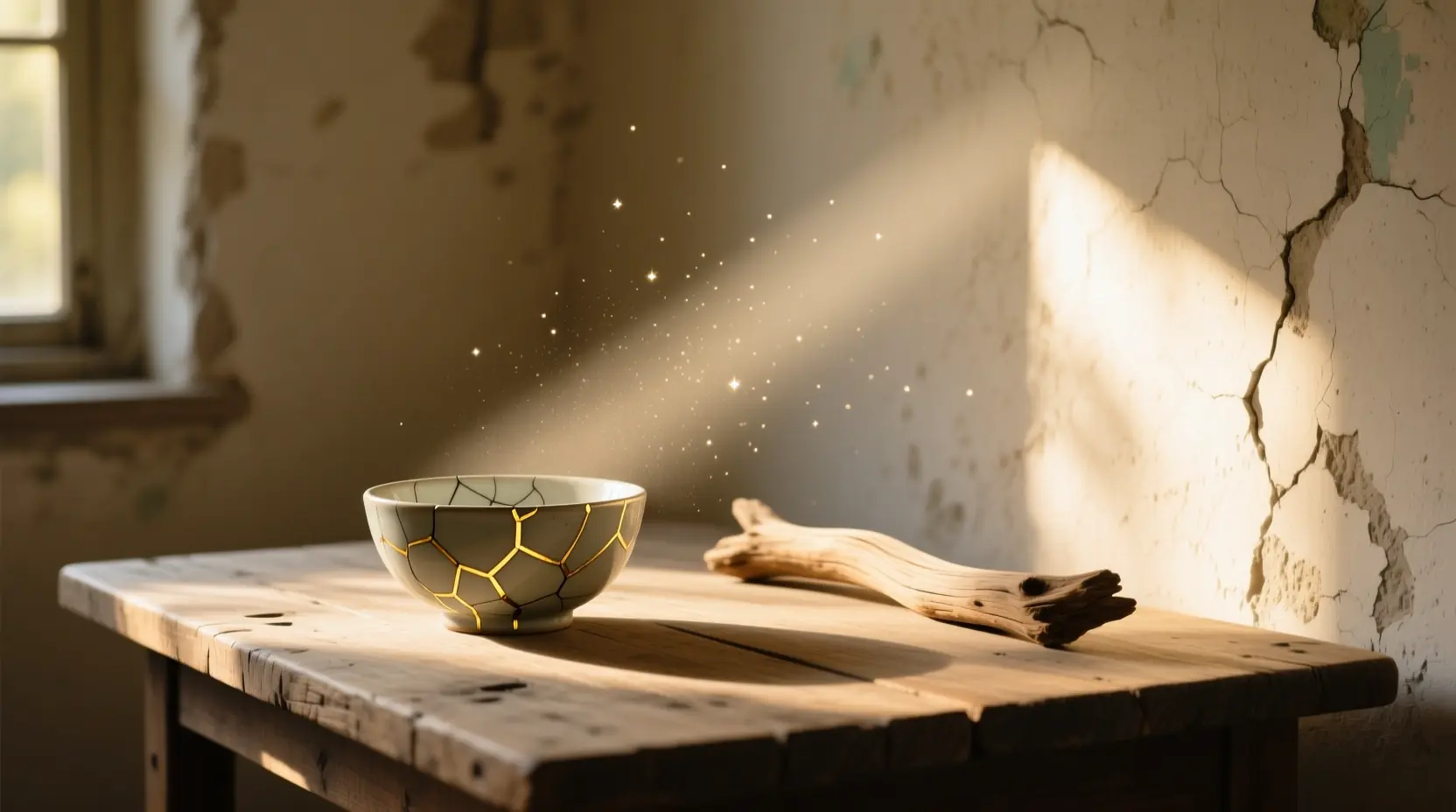
Wabi-Sabi finds its soul in evidence. It does not flinch from the mark, the stain, the hairline fracture that runs like a tiny lightening bolt through the glaze. It reveres it. A cracked bowl, mended with gold lacquer—*kintsugi*—is not made whole again. It is made new. The break is not concealed; it is illuminated. Gilded. It becomes the focal point, a golden river tracing a new course through a porcelain landscape. The story it tells is clear: this vessel has lived. It has held, and overflowed, and fallen. It has known fracture, and known repair. Its history is its beauty. Its wound is its light.
Your floor need not be a mirror. Let it be worn where feet have traveled most, a soft path of habit worn into the grain. Let the table bear the ghost-rings of a hundred cups, pale halos of communion. These are not flaws to be scourged away. They are the signatures of life, autographed in slow, patient script. They are the poetry of use.
The Fullness of the Empty: Ma as Breath
Now, let your gaze rest on the wall.
It is not hungry. It does not ache to be filled. A single scroll hangs, its sumi-e ink bleeding at the edges, fading into the paper like a mountain into mist. Beside it, nothing. A vast expanse of hand-troweled plaster, uneven, breathing. This emptiness is not absence. It is a presence. The Japanese call it *Ma*—the pause. The space between musical notes that makes the melody. The silence between words that holds the meaning.
We are so afraid of quiet. We crowd our spaces, our hours, our minds, fearing the void. Wabi-Sabi teaches the room to breathe. And in doing so, teaches us to breathe with it. A single, wind-twisted branch in a shadowed alcove can hold more narrative than a crowded shelf. A smooth, water-worn stone, placed alone on a low table, becomes a planet. A universe.
This intentional emptiness is an invitation. For the eye to settle, not to scan. For the mind to pool, not to ripple. For the day’s great, slow-moving ornament—the light itself—to perform its silent drama. A beam, heavy with dust motes like tiny stars, wheels across the floor. It reveals, by increments, the texture of rush matting, the grain of oak, the subtle hill and dale of a clay wall. The room changes not with the season, but with the hour. It is alive with time.
The Whisper in the Made Thing: Humility of the Hand
Feel this cloth between your fingers.
Raw linen. It is not soft. It is true. You can feel the individual threads, the slight, irregular thickenings where the spinner paused, the loom accepted. It smells of flax and field and loft. It was woven by hands that knew the rhythm of shuttle and treadle. Its edges are selvedge, fringed—left to speak their own truth, not hemmed into submission. It will soften. With every wash, with every use, it will become a companion to your skin, mapping your life as it does.
This is the quiet rebellion of the handmade.
Wabi-Sabi prefers the trace of the creator. The slight asymmetry of a hand-thrown pot, which feels more natural in the palm than any machined symmetry. The gentle tool marks on a chiseled wooden bowl, like fingerprints of making. The irregular bleed of a berry dye on paper, a captured sunset with clouds. These are not errors to be corrected. They are the whispers of the craftsman’s presence. The quiet admission: a human was here. A breath, a focus, a momentary surrender to the will of the material passed into this object.
It connects you, the user, to the maker across time and space. You feel the intention. You feel the acceptance of the material’s own voice—the knot in the wood, the crackle in the clay, the stubbornness of the stone. It is a conversation, not a command. It stands, a humble testament, against the sterile, the anonymous, the mass-produced. It says, simply: something alive happened here.
The Gentle Sadness: Mono no Aware and the Flow of Time
The light is long now. Slanting. Autumn light.
It catches the dust, setting the motes adrift in a silent, golden beam. Once, we might have seen this as neglect. Now, we see it as part of the moment’s truth. A slow, aimless ballet of infinitesimal worlds. Transient. Beautiful precisely because they will dance away on the next draft.
This is *Mono no aware*. The poignant, gentle awareness of impermanence. The tender sadness for the passing of things. It is not despair. It is the deep, resonant heart that beats beneath Wabi-Sabi. It does not seek to arrest time, to pickle a room in the brine of perpetual newness. It accepts—no, it *cherishes*—the cycle. The green leaf that will crisp and brown and return to earth. The bright copper that will dull to a melancholic, beautiful verdigris. The smooth pebble that will, over millennia of river song, become sand.
This acceptance is the root of peace. When you stop fighting time, you join its flow. Your home ceases to be a museum of the pristine. It becomes a living diary of the seasons of a life. The faded indigo of the cushion where the old dog still dreams. The faint water stain on the sill that, in a certain light, looks like a distant archipelago. The book whose spine is softened and cracked from love, its pages holding more than words.
These are not flaws. They are anchors. They tie your story to the great, slow story of things wearing, fading, becoming. They are comfort.
The Sanctuary That Never Fades: A Homecoming of the Soul
So why does this quiet way persist? Why does it feel, not like a trend remembered, but like a memory recalled?
Because trends are born of hunger. A gnawing want for the new, the different, the *elsewhere*. They are a search for identity in acquisition. They are loud. They must shout, always, to be heard over the last loud thing.
Wabi-Sabi is born of fullness. Of sufficiency. Of having looked long and deeply at a stone, at a piece of moss, at the nature of existence itself, and found it complete. It is an identity rooted not in having, but in being. In seeing. It speaks in a whisper that carries across centuries, because it speaks of what does not change: our mortality, our imperfection, our deep yearning for the authentic.
In a digital age of flawless, filtered surfaces, the tactile, the imperfect, the quietly aged feels like a homecoming. It feels like truth. The cool solidity of clay. The fibrous warmth of wood. The rough kiss of stone. These are antidotes to the dimensionless scroll.
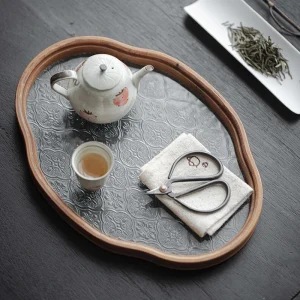
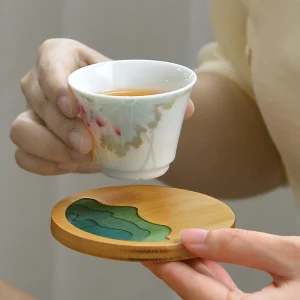
A room shaped by this principle does not demand your admiration. It offers you a sanctuary. It asks nothing but your presence. To feel the roughness of plaster. To watch a single shadow stretch and blue. To cradle a tea bowl that fits your hands not like a tool, but like a held breath.
It is a mirror, finally. One that shows you your own humanity—imperfect, transient, fragile, breathtakingly beautiful in its very incompleteness. It tells you: you, too, are enough.
Begin Where You Stand: A Practice, Not a Purchase
You need not tear down your walls.
Begin with a single, deliberate act of seeing. Find one object in your possession that has aged with grace, not disgrace. A piece of driftwood, hollowed by sea and salt. A tarnished spoon. A linen napkin thin from washing. Place it where the light will find it. Honor its journey.
Let one corner of one room breathe. Remove what does not serve, what holds no memory, no texture, no whisper of a story. Feel the space that opens. Not as emptiness, but as potential. As Ma.
Choose one thing. Let it be natural. Let it be honest. Unglossed wood. Unsealed stone. Undyed wool. Welcome their changes. The water ring on the oak is the tree remembering rain. The tarnish on the silver is its conversation with the air.
Mend what is broken. Not to hide the break, but to honor it. Sew the tear with visible stitches. Glue the fragment with care. Let the repair be a ceremony of continuation.
Most of all, slow down. A home of Wabi-Sabi is not assembled. It gathers. It accrues, like moss on a north stone. Like layers of nacre on a hidden pearl. It is the quiet work of a lifetime, a slow, tender dialogue between you and the materials of your world, with time as your scribe.
It is the understanding, deep in the bones, that the crack is not where the thing ends.
It is where the light gets in.
And in that illuminated fracture, there is no room for the fear of fading, for the shame of wear. There is only the timeless, the tender, the heartbreakingly beautiful now. Held, for a moment, in a bowl of clay. In a beam of dust-filled sun. In the quiet, waiting palm of a stone.