Listen to the Breath of a Place
Come, sit by the hearth. It is not grand. The fire is low. The wood, gnarled and silvered by time, whispers as it burns. You have asked about walls, about roofs, about the bones of a place. But architecture… true architecture… is not about bones. It is about breath. The breath of time. The breath of the material. The quiet breath of a space settling into the earth. We call this understanding *wabi-sabi*. It is not a style. It is a way of seeing. Of listening. From the oldest paper house to the hardest concrete wall, it is the same thread. Worn smooth, but unbroken.
The House That Breathes With the Forest
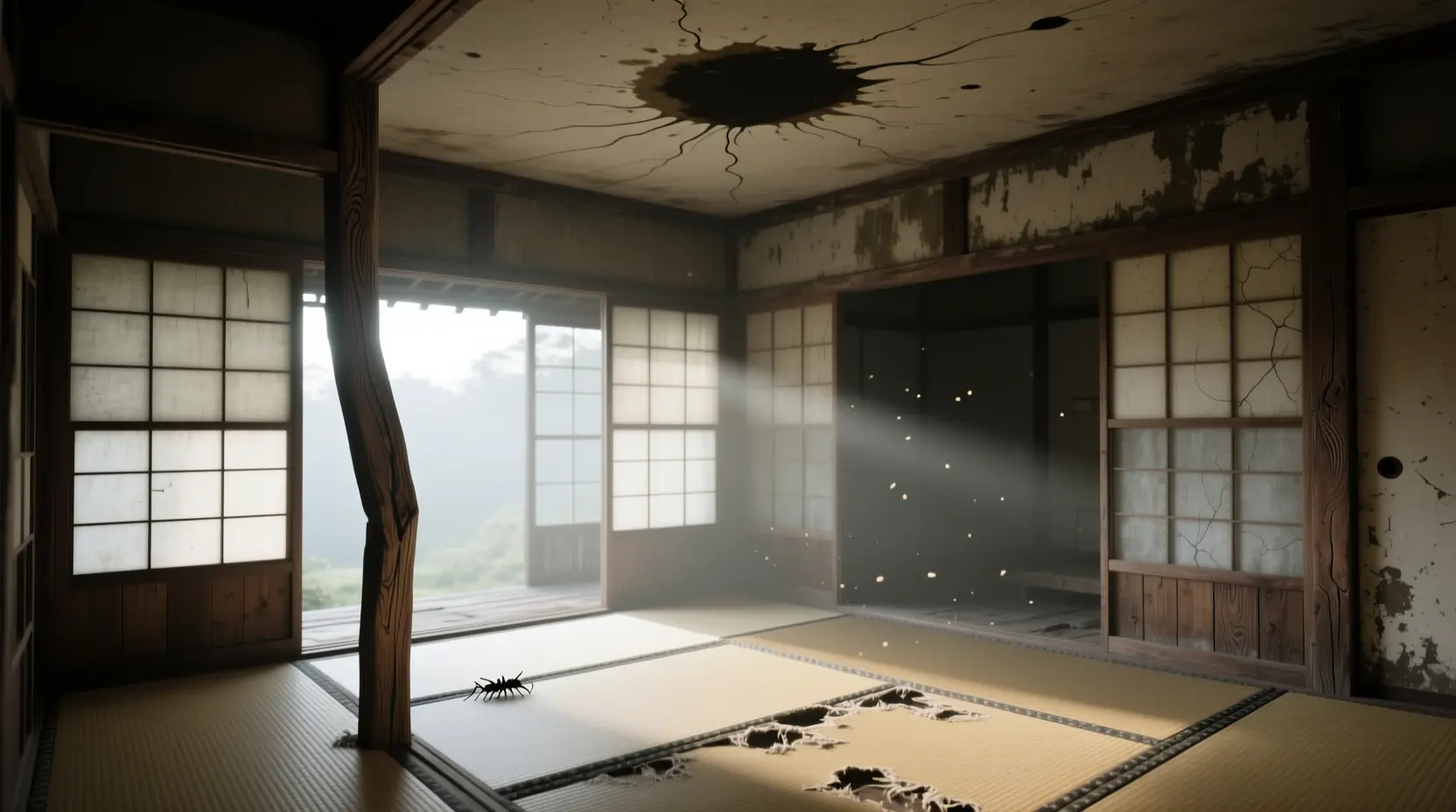
Let us begin where things are soft. With the *minka*, the old folk house. Wood remembers it was a tree. We do not make it forget. The post is crooked. The beam bears the knot’s story. We join them, not with nails that shout, but with joints that whisper. A secret handshake between timber. The walls are earth and straw. They drink the light, thick and golden as honey. The *shoji* screens are rice paper. They are not walls. They are lungs. They breathe with the day. In the morning, they glow, a soft lantern. At noon, they hum with a muted sun. At dusk, they become shadows upon shadows.
The roof is heavy. Thatched, or tiled with aged grey *kawara*. It slumps like a sleeping beast. It does not fight the rain. It accepts it. The water finds its path, drips a slow, musical pattern onto the stones below. Moss grows there. A green so deep it is almost black. This is not decay. This is the house joining the world. The perfect line does not exist here. The curve of time is the only truth. The floor is *tatami*. Its scent is of rice straw and summer fields. It holds the imprint of feet, of sitting, of life lived. It wears its use as a robe of honor.
A chip in the *tokonoma* alcove’s post. A water stain on the ceiling like a phantom mountain range. These are not flaws to be hidden. They are the *kintsugi* of a dwelling. They are where the light of experience has mended the vessel, making it more precious. The house is quiet. But its silence is full of stories. The grain of the wood. The texture of the clay. The patina of hand-worn wood. This is the first lesson. Beauty is not in the birth of a thing, but in its long, graceful fading.
The Silence Between the Stones
Now, step outside. Into the garden. But it is not a garden of flowers shouting for attention. It is a *karesansui*. A dry landscape. Here, wabi-sabi finds its purest voice. Raked gravel becomes ocean. Becomes flowing water. Becomes cloud. The stones are not placed. They are discovered. As if they had always been there, pushing through the skin of the world. Each one is a mountain. An island. A stubborn, ancient thought. Their surfaces are pitted, rough, cloaked in lichen. The lichen is not an infestation. It is a collaboration. A slow, green breath upon the stone’s cheek.
You see the pattern in the gravel. The perfect, concentric circles around a stone. But look closer. The rake’s teeth are not machine-precise. There is a tremble. A variation. The hand of the raker, an old monk perhaps, his own rhythm enters the work. Tomorrow, the wind will disturb it. A leaf will fall. And the next day, he will rake again. Not to make it perfect, but to make it present. This act, this endless, accepting cycle, is the heart of it. The beauty is in the tending, not in a frozen ideal. The wall around the garden is of rough clay, mixed with straw. It crumbles at the edges. It does not pretend to be eternal. It is a sober companion to the ever-changing gravel.
This is the space between. The *ma*. The pause. It is in the gap between stepping stones, where you must walk with intention. It is in the shadow deep inside a mossy grotto. It is in the sound of water dripping into the stone basin, the *tsukubai*, worn smooth by a thousand bowed backs. The architecture here is not the building. It is the invitation. The frame for emptiness. For contemplation. It asks you to be still. To see the universe in a mossy stone, and eternity in the fading of a wooden eave.
When the Rain Fell on Concrete
Now you ask, what of the modern? The hard, the cold, the concrete. Can this spirit live there? Ah. Let us walk to the chapel in the woods. The rain chapel. Tadao Ando’s Church of the Light. It is a box. Of concrete. Raw, brutal, some say. But look with different eyes. See not concrete, but liquid stone. Poured into molds of wood. Ando did not polish the truth away. He let the wood imprint its grain upon the surface. Every board line, every knot, every imperfection of the formwork is etched into the skin of the wall. It is a fossil. A memory of its own making. It is utterly honest. This is *sabi*—the beauty of the authentic mark of time, even if that time was its birth.
Inside, it is dark. A cave. Then, the cut. A cruciform slit in the concrete wall. Not a window. A wound. Light does not simply enter. It is *born* from this incision. It slices the darkness, a blade of pure, solid illumination. It falls upon the rough concrete floor. Dust motes dance in its beam, like stars. The wall is no longer a wall. It is a canvas for the sun. The rain falls on the concrete outside. It darkens the grey to black. It streaks. It stains. Ando welcomes this. The building is designed to be washed by weather. To change its face with the storm and the dry spell.
The concrete ages. It stains. It may crack. Ando knows this. He accepts this as part of its life. The building is not a finished portrait. It is a journal, and the rain, the sun, the decades are writing upon its pages. The hardness becomes a frame for the soft, living light. The permanence holds a space for the most fleeting thing of all: a beam of sun, a shadow at noon, the sound of rain. This is wabi-sabi in steel and concrete. It is the reverence for the material’s own nature, and the celebration of the forces that wear upon it.
The Soul of the Cracks
So you see, the thread is clear. From the thatched roof to the concrete ceiling. It is a philosophy of deep respect. Respect for the material. Let wood be wood. Let concrete be concrete. Do not force it to be what it is not. Its truth is its beauty. Respect for the hand. The tool mark. The joinery. The imprint of the formwork. The slight wobble in a hand-troweled wall. This is the breath of the maker in the thing made. Respect for time. A building is not complete when the builder leaves. It is only beginning its true work: to converse with the years. The water stain, the rust streak, the weathered patina, the crack where ivy finds a home—these are not enemies. They are collaborators. They are the building’s autobiography. Respect for imperfection. The asymmetry that mirrors a branching tree. The irregularity that echoes a coastline. The “flaw” that proves a thing is alive, unique, and mortal.
This is wabi-sabi architecture. It is not Japanese. It is not Brutalist. It is human. It is the quiet understanding that we do not build against nature, or even in nature. We build *as* nature. As things that are born, that live, that change, that wear, that one day will return. Look at the hearth again. The embers are almost ash. But see how they glow, a map of a dying world, more beautiful in their fading than in their fierce blaze. That is the soul of the place. That is the lesson of the wall, the stone, the beam, the crack. Do not seek the forever-fresh. Seek the deeply lived. Seek the quiet, the worn, the honest, the transitional. For in the end, all architecture is a vessel. Not for people, but for moments. For the light of a particular afternoon. For the sound of rain on a specific roof. For the shadow that will never be quite the same again. And a vessel is most beautiful not when it is new and empty, but when it is worn smooth by holding, and stained by the memory of what it has held. The fire is out. But the warmth remains in the stones. Go now. And look at the world, at its walls and its roofs, with softer eyes. Listen for its breath.