The Whisper of Clay Walls
The quiet of the morning holds a different weight here. It is not empty. It is filled with the memory of rain on the tile, the slow song of the wood grain beneath the window, the soft, uneven breath of clay walls drying in the sun. This is not a house that shouts. It whispers. It whispers of time, and in that whisper, I have found the deepest answer to the frantic question of our age: how shall we live without consuming the world?
You see, the most eco-friendly home is not a perfect machine of gleaming efficiency. It is a wabi-sabi home. It is a humble vessel that honours the truth of things. That everything is impermanent. Everything is imperfect. Everything is incomplete. To build, to live, with this understanding in your bones… this is the beginning of true sustainability.
A Crack Lets the Light In
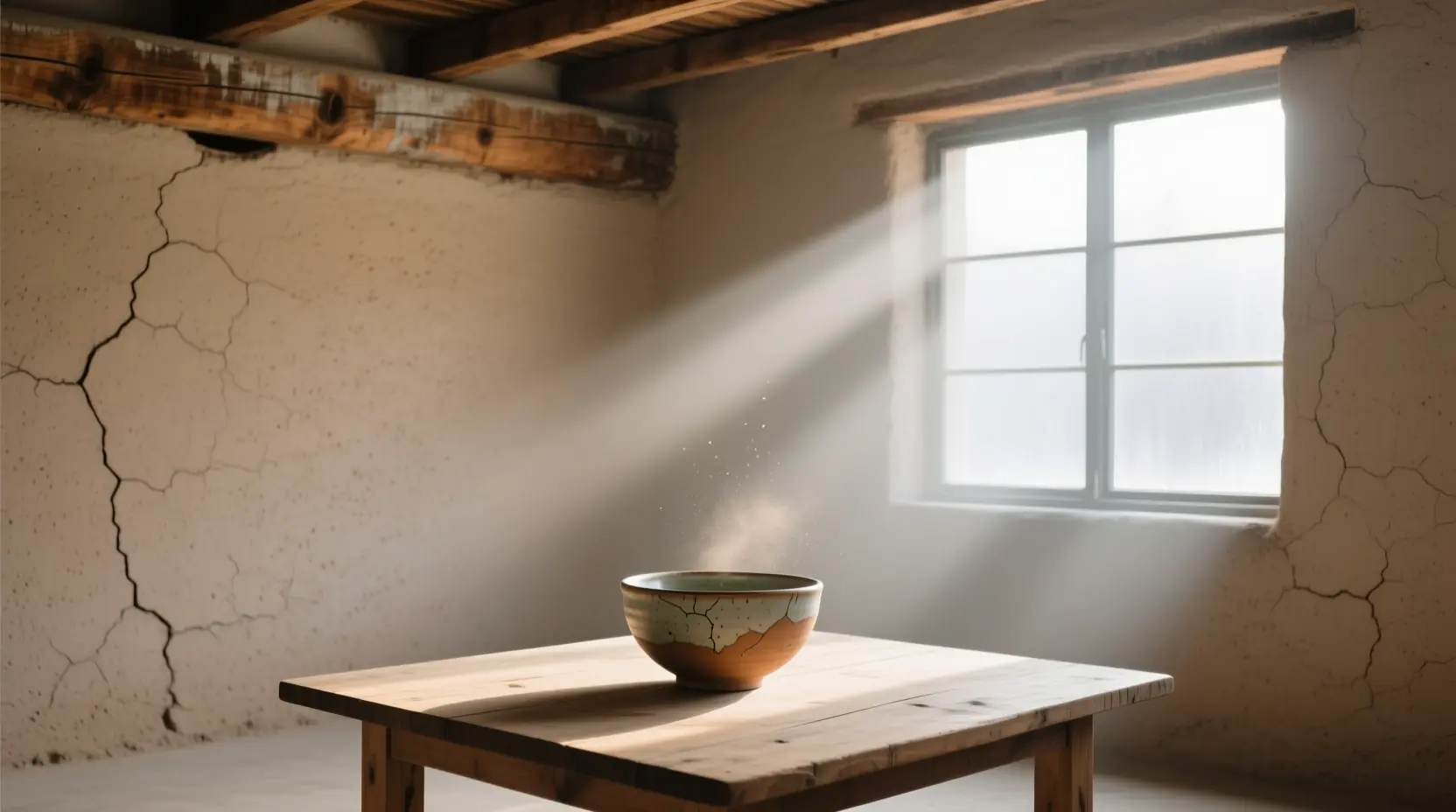
They bring me a bowl, its rim kissed by a fine, hairline crack. “It is broken,” they say, with regret. I take it, feeling the journey of the crack under my thumb. “No,” I say, my voice as rough as the bark outside. “Now it has a story. Now the light can enter in a new way.” We fill the seam with gold, kintsugi. Not to hide the break, but to illuminate it. To make it the most precious part.
This is the first lesson. The modern world sees a flaw and demands replacement. A scratched floor, a faded textile, a weathered board. It sees age as failure. This view creates rivers of waste. Mountains of discarded things, still humming with potential, buried for the crime of showing their years.
But wabi-sabi sees the crack as a record. A unique topography of a life lived. To repair, to cherish, to adapt—this is the most radical act of conservation. It is a deep ‘no’ to the hunger of newness. The eco-friendly home is not filled with perfect, certified-new things. It is filled with things that have been loved back from the brink. A chair re-caned by hand. A wall patched with earth from the garden. A robe, worn soft at the cuffs, mended with careful stitches. These acts are quiet prayers against the flood.
The Patina of Years is the Truest Finish
Look at the old cedar post that holds up the eaves. Feel it. Not the smooth, sterile wood of a catalog. This surface is a landscape. It has been sun-warmed and rain-cooled ten thousand times. The grain has risen, silvered, speaking of wind and long afternoons. This is not decay. This is character. This is the wood becoming more truly itself.
We have been taught to fear this transformation. To seal everything behind a plastic shield, to fight the gentle touch of the elements. But what a frantic, losing battle. And what poison we use to wage it—chemicals that leach into the soil, films that peel and become rubbish.
The wabi-sabi home breathes with the world. It allows materials to age with dignity. Lime wash that mellows like an ancient page. Plaster that shows the sweep of the trowel. Iron that rusts to a gentle, aching orange. These are not defects. They are a collaboration with time. They mean your home requires no violent, toxic interventions. It simply settles, like a stone in a riverbed, becoming more beautiful as it becomes part of the landscape. This is passive sustainability. It asks for nothing but acceptance.
The Soul of the Material Knows Its Purpose
When I shape a vessel from clay, I do not force it to be what it is not. I listen. The clay has a will. A memory of riverbed and fire. My hand is a guide, not a dictator. A rough spot remains, because in that roughness is the truth of the earth.
So many homes are built of materials screaming in protest. Plastic masquerading as wood. Petrochemical fibers pretending to be linen. They are soulless, and they decay without grace, leaving only poison. They have no story to tell except one of extraction and manipulation.
The wabi-sabi home is built of honest materials. Materials that can return. Clay, stone, wood, paper, wool, linen. They are not neutral. They are alive in their own way. They respond to the air. They hold warmth and release it. They absorb sound, not with deadening foam, but with the soft embrace of fiber and mass. To build with these is to build with the future in mind. For when their long, long service is done, they do not become a curse on the unborn. They return. To dust, to earth, to nourishment. This is the cycle. To break it is folly.
Emptiness is the Breath of the House
A room clutters not with things, but with wanting. The desire for the next object, the fuller shelf, the more complete set. This desire is a fire that consumes resources and peace in equal measure.
Wabi-sabi finds richness in austerity. Not a cold, punishing emptiness, but a generous space. A single wild branch in a plain vase. One good bowl, used for a lifetime. The emptiness around an object is what allows it to sing. This is ma, the pregnant pause, the resonant void.
The sustainable home born of this principle is a light one. It treads softly on the earth because it asks for little. It understands that sufficiency is a form of beauty. Every unnecessary object is a chain—of mining, shipping, refining, packaging, selling, and, eventually, discarding. To choose only what is essential, and to love that thing fiercely, is to break countless chains. The space that remains is not empty. It is filled with air, with light, with possibility. It is room to breathe, for you and for the world.
A Home That is a Season, Not a Monument
We build houses as if we are building pyramids. Meant to defy the centuries, static and defiant against the elements. We fight the creeping moss, the settling foundation, the fading colour. It is a war of pride, and it exhausts the spirit and the planet.
A wabi-sabi home is more like a autumn leaf. It has its season of vibrant glory, then it quietly changes, fades, and prepares to return its essence to the soil. It does not seek to be forever new. It seeks to be appropriate. To live and age in harmony with its place.
It may have a roof that shelters a nest of sparrows. A floor that wears the smoothest path from hearth to door, the record of daily pilgrimage. It accepts the damp of spring, the deep cool of stone in summer, the rattle of a loose shutter in the autumn wind. It is not a sealed fortress against nature. It is a participant in nature’s rhythms. This participation eliminates the need for vast, energy-hungry systems to create an artificial, constant climate. It asks you to wear a sweater in winter, to open the windows wide for the cross-breeze. It asks for your awareness, your engagement. In return, it gives you not just shelter, but a true sense of place and time.
The Final Lesson is in the Letting Go
All things pass. The finest joinery will loosen. The strongest tile will chip. The view from the window will change as the sapling becomes a tree. To cling is to suffer. To release with grace is wisdom.
The ultimate sustainability is this inner release. When we understand our homes as temporary shelters—beautiful, loved, but transient—we are freed from the desperate, resource-heavy grip of permanent perfection. We care for them tenderly, but we do not demand immortality from them. We allow them to teach us about our own gentle impermanence.
So, you ask how to build an eco-friendly home? Do not start with a spreadsheet of efficiencies. Start with a stone. Hold it. Feel its cold patience. Look at a piece of wood until you see the forest, the years of slow growth. Understand that you are not constructing a product. You are weaving a temporary harmony. Use what is at hand. Mend what is broken. Cherish the stain, the warp, the patina. Leave space for the moon to track its path across the floor. Let the house be quiet, humble, and alive with the honest marks of life and weather.
For a home that embraces cracks, avoids waste, ages gracefully, uses simple materials, demands little, and teaches you to let go… this is a home that heals, not just your soul, but a small, precious piece of the earth. It is not a statement. It is a sigh of relief. A long, slow exhale into the waiting arms of the world.
The tea is ready now. See how the steam rises, and vanishes, into the quiet air.