The Quiet Before the Golden Seam
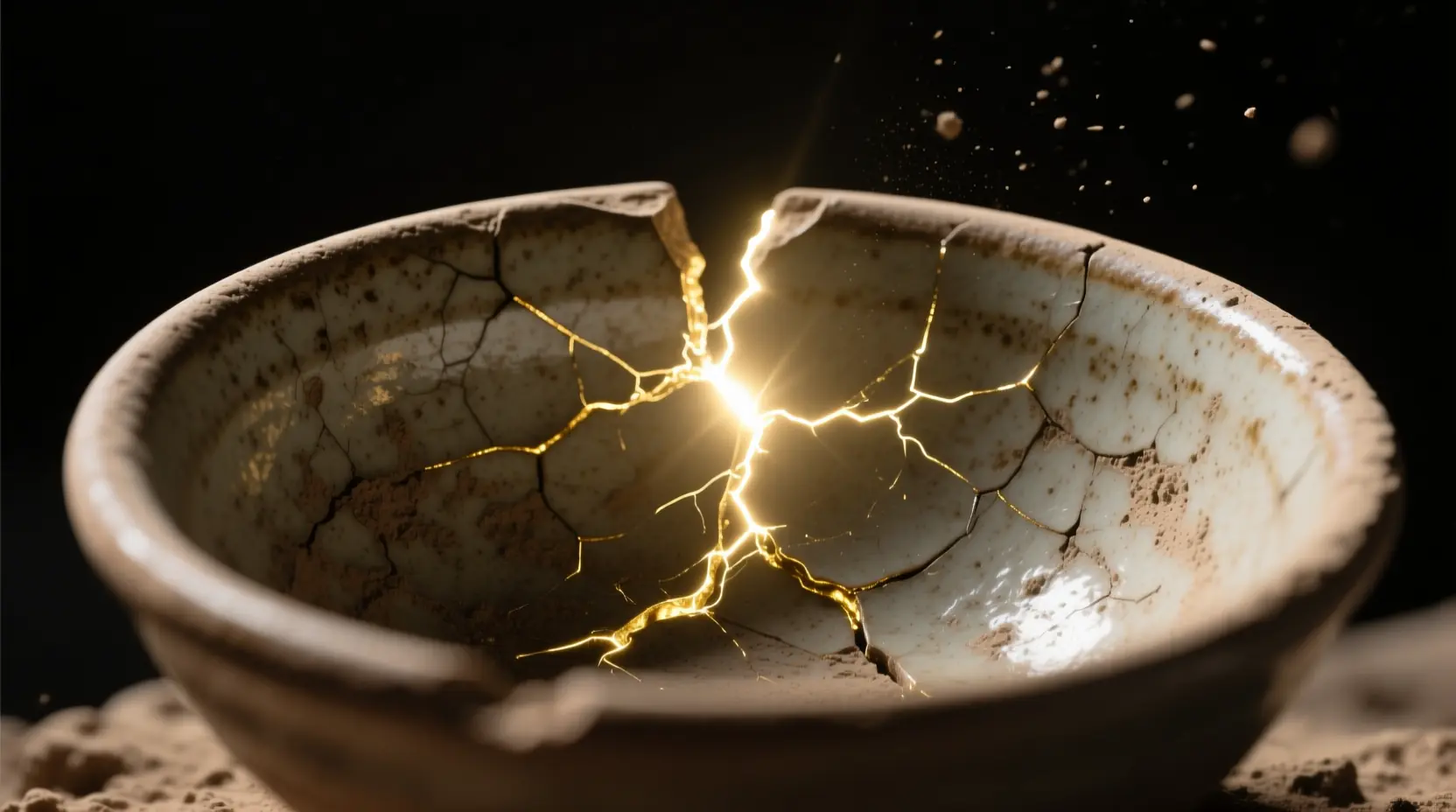
A crack appears in the silence. Not a catastrophe, but a breath held. A teacup, hollowed by ceremony, meets the unyielding earth. Its story fractures into fragments.
In the stillness that follows, a choice hangs in the air. The modern world urges disposal. The broken thing is a concluded sentence. But another path waits, patient as moss on stone. It does not seek to reverse time. It seeks to kneel beside the pieces. To listen.
The Topography of a Break
The artisan’s first act is not repair. It is gathering. Not just of porcelain shards, but of attention. The fragments are laid upon cloth. Each edge is studied—not as a problem, but as a landscape. This ridge, where the glaze feathered. This valley, where the clay tore clean. The mind traces the rupture’s path, learning its unique grammar. This is the foundation: to see the damage completely. To not look away. The work begins not with hands, but with presence.
The Adhesive is Time, the Catalyst is Breath
The binding agent is urushi—lacquer sap. It is not a glue. It is a conversation with the air. It cures not by drying, but by a slow, enzymatic dance with moisture. It demands a specific humidity, a patient climate. A brushstroke along a fractured edge. A careful joining. Then, the long wait. The piece is swaddled in soft cloth, placed in a wooden box, and set aside. Days pass. Perhaps weeks.
This is the antithesis of instantaneity. The mend must become part of the object’s own timeline. The lacquer must breathe, settle, and harden into a bond that is, in its essence, a form of growth. It teaches a quiet truth: healing is not a swift concealment. It is a slow, deliberate osmosis. It requires the right environment. It demands patience. It cannot be rushed without failing. The crack is not erased; it is given a foundation, a bed of resilience where gold will later come to rest.
Applying the Light
Only then, after the lacquer has set like a second nature, does the gold arrive. Powder, fine as pollen. Or liquid, a slow, careful flow into the seam. The excess is wiped away, leaving only the luminous trace in the fissure.
This is the revelation. The break is no longer a flaw. It is a river of light on the topography of the vessel. It has become the most honest part of the object. It has been through something. It has been transformed. The gold does not shout its value. It whispers of attention, of a care that chose to highlight rather than hide. In the low light of a dawn, these golden seams catch the sun. They trace a map of survival across the form. The bowl, once simply whole, now holds a constellation of its own history. It is more complex. More interesting. More beautiful precisely because it did not conceal its suffering. It wore it with grace.
The Soul of the Object, The Vessel of the Self
We speak of an object’s function. But there is another quality, harder to name. In Japanese, it is kokoro—heart, spirit, essence. A mass-produced cup has little kokoro. It is a dead echo of a machine. But a bowl shaped by a potter’s fingers, fired in a wood kiln where ash kisses its side and leaves a accidental glaze—that has a spirit. And when that bowl breaks and is mended with gold, its kokoro is not diminished. It is amplified.
The golden veins become part of its soul. They are a record of its journey. They speak of a second life, granted not by its original maker, but by a mender who saw its worth in its broken state. The object becomes a collaboration across time. The potter gave it birth. The accident gave it a trial. The kintsugi artisan gave it a rebirth. It belongs to all these moments. Its soul is layered, like the rings of an ancient tree.
Turning the Gaze Inward
The true power of this philosophy is how it turns our gaze inward. We are all vessels, carrying the weight and wonder of our years. We accumulate cracks. A loss that left a fissure in the heart. A failure that chipped the confidence. A betrayal that shattered trust. The human instinct is to hide these fractures. We plaster over them with forced smiles, with busyness, with narratives of perfect resilience. We pretend the break never happened.
Kintsugi suggests a more courageous, more beautiful path. It asks: what if we stopped hiding our breaks? What if, instead, we learned to attend to them with the care of the lacquer master? To clean the wound, not ignore it. To apply the slow, patient adhesive of time, of reflection, of compassion. And then, to trace those healed fractures with gold. To recognize them not as shameful weaknesses, but as sources of unique strength and character.
Your grief, once a raw and gaping split, can become a seam of deep empathy for others. Your failure, a jagged line of humiliation, can transform into a golden vein of hard-won wisdom. The mend does not return you to who you were before. You can never be that unbroken vessel again. Instead, you become something new. Someone with a history written in light upon their being. You become more interesting. More compassionate. More real.
A Practice, Not a Metaphor
This is not merely symbolism. It is a practice for the hands, to teach the heart.
Mend the cherished childhood toy with visible stitches. Keep the chipped vase, and place a single, weathered branch in it. Let your environment tell the truth of a life lived, not a showroom fantasy. Value the project that failed but taught you everything. Honor the scars of past mistakes in your team’s culture, so they become guidelines of gold, not hidden shames.
In your own heart, practice applying the lacquer of patience. Sit with your fragments. Do not demand a quick fix. Allow the slow cure of time, of nature, of gentle conversation. Then, when the mend is secure, find the gold. What did that break teach you? How did it make you kinder, wiser, more deliberate? Trace that line with the acknowledgment of its worth.
The World, Mended
We live in a world obsessed with the new, the perfect, the seamless. It is a loud, shouting world that tells us to discard the old, hide the flawed, and present only a polished, unbroken front. This is a brittle way to live. It leaves us terrified of a single crack, for we believe it renders us worthless.
The kintsugi philosophy offers a quieter, stronger, more resilient voice. It is the voice of the old tree, the weathered stone, the mended bowl. It says: Your breaks are part of your story. Do not discard them. Gather them. Mend them with care. And then, highlight them with gold.
For it is in our mended places that the light enters. It is through our cracks that we become truly, uniquely whole. Not in spite of our breaks, but because of them. We are all fragile vessels, walking through a world of hard surfaces. We will crack. We will break. The art is not in avoiding the break. The art is in how we choose to put ourselves back together. Will we try to become invisible, hoping no one sees the damage? Or will we have the courage to assemble our pieces with such slow, loving care that the seams themselves become the most beautiful part?
The answer whispers on the edge of silence. Choose the gold. Mend with light. And let your history, in all its fractured and glorious truth, shine.