The Song of Steam, The Memory of Moss
The kettle sings a low song on the hearth. Not a shout. A whisper of steam. A memory of rain on mountain moss. I sit. The room sits with me. It is not empty. It is full of quiet. Full of space that breathes. In this stillness, I see it. Not a history in books, but in grain and shadow. In the simple act of preparing tea that grew roots. That spread from tatami mat into the bones of homes across the world. This is not a story of fashion. It is a story of soil. Of how a ceremony of imperfection taught us how to live within walls.
A Bowl, Not a Throne
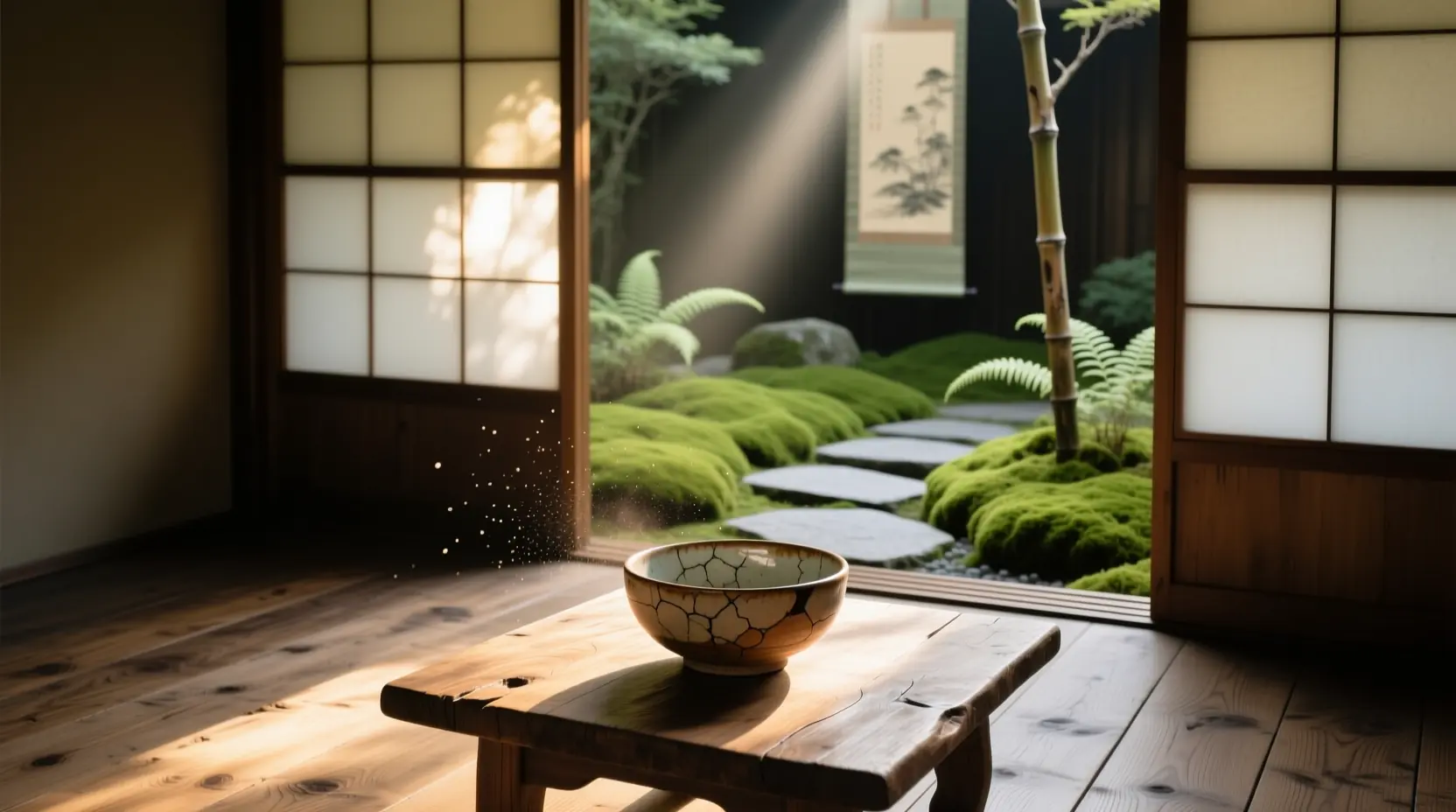
It began in a tearoom. A space so small it could barely hold five men. Sōan, the “grass hut.” A rebellion. Against grandeur. Against the stiff, formal halls of power. The master Sen no Rikyū walked into a palace and built a hovel. He used mud walls. Rough-hewn posts still wearing their bark. A ceiling of woven reeds. He let the nail heads show. He prized asymmetry. A floor that sloped, just so. A post that bent, like a tree under snow. He was not building a monument. He was digging a burrow for the spirit. The ideal was wabi-sabi. A beauty found in humility. In the patina of use. In the quiet melancholy of things that do not last. The tea bowl was not perfect. It was chipped, perhaps. Or glazed in a way that echoed the randomness of a windswept cliff. You cradled it in your hands. Its warmth was the warmth of the earth. This was the first lesson. An object is not to be displayed. It is to be held. To be felt. Its worth is in its communion, not its cost.
The Path of the Sleeve
You entered the tearoom through a low, square door. The nijiriguchi. You had to bow. To crawl. Samurai left their long swords outside. Rank was shed at the threshold. Inside, all were equal under the roof of stillness. This movement—the bow, the compression, the humble entry—changed everything. It was the birth of the transition. The modern “entryway,” the muted foyer, the pause between the chaos of the world and the sanctuary of the home, is a ghost of that crawl. We do not bow our bodies now. But the best spaces ask our spirits to bow. To slow. To cross a threshold of stone, or wood, or simple matting, and leave the noise behind. It is not a grand arch. It is a lowered gate.
Listening to the Materials
The tea masters were listeners. They did not force wood into straight lines. They followed its will. A post with a knot became the tokonoma’s corner post—the focal point. The knot was not hidden. It was honoured. A stone with a hollow became the water basin, tsukubai, where guests rinsed their hands. Its shape was already there, waiting in the riverbed. The craftsman’s hand was a partner to the material, not its commander. This is the soul that seeped into modern design. The appreciation for exposed beams. For concrete that shows the grain of its wooden forms. For linen that wrinkles, for stone that is cool and veined. We call it “texture” now. Then, it was a conversation. A dialogue with the essence of a thing. To see the life in unfinished wood is to see the tree. To honour the hammer-mark in iron is to honour the smith’s breath. The room becomes not a display, but a gathering of quiet lives—mineral, vegetable, human.
The Beauty of Empty Space
Perhaps the most profound export is ma. The pregnant pause. The resonant void. In the tearoom, the empty space between the scroll and the flower arrangement was not blank. It was dynamic. It held the tension of a bowstring before the arrow flies. It was where the eye rested, where the mind could wander. This understanding dismantled the Western urge to fill. It taught that a single branch in a vase, placed in a niche of shadow, holds more power than a crowded bouquet in full sun. The modern “accent wall,” the single art piece alone on a vast plain, the deliberate negative space in a room’s layout—this is the spirit of ma. We are not afraid of emptiness now. We see it as a canvas for light. For thought. For the slow play of afternoon shadow across a floor. The room breathes in the empty places.
The Patina of Years
In the tea world, an object grew more beautiful with use. The bamboo ladle, the hishaku, darkening from the touch of hands and steam. The tea caddy, chaire, its lacquer wearing to reveal a hint of the clay beneath. This was not decay. It was a record of shared moments. A memory made physical. Modern design learned to love this. The leather chair that moulds to the body. The oak floor that gains a soft map of footsteps. The copper sink that stains and shines with the ritual of daily use. We no longer seek the forever-new. We seek the forever-lived. We want objects that tell the truth of time. That accept the gentle marks of our passage, as a stone accepts the smoothing of the stream. This is the deep comfort of a space that ages with you. It does not judge your weariness. It reflects it, beautifully.
Bringing the Garden Inside
The tearoom had no fixed view. But it had a kinship. A sliding screen, shōji, would be opened. Not to a vast panorama, but to a small, curated garden. A roji, the “dewy path.” Just a few stones, a cloak of moss, a weathered lantern. The boundary between inside and outside became a whisper. The garden was not a picture. It was a participant. The sound of water dripping into the stone basin. The smell of wet earth after rain. The dappled light through maple leaves. The room invited the outside in, not as a conquest, but as a guest of honour. Our large windows, our indoor courtyards, our insistence on natural light and living plants—these are children of that principle. We understand now that a room cut off from nature is a room cut off from life. We build not to dominate the view, but to frame a single, perfect branch.
A Quiet That Echoes
So, this is the history. It flows not like a straight line, but like a meandering stream. From Rikyū’s rough hut to a Copenhagen apartment of pale wood and wool. From the nijiriguchi to a muted, slate-floored entry. From the honoured knot in the pine beam to the celebrated vein in the marble slab. It is the history of an inner posture made visible. The tea ceremony was a method of cultivating attention. Of being fully present with a bowl, a breath, a beam of light. Modern interior design, at its best, is the architecture for that attention. It builds the bowl of quiet. It pares away the noise so the kettle’s song can be heard. It values the rough texture of a hand-thrown pot over the slickness of a perfect surface. It finds grace in the faded, the irregular, the humble.
The fire has died to embers now. The light in the room is long and slow. It pools in the low spots of the floorboards. It catches the dust in the air, turning it to gold. This moment, too, is part of the ceremony. The acceptance of fading light. The comfort of gathering dark. A well-designed space holds this twilight as tenderly as it holds the noon. It does not fight the passage of time. It makes a home for it. In the grain of the wood, in the silence between the sounds, in the warm wear on the chair’s arm, the spirit of that small grass hut lives on. Not as a style, but as a sanctuary. A quiet place to kneel, to bow, and to receive the warmth of the world, one humble, imperfect bowl at a time.