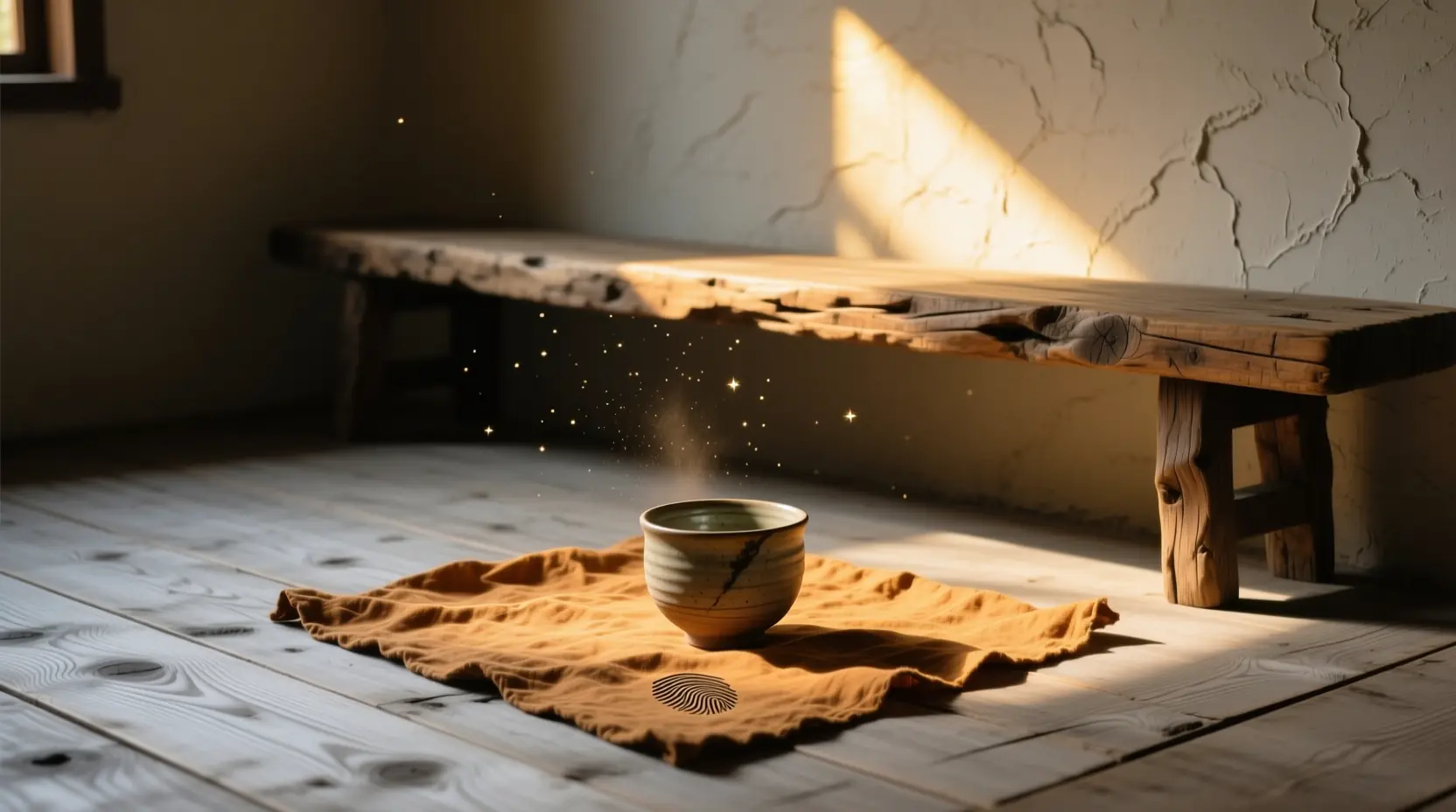
A perfect room is a lonely room.
Smooth walls. An unblemished floor. Even, unasking light. It is a pleasant nowhere. A space that demands nothing, and thus, offers nothing to hold. Your eye finds no purchase. Your hand, no invitation. Your thoughts slide away, seeking a crack, a shadow, a story—anything to catch upon.
Now. A different door.
A pine floor, worn silvery in a path from hearth to table, bearing the soft maps of generations. A stone sink, its basin hollowed by a century of water and hands. A linen curtain, dyed not a flat blue, but with the gentle, clouded breath of natural indigo, fading where the sun loves it most. You enter. You breathe. You belong.
This is not a style. It is a way of seeing. A pact with time.
Listening to the Whisper in the Wood
Begin with the wood.
Modern lumber is a uniform sigh. Its grain, a repeated pattern. Its surface, sealed under a plastic skin, defiant. It is wood that has forgotten it was a tree.
Now. Hold a piece of old barn timber. Feel the weathering. The subtle, rolling landscape where hard grain and soft grain surrendered differently to decades of sun and rain. The knots are not flaws. They are memories. The ghost of a branch, once reaching for light. This wood has a biography. When you make it a shelf, a mantel, a table, you do not install a product. You grant a new chapter to an old, silent story.
The wood will continue. Sun will warm it, deepening its hue. The oil from a hand, resting in the same place year after year, will leave a gentle, gleaming testament. It becomes a record of your life, too. A collaboration.
This is the understanding. Wabi-sabi. Not an aesthetic, but a gaze that finds beauty in the impermanent, the incomplete, the imperfect. It tells us a crack is not a thing to hide. It is a testament to survival. The silvered driftwood on the shore. The moss on the stone. The tea bowl, slightly irregular from the potter’s hand, cherished for its uniqueness. It whispers that aging is not decay. It is an enrichment. A deepening.
The Memory Held in Stone
Stone is the bone of the earth. In its perfection, it is cold. A polished granite slab, flawless, reflects only your own fleeting worry.
But place your palm on a rough-hewn limestone wall. Your feet on a flagstone path, worn smooth in the center by centuries of pilgrims. You are touching time. Not abstractly. In the cool, solid reality of it.
In a home, stone asks to be felt. A limestone countertop will etch with the acid of a lemon, the tannin of wine. This is not a tragedy. It is the beginning of its life with you. Each faint, cloud-like mark becomes a memory. A meal shared. Laughter spilled. A slate floor will chip at the edges. The hollows will gather shadow and light in a way a flat plane never could. These are the notes in the stone’s long, slow song. To live with it is to learn its rhythm. To accept that it is of nature, and so, it behaves as nature does—never static, always evolving. It grounds a room. It hums with a geological patience that, if you listen, can slow the frantic pulse in your own wrist.
The Breath and the Cloth
We wrap ourselves in cloth. We curtain our windows, upholster our rest, lay linens on our tables. The modern world offers synthetics that never fade, never wrinkle, never change. They are dead things. Silent.
Now, consider linen. Woven from the flax plant, it begins crisp. But it yearns for the human touch. It softens with every wash, its fibres relaxing into a supple drape that synthetics can only mimic poorly. It will crease. Those creases are not flaws. They are the fabric’s way of remembering. A fold from where you curled on the sofa. The gentle crumple of a morning’s embrace. Natural dyes will shift. Fade like a sunset, moving from vibrant to subdued, telling the story of all the light that has passed through it.
A patch on a beloved cotton quilt is not a sign of poverty. It is a sign of wealth. The wealth of care. The wealth of continued use. The fabric breathes. It tells you the season by its weight. The time of day by how the light falls upon its weave. It is alive.
Light That Learns to Linger
And how does light fall in such a room?
Not in a sterile, even glare. But in a dance. It pools on the uneven plaster of a wall, revealing the gentle trowel marks of the artisan—what the Italians call la mano. The hand. It streaks across that silvery floor, highlighting the path of generations. It filters through the clouded linen, softening the day’s sharp edges. It catches the rim of a hand-thrown cup, glowing in the slight, blessed irregularity of the glaze.
This is light with texture. Light with interest. It creates shadows that are not mere absences, but shapes with volume and mystery. A perfectly smooth wall has no shadow. A room of imperfect surfaces is a room full of subtle, shifting depth. A room that changes with the hour. That invites you to notice. To sit in the same chair at dawn, at noon, at dusk, is to sit in three different rooms. This is the gift. It makes you present.
The Soul of the Object: A Story in the Making
When you choose an object for its flawless symmetry, you choose it for what it is.
When you choose an object for its gentle asymmetry, for the thumbprint in the clay, for the wandering grain, for the hammer mark left by the blacksmith, you choose it for the story of its making. You choose it for the humanity in it.
This is the soul we speak of. Not in price tags or brands. But in this collected, quiet evidence of life and craft. A basket, slightly out of round, woven from willow that grew by a stream. A wrought-iron hook, bent to shape over a coal fire. A wool rug, its colours uneven like a hillside, spun and knotted by hands that know the patterns as old songs. These objects carry the energy of their making. A warmth no factory replica can conjure. They connect your daily life to the earth. To tradition. To the human scale.
They are honest.
The Practice of Letting Go
To cultivate this is, above all, a practice of letting go.
Letting go of the pursuit of perfection, a ghost that can never be caught. Letting go of the fear of wear, which is but the fingerprint of love. Letting go of the need to control every surface, every outcome.
It begins with a single, quiet choice. Choose the wooden bowl with the small crack filled with gold—the art of kintsugi, where the repair is made visible, celebrated, more beautiful for the breaking. Choose the sofa in a natural fabric you know will soften, will fade with grace. Choose the floor you will not panic over when the first scratch appears—that thin, silver line that will one day be part of its patina. Let the books on your shelf become dog-eared, annotated, lived-in. Let the kitchen table bear the gentle scars of meals prepared with passion.
See your home not as a finished picture to be preserved under glass. But as a living canvas. Where you, your family, time itself, are all co-artists. The goal is not a look. It is a feeling. The feeling of sinking into a well-worn leather chair. Of running your palm along a smooth wooden banister. Of the cool, slightly uneven touch of terra cotta under bare feet.
The art of imperfection is, finally, the art of welcoming life itself. In all its glorious, untidy, transient beauty. It is an invitation. To sit. To touch. To notice. To live not in a showroom, but inside a story.
A story written in the grain of wood. The breath of cloth. The song of stone. And the light that lingers, loving every imperfect, every fleeting, every perfectly real thing.