The Quiet Before the Arrangement
The room holds its breath. Only the soft, dry rustle of a page turning—a sound like leaves in a deep autumn wood, falling one by one. You stand before the shelf. It is full, yet it feels barren. A regiment of spines, shouting in uniformed rows. No pause. No space for the eye to wander, for the soul to rest between thoughts. This is not styling. It is storing. A keeping of things, not a keeping of space.
To Listen, Not to Command
To style a shelf is an act of deep listening. It is the practice of *ma*—that Japanese understanding of negative space not as emptiness, but as a sacred interval. The pregnant pause between heartbeats. Imagine a mountain stream. It does not seek to fill every crevice. It flows around stones, rests in still pools, chatters over pebbles. It is the relationship between the water, the stone, and the air that creates its music. Your shelf is that stream. The books are the water. The chosen objects are the stones. The empty space is the air. Without the air, there is no song.
First, Create a Void
Begin with emptiness. A humble bow to potential. Remove everything. Every book, every forgotten token. Lay them upon the floor—this quiet congregation of your past. Feel the weight of the bare shelves. See their grain, their scars, their dust. Run a hand along the wood. Does it remember the tree? This is the first lesson: know your canvas. Respect the material. The foundation matters.
Now, observe the gathered life at your feet. Do not see clutter. See a collection of souls. A book is not paper and glue. It is a vessel of thought, worn smooth by the hands that have held it. A stone from a shore holds the memory of ancient tides. A fragment of driftwood is a sculpture shaped by wind and saltwater patience. A ceramic bowl holds the stillness of the potter’s wheel in its curve. See them as artifacts. Each with a texture that speaks not to the eye, but to the hand, to the memory.
The Water: Letting Thoughts Breathe
Begin with the books, the current of your stream. Do not line them up like soldiers. Group them by the feeling they carry. Let dense philosophy sit together, a deep, still pool. Let slender volumes of poetry flow like a gentle rivulet. Then, the essential act: turn some spines inward. Let the quiet, cream-colored pages face the world. This is not hiding. It is offering respite. The rough edge of the page block, with its subtle shadows, becomes a landscape of soft neutrals. A sigh amidst the chatter.
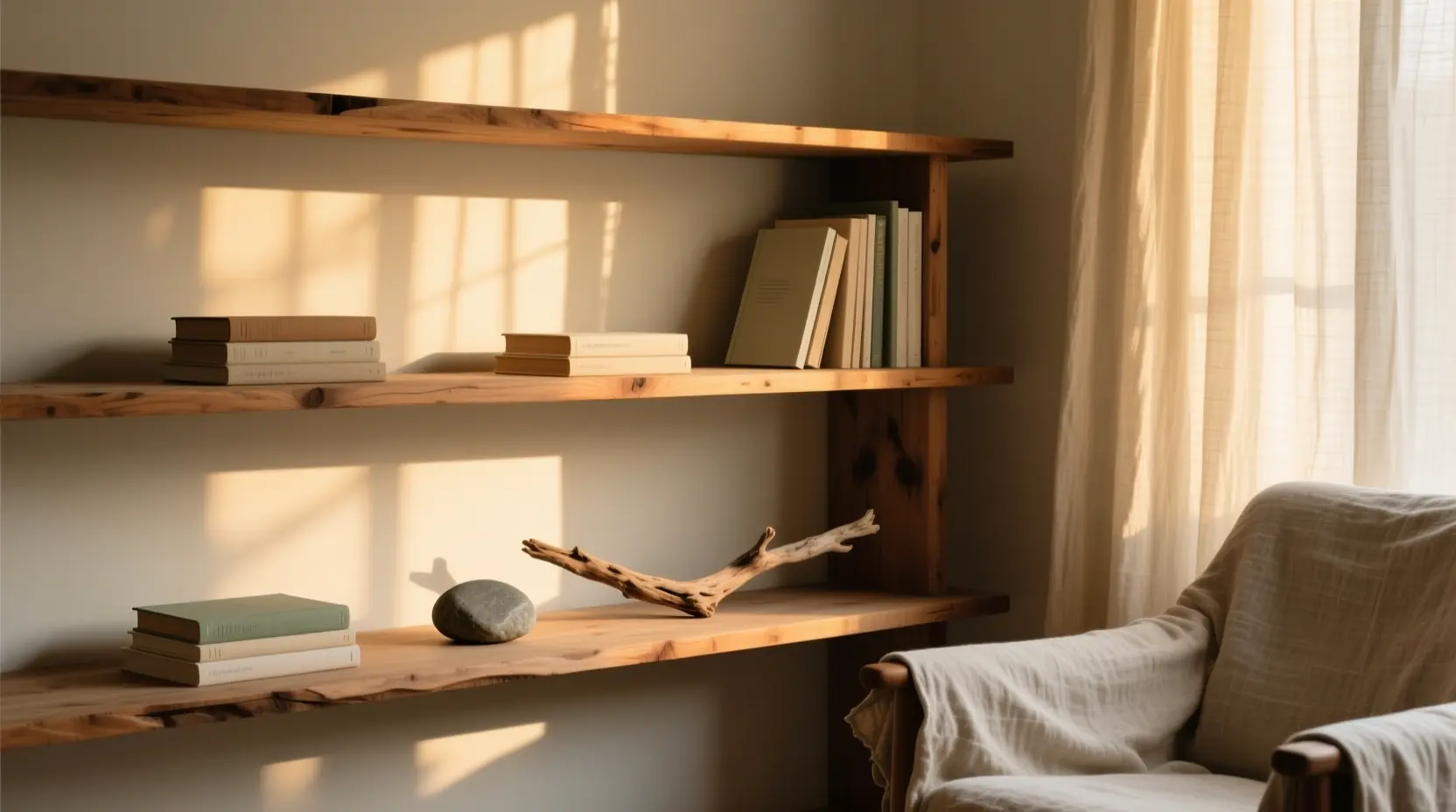
Intersperse them as a gardener places plants. A tall volume here. A horizontal stack there—a ledge in your stream. Crown it with a single, smooth stone. A paperweight of intention. Upon it, perhaps, one object. A feather. A dried seedpod. Allow gaps. Let there be shelves where only two books lean, like old friends sharing a secret. This emptiness around them gives them weight. It makes their presence a choice, not an accident.
The Stones: Objects That Hold Silence
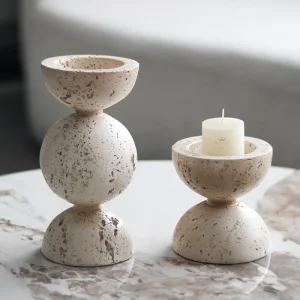
Now, the stones in your stream. Choose them not for their shine, but for their quiet. Seek the imperfect, the time-worn. A piece of raw geode, its rough exterior guarding a hidden cathedral. A simple terracotta pot, unglazed, breathing with the earth. A bell of forged iron, its sound low and lasting. A skeletal branch, a calligraphy of winter.
Placing With an Open Hand
Place them with intention, but not with force. Feel their weight in your palm. Set a river-polished stone atop that horizontal stack. Its cool eternity against the fragile paper—a conversation between epochs. Stand a piece of driftwood upright in a gap. Its weathered grey is a poem written by the sea. Do not scatter many small things. One significant object has more presence than a chorus of trinkets. It becomes an anchor. A place for the gaze to land, and rest.
Remember texture. The rough, bark-covered sphere beside sleek leather. The soft drape of raw linen behind a rigid, geometric frame. These contrasts are not clashes. They are harmonies. They speak of the world—the smooth pebble beside the jagged cliff, the soft moss on the hard granite.
The Most Sacred Element: The Air Itself
This is the heart. The air. The space. After you place a book, after you set a stone, step back. Breathe. Look. Is there room for the object to *be*? Is there emptiness around it that gives it meaning? Do not fear the blank shelf. It is not a void to be filled. It is the silence between musical notes. The pause in a breath. It is where the story unfolds in the mind of the beholder.
A Bowl for Light, A Shelf for Shadow
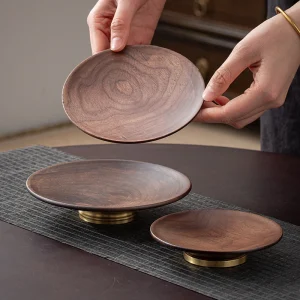
On one shelf, perhaps, place only a single, shallow bowl. Leave the rest bare. Let that bowl hold nothing but the slow passage of light and shadow through the day. It becomes a universe. On another, a small vignette: a vertical book, a horizontal book, a stone. Then… space. Let the composition breathe. The emptiness frames it. It allows the texture of the wood beneath to participate. To become part of the whole. This is *ma*. The shelf itself is not a backdrop. It is the sky in the landscape.
A Living Arrangement, Never Finished
A styled shelf is not a monument. It is a garden. It will change. The light will shift with the seasons. A new book will arrive, demanding to be seen. A feather will be found on a path. Allow this. The arrangement is a dialogue, not a dictate. One day, you may feel the need to remove half of what is there. To simplify further. To allow even more air, more silence. This is good. This is the practice.
The goal is not perfection—a rigid, lifeless thing. The goal is harmony. A quiet rightness. When you enter the room, your shelf should not shout for attention. It should whisper an invitation. It should feel like a clearing in a forest—a curated, thoughtful space where every element has room to exist, to tell its fragment of a story.
The Craftsman’s Meditation
In the end, you are not a decorator arranging items. You are a craftsman curating atmosphere. You are tending to the spirit of a space. Your hands, learning the weight of a stone, the texture of linen, the soft resistance of a page, are in meditation. You are creating a still point in a turning world. A place where the eye, over-burdened with the digital and the fleeting, can rest on the real, the textured, the enduringly quiet.
Stand back now. Look with soft eyes. Is the stream flowing? Can you hear its quiet music? If so, you have not styled a bookshelf. You have composed a haiku in three dimensions. Each element, a syllable. Each space, the breath that gives it meaning. And in that meaning, you find a deep and lasting peace. The room is quiet again. But now, the silence is full.