The Dust in the Honeyed Light
A quiet room. A sliver of late sun, thin and slow-moving. It finds the floorboard’s scar. The dust motes dancing in its path. It does not hide them. It reveals them. Illuminates them. This is not a beginning of decoration, but of seeing. A different way of breath.
We speak of wabi-sabi. Not as a word to be sold. But as a silence to be felt. It is the crack that tells the story of the cup’s life. The silver-grey moss on the north side of the stone. The beauty of the worn, the weathered, the incomplete. It is the quiet recognition in autumn’s peak—the knowing of the bare branch to come.
To Scent the Transient
How, then, do we invite this feeling into the very air? With scent. The most fleeting art. It arrives unbidden. It lingers just long enough to be known. It departs, leaving only a ghost in memory. To choose a candle or incense for a wabi-sabi home is not to choose a fragrance. It is to choose a companion for the quiet. A fellow traveler in the graceful art of fading.
Not Perfume, But the Earth’s Own Breath
First, forget the notion of “covering.” This is not a battle against smell. It is an invitation to it. The scent here does not announce itself from a shelf. It whispers from the corner where the shadow meets the wall. It is the chasm between a synthetic “rainforest” and the true, damp, complicated breath of a cedar bough after a storm. One is a shout in a bright room. The other is a memory, soft at the edges, rich with loam and decay and slow growth.
Seek the materials that speak of their origin. Not their disguise.
The Wax of the Hive
Beeswax. Smell it cold. It is faintly of honey, of sun on the comb, of the pollen-dusted labor of thousands. When lit, its flame is a soft, yolk-yellow globe. Its smoke is clean, almost sweet. It does not perform. It simply is. It ages, its color deepening to old ivory. It bears the gentle fingerprints of warmth.
The Bean and the Humble Flame
Soy wax, from the quiet bean. A slower, quieter burn. Poured into a vessel of raw, unglazed ceramic. Rough under the thumb. It holds the wax not as a jar holds a product, but as a stone cup holds a pool of rainwater. Imperfectly. Therefore, perfectly.
Vessels That Remember the Hand
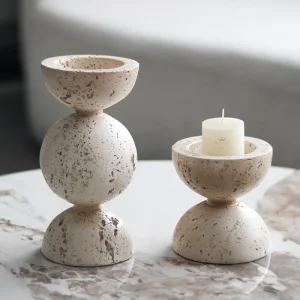
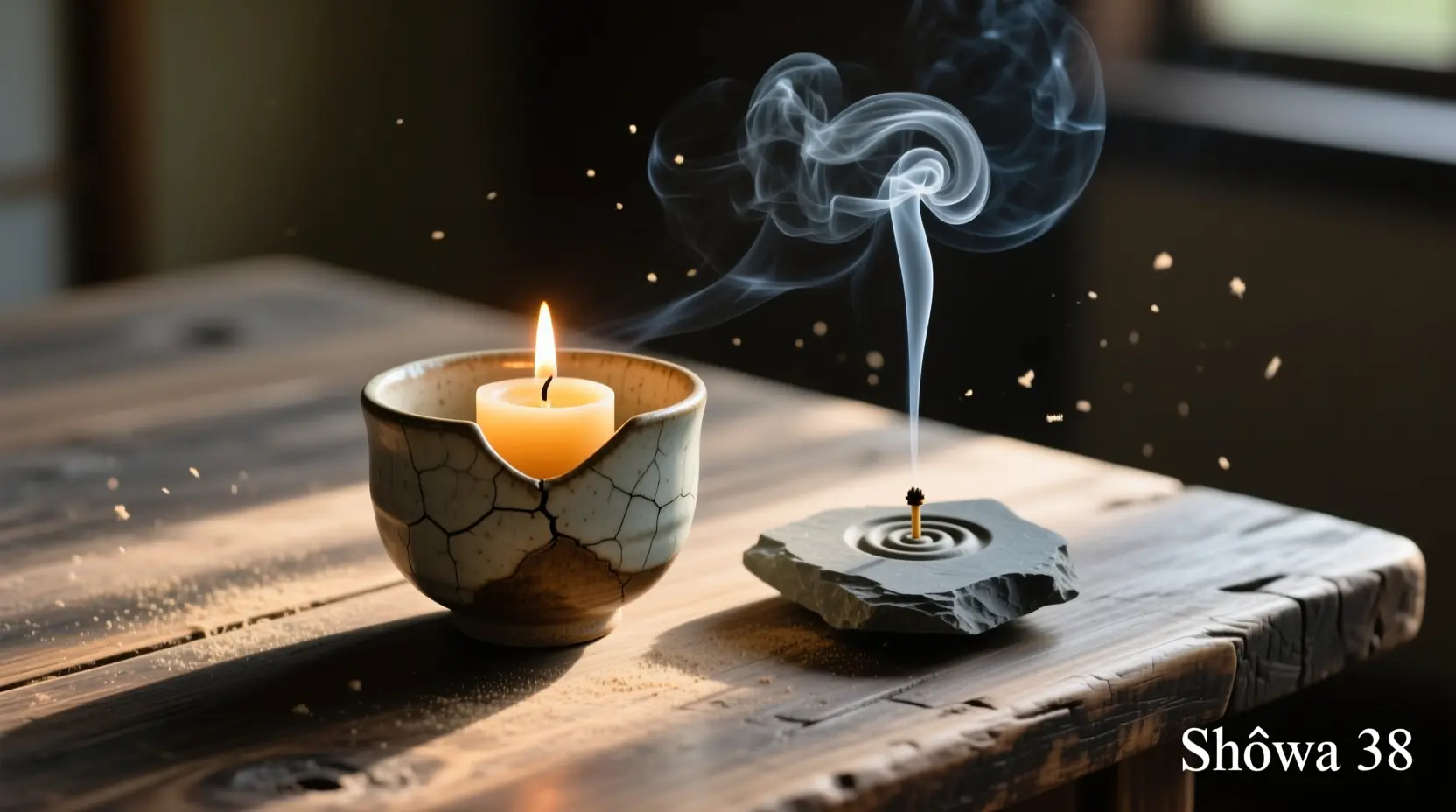
Look to the holder. The dish. A machined glass jar is a clear, soulless statement. It speaks of uniformity, of speed. But a votive nestled in a small, asymmetrical cup thrown by a potter whose name you know? The clay remembers the spin of the wheel. The slight warp remembers the kiss of the kiln. A shino glaze, cloudy and pebbled like a riverbed, drinks the light. It does not illuminate the room. It gentles it.
For incense, a burner carved from a single fragment of reclaimed wood. The wood’s own scent, old and resined, begins to dance with the rising smoke. Their stories braid. Or a piece of sea-smoothed slate, cool and grey. The ash, a soft powder, gathers in its natural hollows. Do not be quick to sweep it away. For a day, let it lie. Observe the topography it forms. A map of the consumption. A record of time’s quiet passage.
The Notes of the Incomplete
Now, the scents themselves. Think of seasons turning. Think of phases of the moon. Think of materials that know, in their essence, they will return to the ground.
Dry Grass and the Surrender of Summer
Not the green crush of spring, but the hay-sweet, papery whisper of late summer yielding. The nostalgic scent of sun on fallen oak leaves, their undersides cool and damp. It speaks of cycles. Of graceful letting go. It is not melancholy. It is the fragrance of deep peace.
Petrichor: Rain on Ancient Stone
The first drops hitting sun-baked rock. Cold, mineral, profoundly clean. It is the smell of mountain bones wearing down to sand. It clears the mind’s slate as rain clears stone.
Embers and the Ghost of Fire
Not the roaring hearth, but the dying fire. The sweet, ghostly scent of cedar or applewood embers, their fierce heat now just a memory held in scent. It is the aroma of quiet conclusion. Of labor complete. Of earned rest.
Linen and the Memory of Sun
The simple, wholesome smell of cloth dried by the wind and sky. Not perfume. Not soap. But cotton and flax warmed by the day. It is the scent of the everyday, elevated to a quiet sacrament.
Wild Mint and the Damp Bank
A green note, but a quiet one. Sharp, clearing, yet rooted inextricably in the dark, fertile mud of the stream’s edge. It is life, yes, but life that is tangled, untamed, gloriously unkempt.
Avoid the tropes of opulent fantasy. No “gilded tuberose” or “velvet oud.” These are dreams of permanence, of domination. Wabi-sabi finds its luxury in the honesty of a bare branch against a grey sky. In the quiet persistence of moss on a step.
The Ritual Is the Anchor
To light this candle, this incense, is not to flip a switch. It is a small ceremony of attention.
Your hands move slowly. The match rasps to life—a sudden, flaring bloom of sulfur and wood. You see the flame meet the wick. You watch the solid wax, opaque and firm, begin to yield at its edges. It becomes liquid. It becomes light.
You place the incense cone on its bed of previous ash. You watch the ember glow, a tiny, pulsing orange eye, as it begins its slow, consuming pilgrimage downward. You do not then turn away. You might sit. You might watch the smoke. How it rises first in a thin, unwavering line, then, as the air cools it, begins to curl and wander. It becomes thought itself. Visible. Then invisible.
This act is the anchor. The scent that follows is not the product you bought. It is the evidence. The proof of your momentary, devoted presence.
The Beauty of the Aftermath
And then, it ends. The wax pools calm and level. The wick dims, sighs, drowns in its own liquid. The last spiral of incense smoke unravels into the air, leaving only a ghost of itself caught in a sunbeam.
Here lies another layer of beauty. The beauty of what remains.
The cooled wax in its ceramic vessel is now a new landscape. A cratered moon. A frozen, miniature lake at dawn. Keep it. Let the vessel hold this solidified memory until the next burning. Let the histories accumulate, layer upon translucent layer.
The ash in the incense burner is a fine, soft powder. A pale grey and white sculpture, impossibly fragile, holding the hollow shape of the cone that created it. Let it stand for a day as a monument to transience. Then, when the moment feels right, take it to a potted plant. Gently fold it back into the soil. Return it. Complete the circle.
This is the final, most profound note of the wabi-sabi scent. It is not in the bold smelling. It is in the returning. The ash to earth. The memory to the welcoming silence.
A Space That Breathes
And so your home becomes not a space filled with scent, but a space that breathes with it. The scent arrives as a gentle guest. It sits quietly in the worn armchair by the window. It shares the silence. And then, it takes its leave. It does not overstay. It leaves only a faint memory in the room, like the gentle indentation of a body on a cushion, slowly rising back to formlessness.
You will find you need less. A single candle, burned with full attention, can scent a week’s worth of memories. One cone of incense can frame an entire afternoon, giving it a gentle beginning, a contemplative middle, and a soft, definite end.
The goal is never a house that smells a certain way. The goal is a soul that notices in a certain way. That finds a deep poetry in wood grain, in lengthening shadow, in the wandering path of smoke, in the softness of ash. That sees the passage of time not as theft, but as a kind of weathering. A softening. A becoming more authentically, beautifully real.
Let your chosen scent be the scent of the stone after the rain has vanished. Let it be the quiet warmth of beeswax holding a captured fragment of summer sun. Let it be the faint echo of smoke in a slanted beam of light.
Light it. Watch it with soft eyes. Let it go.
And in that sacred cycle—the lighting, the lingering, the letting go—you will perhaps discover the deepest fragrance of all. The scent of your own, quiet, perfectly imperfect presence. Here. Now. Already fading. And therefore, utterly beautiful.