There is a truth older than plaster, more profound than paint. It waits in the quiet intervals, in the broad, hushed plains of a wall left alone. In a world that screams for attention, these silent surfaces become sanctuaries. They are not voids to be feared, but fields of potential—vast, calm canvases awaiting not decoration, but a single, breath-held word.
To place an object upon such stillness is not an act of design. It is an act of reverence. It is to speak into a quiet canyon and listen for the echo. Each choice must be a stone dropped into a still pond, the ripples slow, deep, and true. Here, in this contemplative space, we do not seek things. We seek essence.
Anchors to the Ancient World: The Line Against the Void
Look to the horizon at dusk. See the clean, dark line of land meeting sky. This is the first lesson.
Nature is the ultimate minimalist. It does not clutter. It pares down to the essential curve of a dune, the stark fracture of a cliff, the lone branch tracing a prayer against the winter sky. Your wall can hold this same primordial grammar.
The Grain of Weathered Wood
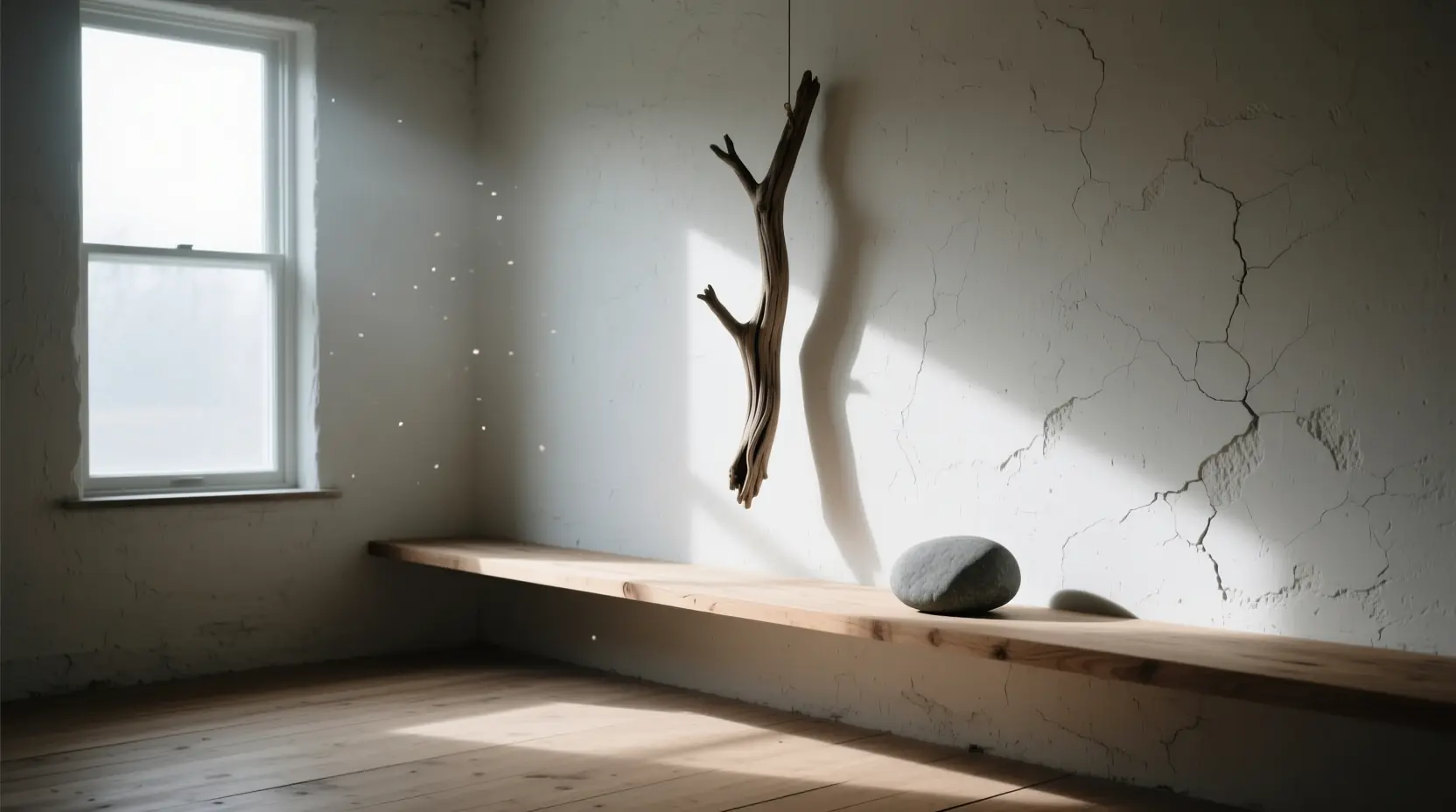
A fragment of driftwood, silvered by salt and sun. Its surface is a map of storms endured and pacified. To hang it alone is not to display a curio. It is to install a relic. Its twisted form speaks of resilience, of surrender, of a journey smoothed to silence.
The Cool Breath of Stone
A slate shard, dark as a deep pool. Fixed to the plaster, it is an island of geological time. Touch it. Its coolness is the memory of mountain weight, of patient compression. It whispers of roots, of foundations, of an earth that holds us all.
The Forged Horizon
A simple iron bar, unadorned. Its strength is naked, honest. Placed low and horizontal, it draws a firm line—a man-made horizon within your room. It speaks of fire, of force contained, of human will meeting elemental ore.
These are not decorations. They are anchors. They tether the floating, abstract space of a room to the tangible, enduring bones of the world. They do not shout of style. They whisper of origin.
The Hand’s Whisper: Beauty in the Imperfect Breath
A machine makes perfect circles. They are cold, endless, soulless. A human hand, guided by breath and heartbeat, leaves a trace. A slight warp in the clay. An unevenness in the weave. A hammer’s kiss lingering on metal. These are not flaws. They are signatures. They are the proof of a life lived in the making.
The Texture of Unglazed Clay
One ceramic plate. Not a set. One. Its surface holds the texture of parched earth, the color of a fading twilight. Hung alone, it catches the light not to reflect it, but to absorb it slowly. The shadow it casts is soft, a companion silhouette.
The Gentle Fall of Linen
A length of raw, undyed cloth. Woven on a narrow loom, its irregularities are a record of the weaver’s day. Hung from a simple rod, it falls in quiet folds. It holds light like still water, and moves, almost imperceptibly, with the room’s own gentle exhalation.
The Golden Seam of Kintsugi
A bowl, once broken. Mended with lacquer and gold. Kintsugi. This is not a celebration of the break, but a profound reverence for the repair. The golden veins do not hide the fracture; they illuminate it. They teach that damage, when honored with patience and precious material, can become the most luminous part of the story. It is a mirror for the soul’s own mending.
Such objects do not ask for admiration. They invite a slower gaze. They ask you to see the dignity in the worn, the beauty in the faded, the grace in the asymmetrical. They are teachers of acceptance.
Light and Its Silent Twin: The Pedagogy of Shadow
You must come to see light as a substance. The empty wall is its stage, and your chosen object is not merely an object. It is a sculptor of darkness.
The Luminous Skin of Paper
A shoji screen, or a lantern of handmade paper. When light glows behind it, the wall itself becomes a source of soft radiance. The paper is a skin; the light, its lifeblood. This beauty is transient, gentle, dying with the day. It is a lesson in ephemerality.
The Woven Net of Sun
A simple, open-weave basket. Hung flat, it becomes a sundial for the soul. In morning light, it casts a sharp lattice of shadows—a net of dark upon the floor. By evening, those shadows stretch, grow long and soft, the pattern transformed. The basket is still. Its conversation with the light is never the same.
The Stone’s Elongated Echo
A smooth, river-worn stone on a shelf. At noon, its shadow is a tight, faithful companion. At the golden hour, that shadow stretches—a long, graceful echo of its solid form. It speaks of constancy and change, of the self and its extended, shifting spirit.
Do not fight the shadow. Welcome it as the necessary silence between musical notes. It is the depth that gives form its meaning.
The Courage of the Empty Field: Where Meaning Takes Root
The final, and most difficult, lesson lives in the void itself. The greatest art understands the power of the unsaid, the potency of the pause, the blank paper that makes the ink stroke sing.
In your home, this is the empty wall. Do not fear it. This is not a lack. It is a fertile ground. What you choose to place must earn its space. It must justify the silence it interrupts. One piece, perfectly chosen, is a haiku. Ten pieces are noise.
Ask of every potential object: Does this deepen the quiet? Does it tell a story that is true, not trendy? Does it belong to *this* light, *this* room, *this* chapter of my life? If the answer is not a calm, unequivocal yes, then the answer is simply: not yet.
Let there be walls that hold nothing but the slow passage of day into night. Let them be your meditation. Their emptiness is a fullness of potential—a room for the mind to rest, for the eyes to soften, for the spirit to expand without bumping into things.
This way of being is not a style one buys. It is a practice one cultivates, day by patient day. It is the slow art of subtraction. Of listening more than acquiring. It is finding the mountain in the stone, the forest in the branch, the ocean in the single, sun-bleached shell.
Your home is the inner landscape of your soul, made visible. Let your walls speak of quiet canyons and weathered rock, of the elegant, solitary line of a heron in flight. Choose objects that have known sun and wind, that bear the gentle scars of honest use, that honor the profound beauty of fading, of aging, of return.
In the deepest silence, you will understand. The only must-have wall decor for a minimalist soul is not a thing at all.
It is the courage to leave space empty.
It is the wisdom to choose only what possesses a quiet soul.
It is the practice of seeing, truly seeing, the shadow around the stone, the light upon the grain, the immense, breathing beauty of the silence between the walls.